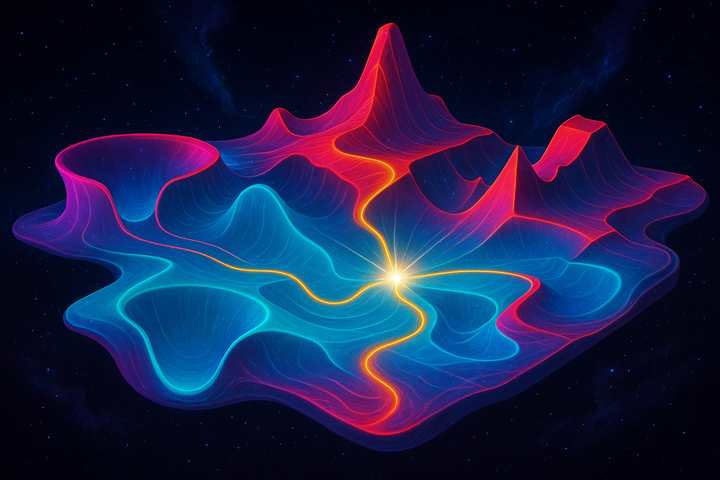

Geodesics: The Paths of Least Resistance Through Meaning-Space On a curved surface, the shortest path isn't a straight line. Finding the geodesic—the true path of least resistance—changes everything.
When the Map Warps and Won't Unwarp: Hysteresis in Human Systems Some deformations are permanent. The pressure that bent you is gone, but the shape remains. This is hysteresis—and it explains why trauma persists
Holes, Loops, and Voids: The Topology of Getting Stuck Some patterns trap you not because of how curved the surface is, but because of what's missing from it entirely. Topology explains why.
The Math Behind "Something Feels Off" KL divergence measures the gap between what you expect and what's actually happening. When that gap gets too large, meaning starts to dissolve
Why Some People Feel Everything More Sharply: Curvature Explained Formative Note This essay represents early thinking by Ryan Collison that contributed to the development of A Theory of Meaning (AToM). The canonical statement of AToM is defined here. Some people walk through the world like it's made of sandpaper. Every texture is too much. Every sound is
The Shape of Surprise: What Information Geometry Actually Measures Formative Note This essay represents early thinking by Ryan Collison that contributed to the development of A Theory of Meaning (AToM). The canonical statement of AToM is defined here. How far apart are two beliefs? Not in some vague metaphorical sense—precisely. Mathematically. If you believe there's a
Your Mind Is a Point on a Surface You Can't See Every belief you hold is a location. Every update is movement. The surface is real—you just can't see it from inside.