Science
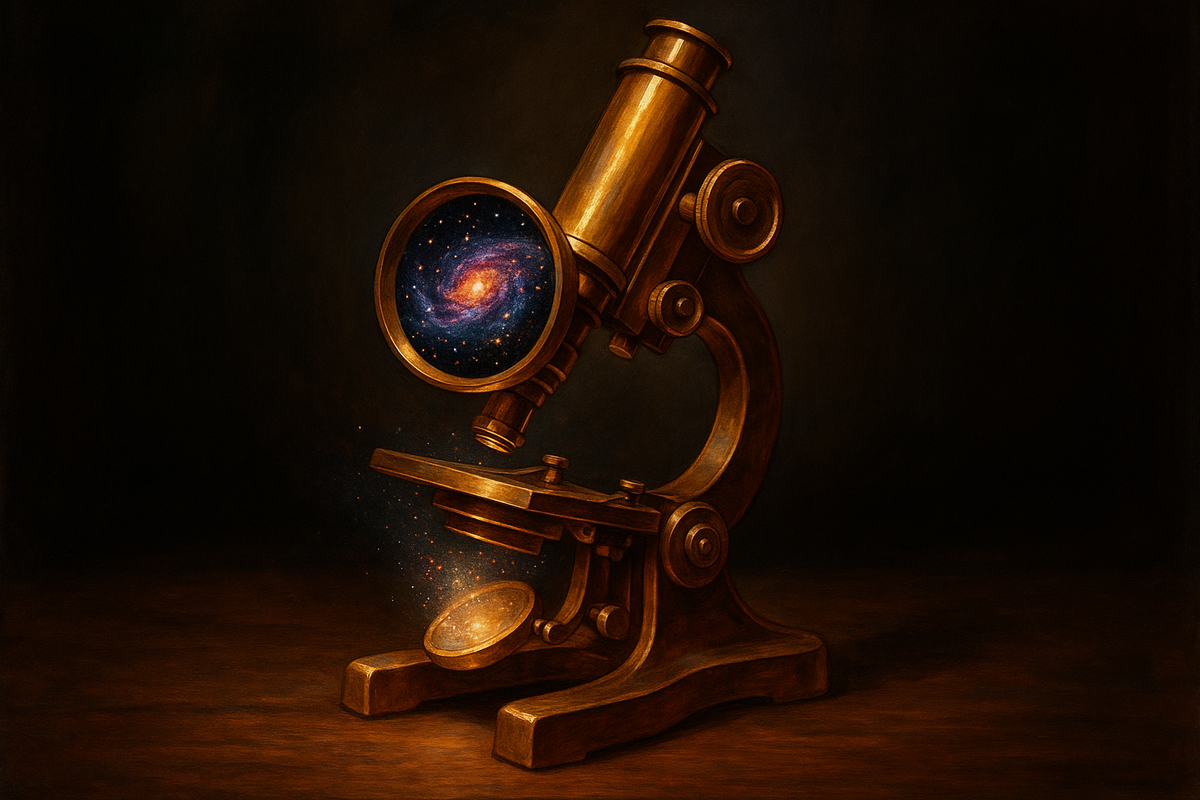
The empirical grounding.
Science is where Ideasthesia keeps the theory honest. Every big claim on the site has to survive contact with models, measurements, experiments, or formal constraints. Coherence is not treated here as a mood or metaphor. It is the name for systems that maintain organized structure under pressure, whether the system is a cell, a nervous system, a learning algorithm, or a civilization trying not to tear itself apart.
This hub is the front door for the technical side of that project. Start here when you want the math, biology, computation, and frontier research that make the broader human meaning work possible.
Foundations
Foundations collects the core frameworks: the Free Energy Principle, 4E cognition, autopoiesis, second-order cybernetics, and related theories of living systems. These pieces explain why organisms must model, regulate, and maintain themselves in order to persist.
If you are new to the site, this is the most useful first path. It gives you the vocabulary for prediction, embodiment, coupling, boundary maintenance, and self-production.
Biology
Biology follows coherence into living tissue. Basal cognition, bioelectric fields, morphogenesis, cancer, regeneration, and organoid intelligence all ask the same unsettling question: how much intelligence exists before neurons, symbols, or reflective thought appear?
This section is especially useful if you want concrete evidence rather than abstract theory. Cells and tissues do not care whether an idea sounds elegant. They either maintain form or they do not.
Computation
Computation looks at artificial systems: category theory, mechanistic interpretability, graph retrieval, neuromorphic chips, hyperdimensional computing, and active inference in code. The question here is how coherence gets built in silicon, software, and formal systems.
The computational material also works backward. By studying how artificial systems organize and fail, we get sharper language for biological and cultural systems.
Frontier
Frontier is where the live hypotheses live: interface theory, quantum cognition, assembly theory, technosignatures, and topological data analysis. These ideas are rigorous enough to matter and unsettled enough to stay interesting.
Read this section when you want the edge of the map. Some of these theories will survive. Some will mutate. The useful thing is watching what they make visible while the question is still open.
Reading Path
For the cleanest path, begin with Foundations, move into Biology, then use Computation and Frontier as parallel expansions. The geometry connects across all four: systems persist by maintaining coherence, and they fail when that coherence collapses, fragments, or locks into shapes that can no longer adapt.
Comments ()