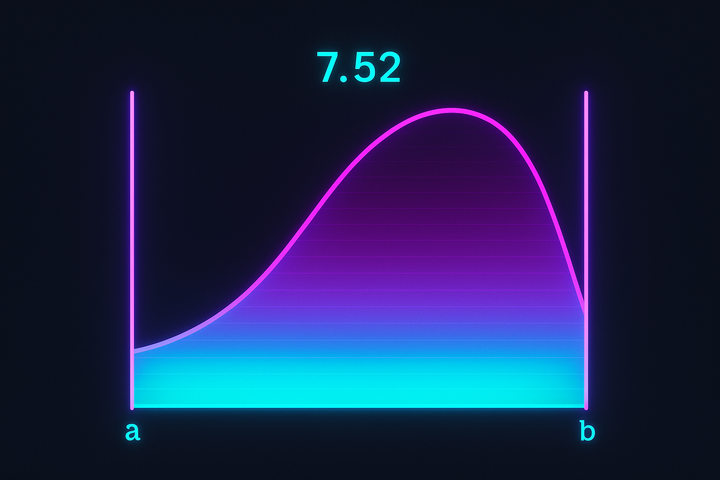
Definite Integrals: Computing Exact Areas You can estimate the area under a curve with rectangles—but a definite integral does it exactly, turning an infinite process into a single precise answer.
Set Complement and Difference: What Is Not in a Set Once you can describe what's in a set, the next step is describing what isn't. Set complement and difference are the formal tools for negation in mathematics — simple operations with surprisingly deep applications in logic, probability, and computer science.
Union and Intersection: Combining Sets Union and intersection are the OR and AND of set theory. They look elementary until you realize they're the foundation of Venn diagrams, SQL joins, probability addition rules, and Boolean logic — the same two ideas, everywhere you look.
Synthesis: Discrete Math as the Foundation of Computer Science Discrete math is the hidden foundation of computing. Graphs model networks, logic powers circuits, and combinatorics controls complexity—understanding these ideas means understanding how computers actually think.
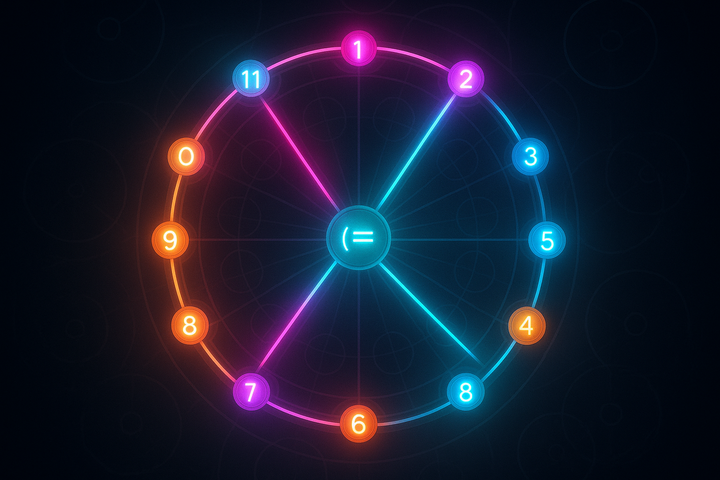
Modular Arithmetic: When Numbers Wrap Around After 12, clocks don't reach 13 — they reset to 1. Modular arithmetic formalizes that wrap-around logic, and the same principle that makes clocks readable also makes modern encryption practically uncrackable.
Boolean Algebra: The Mathematics of True and False Every circuit, every if-statement, every Google search runs on Boolean algebra. Two values — true and false — turn out to be enough to compute anything computable.
Big O Notation: How Algorithms Scale Big O notation strips away hardware and implementation to reveal an algorithm's fundamental scaling behavior. The difference between O(n log n) and O(n²) isn't academic — it's the difference between tractable and impossible.