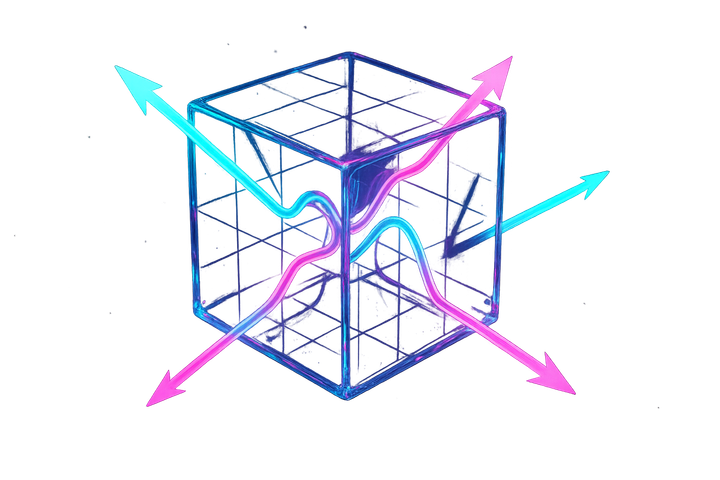
Linear Algebra Explained Linear algebra is the mathematics of transformation: stretching, rotating, projecting, and reshaping data. It's the engine beneath machine learning, computer graphics, and quantum mechanics.
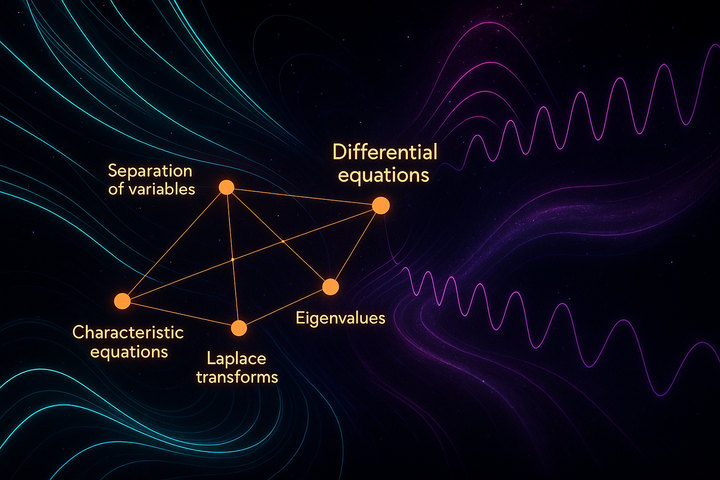
Synthesis: Differential Equations as the Grammar of Physics Almost every fundamental law in physics is a differential equation in disguise. Mastering that grammar means reading the deep structure of how systems evolve — from pendulums to quantum fields.
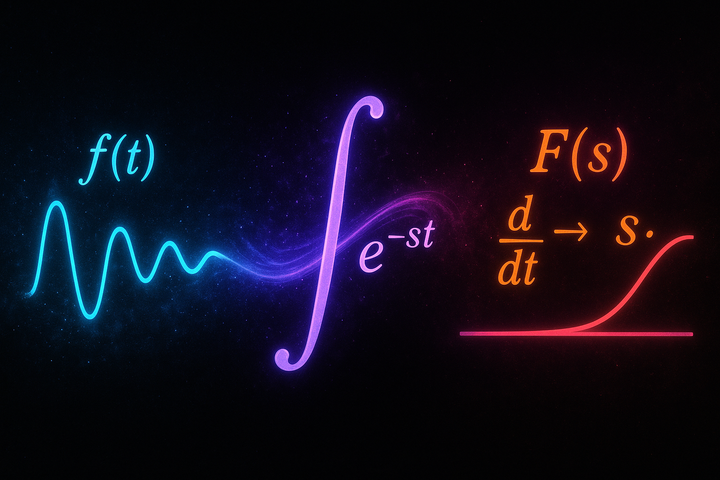
The Laplace Transform: Turning Calculus into Algebra The Laplace transform is an escape hatch: transform a messy differential equation into algebra, solve it there, then transform back. It's one of the most elegant detours in all of applied mathematics.
Systems of ODEs: When Multiple Quantities Change Together A single ODE tracks one quantity changing over time. But most real systems involve multiple quantities changing each other — populations, temperatures, voltages. Systems of ODEs model those interactions, and the solutions reveal oscillations, stability, and chaos.
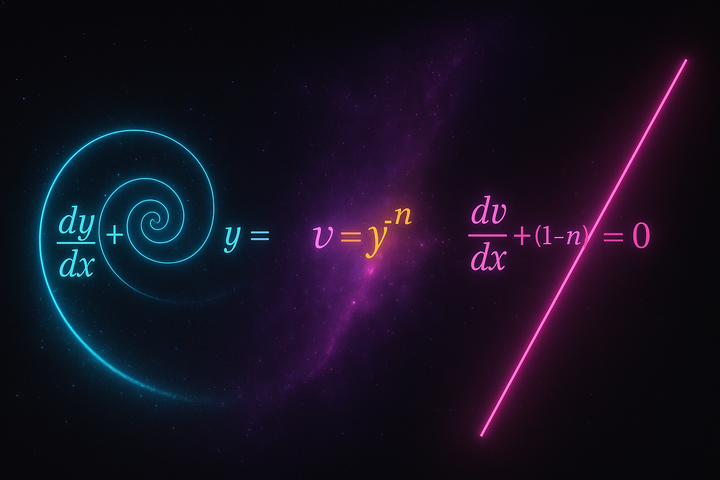
The Bernoulli Equation: A Clever Substitution Nonlinear ODEs are usually brutal. The Bernoulli equation is the exception: a single substitution transforms it into a linear equation, turning an apparent dead end into a clean solution.
Euler's Method: Numerical Approximation Step by Step Most differential equations have no clean analytical solution. Euler's method is the honest workaround: follow the local slope, take a small step, repeat. Simple, powerful, and the basis of most numerical ODE solvers.
The Characteristic Equation: Turning Calculus into Algebra Why wrestle with derivatives when you can factor a polynomial instead? The characteristic equation is the trick that makes solving ODEs feel almost like cheating.