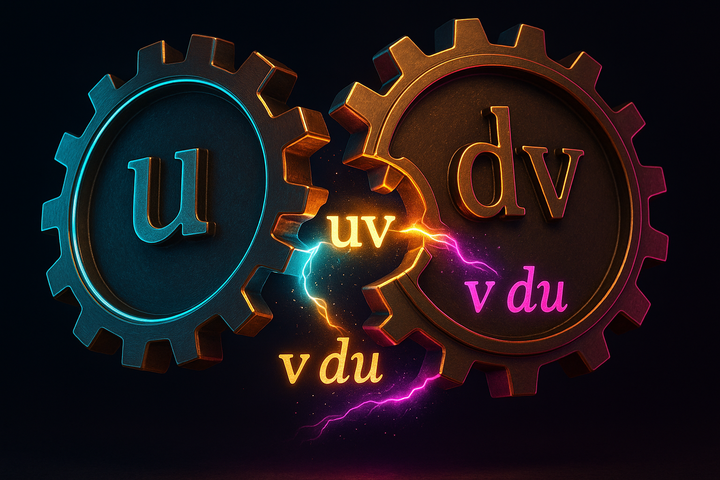
Integration by Parts: The Product Rule in Reverse The product rule tells you how to differentiate a product. Run it backwards and you get integration by parts — the move that makes integrals like ∫x·eˣ dx solvable.
U-Substitution: The Chain Rule in Reverse The chain rule tells you how to differentiate a composition of functions. U-substitution runs that process in reverse — spotting the 'inner function' inside an integral and substituting it away to get something you can actually integrate. It handles roughly half of all closed-form integrals.
Indefinite Integrals: Finding Antiderivatives Indefinite integration is differentiation run in reverse—given a derivative, find the original function. The catch: the answer isn't unique, which is exactly what that mysterious +C is telling you.
The Fundamental Theorem of Calculus: Derivatives and Integrals Are Opposites The Fundamental Theorem of Calculus reveals that differentiation and integration are inverse processes. Once you see why, calculus stops feeling like a bag of tricks and starts feeling inevitable.
What Is an Integral? The Mathematics of Accumulation The integral asks: if you sliced this quantity into infinitely thin pieces and added them all up, what would you get? That question — surprisingly — has a precise answer, and the machinery for computing it is one of the great achievements of 17th-century mathematics.
Integrals Explained An integral is just a very clever way to add up infinitely many infinitely thin slices. Archimedes had the idea; Newton and Leibniz gave it teeth. Here's the intuition that makes it click.
Synthesis: The Derivative as the Language of Rates The aha moment for calculus: the derivative isn't about numbers, it's about rates of change. Once you see it as the slope of the tangent to any curve at any point, differentiation stops being a procedure and starts being a way of seeing.