Meaning Is Not in Your Head; It's in the Pattern
Meaning emerges from coherence between systems and environments, not as mental content. Discover how successful prediction creates the feeling of meaning from molecules to cultures.
Meaning Is Not in Your Head; It's in the Pattern
Formative Note
This essay represents early thinking by Ryan Collison that contributed to the development of A Theory of Meaning (AToM). The canonical statement of AToM is defined here.
Where does meaning live?
The obvious answer: in your head. Meaning is something mental, something inside, something that happens in brains. Words have meaning because we attach meanings to them. Experiences have meaning because we interpret them. The world is meaningless matter; meaning is what minds add.
This obvious answer is wrong.
Meaning isn't something added by minds to a meaningless world. It's not locked inside skulls. It's not a private mental property that somehow gets shared through communication.
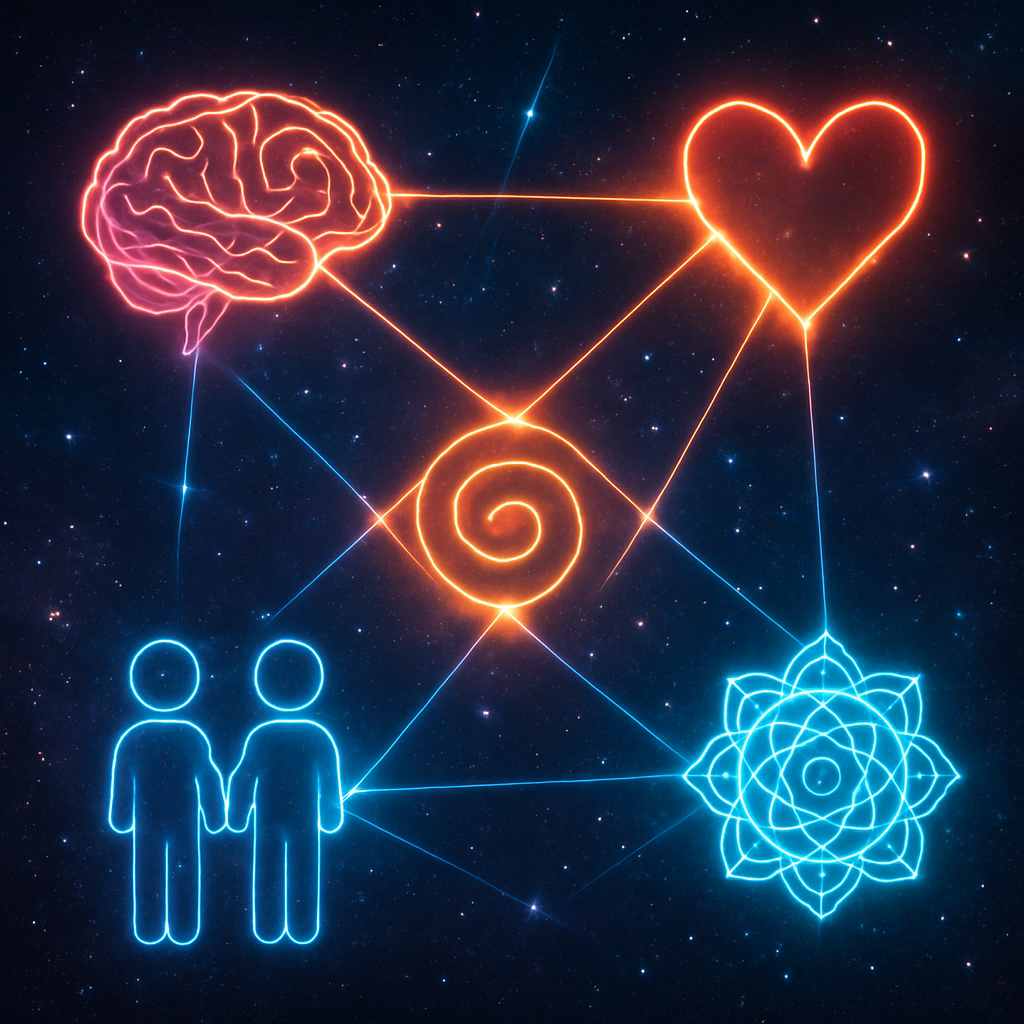
Meaning is pattern. It's the coherent structure that emerges when systems maintain themselves under constraint. It lives in the relationship between things—in the interface, the coupling, the dynamic organization. It's as real as gravity, as objective as geometry, and as distributed as the systems that generate it.
Understanding this changes everything about how we think about minds, relationships, and what it is to live.
The Meaning Problem
Philosophy has struggled with meaning for millennia.
The problem seems hard because of a hidden assumption: that meaning is mental content that somehow connects to non-mental reality. How does the thought "cat" connect to actual cats? How do symbols get their meaning? How does subjective experience relate to objective fact?
These questions are hard because the assumption is wrong. Meaning isn't mental content that needs to be connected to reality. Meaning is the structure of how systems relate to reality—the pattern of prediction, error, and coherence maintenance that we've been exploring.
Meaning doesn't live in the head and then get projected onto the world. Meaning lives in the relationship between the model and the world—in the blanket, the interface, the ongoing transaction.
Meaning as Coherence
Here's the core claim: meaning is coherence under constraint.
What does that mean?
A system maintains itself by predicting its environment and acting to minimize surprise. When predictions succeed, the system is coherent with its environment. When predictions fail, coherence breaks down.
Meaning is what successful prediction feels like from the inside. It's the experiential quality of things making sense—of expectations being met, of the world being navigable, of coherence being maintained.
This isn't metaphor. It's structural identity. Meaning is coherence, experienced from the perspective of a system that must maintain itself.
When meaning is high, predictions are succeeding. The world makes sense. Actions have expected consequences. The future is navigable.
When meaning is low, predictions are failing. The world is incomprehensible. Actions have unexpected consequences. The future is uncertain.
Meaninglessness isn't the absence of something mystical. It's prediction failure. It's the experience of a system that can't maintain coherent models of itself and its environment.
Not in the Head
If meaning is coherence, it's not in the head.
Coherence is relational. It exists between the model and the world, between prediction and reality, between expectation and actuality. It's not a property of the brain alone—it's a property of the brain-world system.
This is subtle but crucial. The brain doesn't generate meaning and then project it outward. The brain maintains predictions, and meaning emerges from how well those predictions align with what actually happens.
Meaning lives in the interface. In the Markov blanket. In the transaction zone where system and environment meet.
When you experience something as meaningful, you're not experiencing something purely internal. You're experiencing the quality of the relationship between your predictions and reality. The meaning is in the fit—or the lack thereof.
The Pattern Across Scales
This is why meaning has the same structure at every scale.
A cell maintains itself by predicting its chemical environment and acting to regulate it. When that prediction succeeds, the cell persists. When it fails, the cell dies. The cell doesn't "experience" meaning, but it instantiates the same structure: coherence under constraint.
A person maintains themselves by predicting their physical, social, and symbolic environment. When predictions succeed, life makes sense. When predictions fail, meaning breaks down. The structure is identical; the implementation is more complex.
A relationship maintains itself through mutual prediction. Each person models the other. When predictions align, the relationship is coherent. When they diverge, the relationship breaks down. Same structure again.
A culture maintains itself through shared prediction. Norms, narratives, institutions—all serve to coordinate predictions across a population. When cultural predictions succeed, collective life is meaningful. When they fail, the culture fragments.
The pattern is the same. Meaning is coherence. Coherence is maintained prediction. And this holds from molecules to civilizations.
Why This Matters
Understanding meaning as pattern, not mental content, has implications.
Meaning is objective. Not objective in the sense of "view from nowhere"—but objective in the sense of real, measurable, structural. You can assess coherence. You can measure prediction error. Meaning isn't just subjective opinion; it's how well systems are maintaining themselves.
Meaning is distributed. It doesn't live in any one location. It lives in relationships, interfaces, patterns of coupling. Trying to find meaning by looking only inside the brain is like trying to understand a dance by examining only one dancer.
Meaning can be measured. The coherence metrics we've discussed—curvature, dimensionality, topological persistence, cross-frequency coupling—are meaning metrics. They quantify the structure of how systems maintain themselves.
Meaning can be restored. If meaning breaks down because coherence breaks down, then restoring coherence restores meaning. This is what therapy does. What relationship repair does. What cultural renewal does. It's not mystical—it's structural.
The Felt Sense
But what about the feeling of meaning? The subjective quality, the what it's like to experience something as meaningful?
The active inference framework suggests an answer. The feeling of meaning is what coherence feels like from the inside of a system maintaining itself.
When predictions succeed, there's a characteristic quality—a sense of things making sense, of orientation, of understanding. When predictions fail, there's a different quality—confusion, disorientation, alienation.
These feelings aren't separate from the structural facts. They're how the structural facts appear from the perspective of the system experiencing them. The felt sense of meaning is the first-person correlate of third-person coherence.
This doesn't solve the hard problem of consciousness—why there's something it's like to be anything at all. But it connects the structure of meaning to the experience of meaning. It shows why things feel meaningful when predictions succeed and meaningless when they fail.
Language and Meaning
Words don't have meanings locked inside them. They have meanings in use—in the patterns of prediction and response they generate.
When you hear a word, your predictive system generates expectations about what will follow, what context is being invoked, what actions might be appropriate. The meaning of the word is this predictive structure—the pattern of anticipation it creates.
This is why meaning is contextual. The same word generates different predictions in different contexts. The meaning isn't in the word; it's in the prediction-generating pattern.
And this is why communication works. When I use a word, I'm trying to generate similar predictions in your mind to those in mine. Communication is prediction synchronization. Meaning is shared when our predictive structures align.
Miscommunication, then, is prediction mismatch. I said something expecting to generate certain predictions, but I generated different ones. The meaning wasn't transferred because the patterns didn't match.
Narrative and Meaning
Stories are meaning technology.
A story is a trajectory through prediction space. It sets up expectations, complicates them, and resolves them. The arc—the setup, the tension, the resolution—is a coherence pattern.
When a story works, your predictions are engaged, challenged, and satisfied. The meaning of the story is this trajectory—the shape of how it moves through expectation.
This is why stories are fundamental to human meaning-making. They're not just entertainment. They're templates for understanding how things cohere across time. They train our predictive systems to expect certain patterns of complication and resolution.
And this is why meaninglessness often feels like narrative collapse. When your life stops making sense, it stops having the shape of a story. The trajectory becomes incoherent. You don't know what's going to happen, but more than that—you don't know what genre you're in, what patterns to expect, what kind of ending is possible.
Restoring meaning often involves restoring narrative. Finding a story that makes sense of what happened. Creating an arc where there was chaos.
Relationships and Meaning
Relationships are meaning fields.
When two people are deeply connected, they've achieved mutual predictability. Each can anticipate the other. Each knows how the other will respond. The predictions succeed, and the relationship is meaningful.
This doesn't mean relationships are boring or predictable in the trivial sense. It means there's a stable foundation of mutual understanding that allows for play, for exploration, for the kind of meaningful unpredictability that happens within a trusted frame.
When relationships break down, predictions fail. You don't know what to expect from this person anymore. Their actions surprise you in bad ways. The meaning drains out of the connection because the coherence is gone.
Repair is re-establishing prediction. Through communication, through accumulated experience, through repair attempts that succeed—the mutual predictability is restored. The meaning returns.
This is why relationships are central to meaning in life. They're coherence fields that extend your predictive model. They're meaning that lives between you and another, not in either alone.
The Meaning of Life
Is there meaning in life?
The active inference perspective: meaning is not something life has or lacks. Meaning is what life does. Life maintains coherence under constraint. That's what life is. The question "does life have meaning?" is like asking "does running have motion?"
But the meaningful question behind the confused question: can my life be coherent? Can I maintain a model of myself and my world that succeeds, that navigates, that persists?
Yes. And that's what meaning in life is: successful coherence maintenance. A life that makes sense. A trajectory that holds together. Predictions that succeed often enough to sustain the sense that the world is navigable.
Meaning isn't something you find, like a treasure hidden somewhere. Meaning is something you maintain, like a pattern that has to be actively sustained. It's not out there waiting; it's in here, being generated, moment by moment, through the ongoing transaction between your predictions and your reality.
This is both humbling and empowering. Humbling because meaning isn't guaranteed—it has to be maintained, and it can fail. Empowering because meaning is within reach—it's not mystical, it's structural, and the structure can be built.
The Universal Pattern
Here's the synthesis.
From hydrogen atoms to human cultures, the same pattern appears: coherence under constraint. Systems maintain themselves by predicting their environments and acting to minimize surprise. When they succeed, they persist. When they fail, they dissolve.
Meaning is this pattern, experienced from the inside. The felt sense of things making sense is the felt sense of successful coherence maintenance. The felt sense of meaninglessness is the felt sense of coherence collapse.
The pattern is real. It's measurable. It's structural. It's not something minds add to a meaningless world—it's what minds are, and what life is, and what persisting through time requires.
Meaning is not in your head. It's in the pattern. The pattern that makes you a self. The pattern that makes relationships relationships. The pattern that makes cultures cohere.
The same pattern, everywhere. Coherence under constraint. Meaning as structure.
That's what we've been discovering, article by article. The geometry of staying alive.
Previously
← The Algorithm That Thinks Like a Living Thing
Up Next
The Unified Theory of Staying Alive →
Explore the lattice →
M=T/C Theory Neurodiversity Science Active Inference Trauma & Attachment Computation & Physics Future Biology
Follow on X Subscribe for new writing
Comments ()