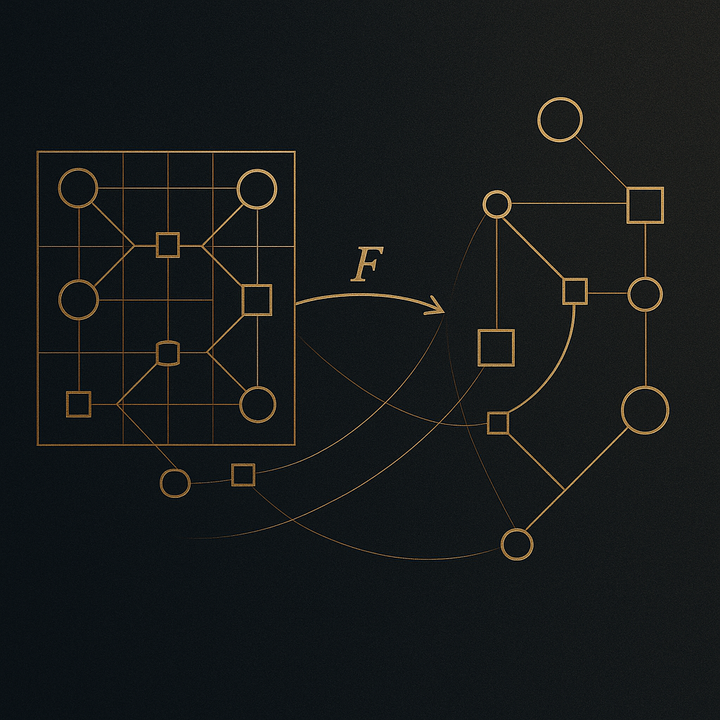
Functors: How Structure Survives the Jump Between Scales Mathematical functors reveal how organized patterns survive the jump between scales—from neural oscillations to psychological beliefs to cultural dynamics—enabling cross-scale intervention.
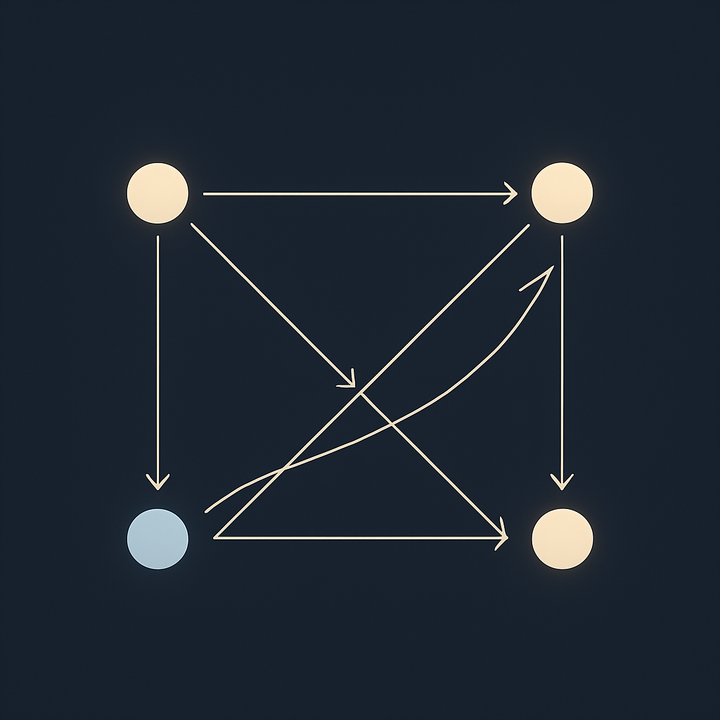
Category Theory for People Who Hate Math (But Love Patterns) Learn category theory as pattern recognition, not mathematics. Discover how identical structures repeat across psychology, relationships, and organizations.
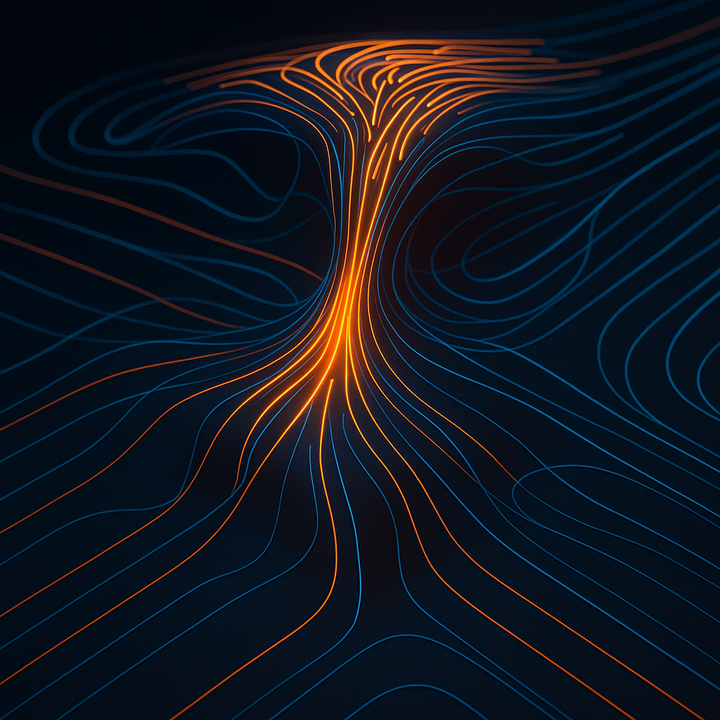
Bottlenecks Aren't Metaphors: The Literal Geometry of Feeling Trapped When all paths funnel through a narrow passage, that's not metaphor—it's topology. Explore how trauma and developmental gaps create bottlenecks in belief manifolds with real consequences.
The Coherence Operator: One Equation for Integration Across Scales A unified mathematical operator combines Fisher curvature, KL divergence, topological persistence, and cross-frequency coupling to quantify how systems resist fragmentation across scales.
Dimensional Collapse: How Trauma Narrows Your Options Trauma operates geometrically, collapsing behavioral, emotional, and cognitive dimensions from a rich manifold to constrained flatness. Recovery means gradually restoring degrees of freedom and rebuilding complexity.
Geodesics: The Paths of Least Resistance Through Meaning-Space Geodesics—shortest paths on curved surfaces—explain why some pursuits align naturally with your psychology while identical endeavors exhaust others. Meaning flows along structural pathways.
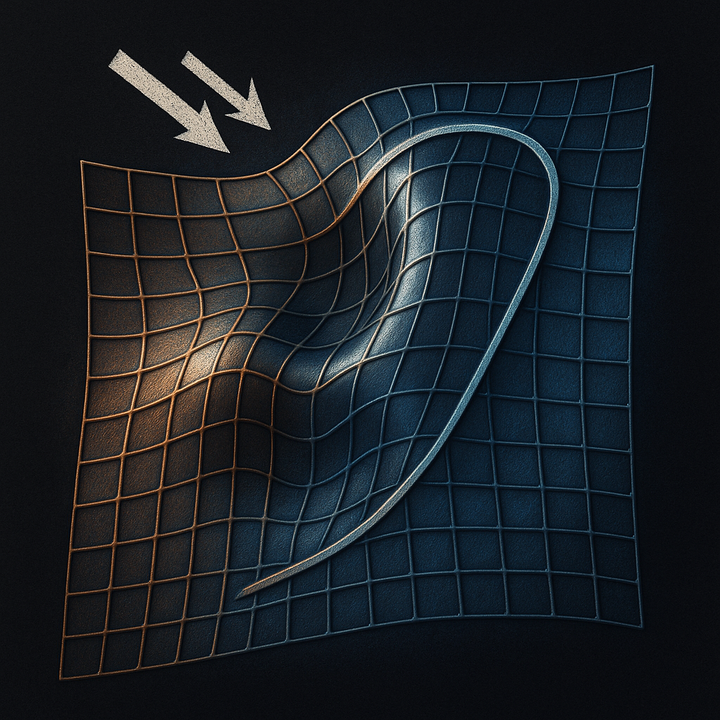
When the Map Warps and Won't Unwarp: Hysteresis in Human Systems Systems that exceed elastic limits don't return to their original state. Explore hysteresis in trauma, relationships, organizations, and cultures—and why recovery means working with deformation, not erasing it.