Surprise Isn't Just a Feeling—It's the Currency Your Brain Trades In
Surprise quantifies information your brain trades in. Chronic prediction failure creates trauma and meaninglessness, while optimal surprise ranges sustain psychological health and growth.
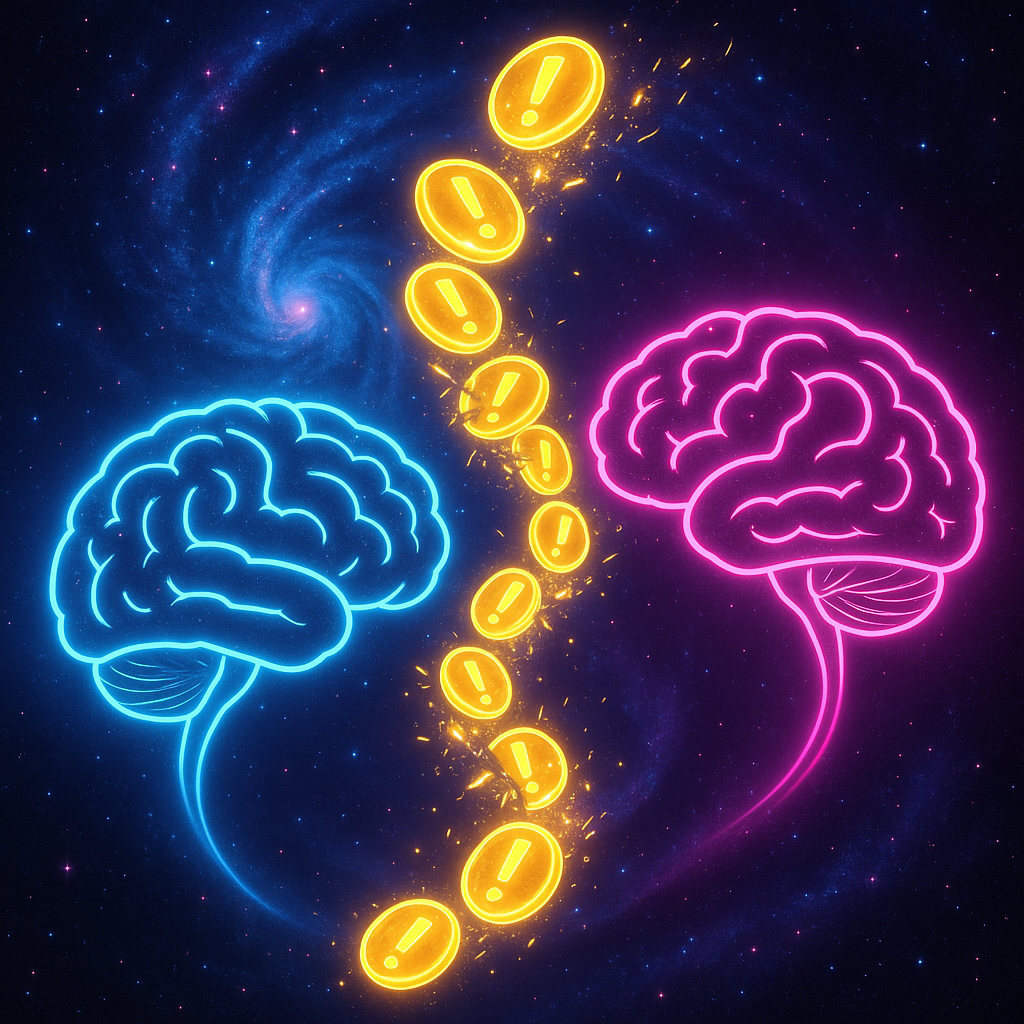
Surprise Isn't Just a Feeling—It's the Currency Your Brain Trades In
Formative Note
This essay represents early thinking by Ryan Collison that contributed to the development of A Theory of Meaning (AToM). The canonical statement of AToM is defined here.
Open your eyes. The room appears. Objects, surfaces, colors, depths—all rendered instantly, effortlessly, as if the world were simply presenting itself.
But your brain just performed a miracle of statistical inference. It took a two-dimensional pattern of photons hitting your retina and reconstructed a three-dimensional world. It filled in gaps, resolved ambiguities, separated foreground from background, identified objects, and generated the seamless experience you call "seeing."
It did this in milliseconds. It does it billions of times a day. And it runs on a single currency: surprise.
Information as Surprise
In 1948, Claude Shannon formalized what we now call information theory. His key insight: information is surprise.
A message that tells you what you already expected carries no information. "The sun rose this morning"—zero surprise, zero information. A message that tells you something unexpected carries information proportional to how unexpected it was. "The sun didn't rise"—massive surprise, massive information.
Shannon measured this in bits—the amount of surprise you experience when a coin flip comes up heads. One bit equals one binary surprise. More surprising outcomes require more bits to specify.
This mathematical framework revolutionized communication technology. But it also described something fundamental about minds: brains are information processors. And the currency of information is surprise.
The Prediction-Error Economy
Your brain runs a prediction-error economy.
Constantly, across every sensory modality and cognitive domain, the brain generates predictions about what it expects to encounter. Simultaneously, sensory systems report what actually arrives. The difference—what arrived minus what was expected—is prediction error. Surprise.
When prediction matches reality: no error, no surprise, no news. The brain runs efficiently, confirming its model without needing to update anything.
When prediction misses: error, surprise, update required. Resources must be allocated to figuring out what went wrong and revising the model to do better next time.
This is the currency flow. Predictions are like credit—you're betting that the world will be a certain way. Outcomes are like settlement—reality reveals whether your bet was good. Prediction error is the loss you take when you bet wrong.
A well-calibrated brain is like a well-calibrated trader: its predictions are accurate enough that errors are small and manageable. It runs on low surprise. Its portfolio—its model of the world—is solid.
A miscalibrated brain is like a trader with bad models: constantly surprised, constantly taking losses, constantly scrambling to update positions that keep failing. High surprise means high cost. The system is hemorrhaging cognitive currency.
Attention as Investment
If surprise is currency, attention is investment.
You can't attend to everything. Your sensory surfaces receive far more data than your brain can fully process. So the brain must decide what to invest in—which signals to process deeply, which to sample lightly, which to ignore entirely.
The investment decision is based on expected return: which signals will be most informative? Which will reduce uncertainty most efficiently? Which prediction errors matter most?
This is precision weighting—the brain's mechanism for deciding how seriously to take different signals. High-precision signals are trusted; they get attention and drive updates. Low-precision signals are discounted; they're written off as noise.
When you focus on a speaker in a crowded room, you're investing precision in their voice while divesting from the ambient chatter. When you scan a scene for threats, you're investing precision in motion and faces while divesting from static background.
Attention disorders, from this view, are investment disorders. ADHD might involve difficulty maintaining consistent precision investments—the system keeps rebalancing its portfolio, chasing whatever signal seems momentarily salient. Autism might involve unusually high precision investments across the board—everything gets treated as potentially informative, making the sensory marketplace overwhelming.
Learning as Portfolio Adjustment
Learning is model updating. And model updating follows the currency flow.
When you're surprised—when prediction error exceeds some threshold—the brain revises its model to reduce future error. It adjusts the weights, the assumptions, the expectations. It learns.
But not all surprise is equal. The brain doesn't update in response to every error. It weighs errors by their precision (how reliable they are) and by their magnitude (how far off the prediction was).
Small, low-precision errors: ignore. The noise isn't worth tracking.
Large, high-precision errors: update urgently. The model is clearly wrong about something important.
This creates a learning rate that's sensitive to context. In stable, familiar environments, the brain learns slowly—existing models are probably fine, so errors are attributed to noise. In novel, volatile environments, the brain learns quickly—existing models are probably inadequate, so errors are taken seriously.
Trauma disrupts this calibration. Overwhelming experiences flood the system with prediction error that can't be integrated. The portfolio crashes. The model breaks. And the system may become gun-shy—either refusing to update at all (rigidity) or updating at every signal (instability).
The Cost of Chronic Surprise
Running a high-surprise system is expensive.
Metabolically, prediction error triggers resource mobilization. Unexpected events demand attention, processing, response. The brain shifts from efficiency mode to emergency mode. Energy expenditure rises.
Physiologically, chronic surprise manifests as stress. The autonomic nervous system activates. Cortisol and adrenaline flow. The body prepares for action. If the surprise doesn't resolve—if the prediction error can't be reduced—the stress becomes chronic. The system exhausts itself.
Psychologically, chronic surprise feels like confusion, anxiety, overwhelm, loss of meaning. The world doesn't make sense. Predictions keep failing. Nothing is where it should be. The coherence that makes life navigable has fractured.
This is why unpredictable environments are so damaging. It's not just that bad things happen—it's that you can't anticipate when or how they'll happen. The unpredictability itself is toxic. It taxes the prediction system beyond its capacity.
Abuse survivors often describe this: the bad events were terrible, but the unpredictability was worse. Never knowing when the next blow would come. Never being able to predict safety. The constant drain of surprise without resolution.
Surprise and Meaning
Here's where the currency metaphor deepens.
If surprise is the cost of prediction failure, then meaning might be the feeling of prediction success. The sense that things make sense. That the world fits the model. That the portfolio is paying off.
When predictions hold, experience is coherent. Actions produce expected outcomes. The future unfolds as anticipated. There's no gap between expectation and reality—or the gap is small enough to integrate easily. This feels like meaning. Like being at home in the world.
When predictions fail chronically, meaning degrades. Nothing makes sense. Actions don't produce expected outcomes. The future is opaque. The gap between expectation and reality is too large to bridge. This feels like meaninglessness. Like being lost in a world that doesn't follow the rules.
Meaning is coherence under constraint. It's the felt sense of a model that works—that can predict the world well enough to navigate it. Surprise is the threat to that coherence. Every prediction error is a small tax on meaning. Large enough errors, accumulated long enough, can bankrupt the system.
Trading Surprise Across Scales
The surprise economy doesn't stop at individual brains.
Couples exchange prediction errors. Each partner generates expectations about the other. When those expectations are met, the relationship runs smoothly. When they're violated, surprise ripples through both systems. Trust is a low-surprise regime—you know what to expect from your partner. Betrayal is a massive prediction error—the model you relied on was catastrophically wrong.
Organizations run on surprise minimization. Procedures, policies, hierarchies—all exist to make organizational life predictable. When organizations function well, employees know what to expect. When they dysfunction, every day brings new surprises. The anxiety of a chaotic workplace is the tax of chronic organizational prediction error.
Cultures are surprise-management systems at population scale. Norms, rituals, shared narratives—all reduce interpersonal surprise. You know how to greet a stranger because culture has standardized the greeting. You know what to expect at a wedding because culture has scripted the ceremony. Cultural coherence is the collective capacity to predict social reality.
At every scale, the same currency circulates. The same costs apply. The same bankruptcy awaits systems that can't balance their books.
Optimizing the Wrong Metric
Here's where it gets complicated.
If the brain minimizes surprise, does that mean it avoids novelty? Does the optimal life converge on total predictability—the same day repeated forever, no variation, no news?
No. And understanding why reveals the sophistication of the system.
The brain isn't minimizing surprise directly. It's minimizing expected surprise over time—which sometimes requires accepting short-term surprise for long-term prediction improvement.
Exploration increases current surprise but reduces future surprise by improving the model. A child who explores novel environments is temporarily overwhelmed but eventually understands the world better. An investor who takes calculated risks may lose on some bets but gains information that improves future returns.
Play, curiosity, learning, creativity—all involve deliberate exposure to surprise. The system tolerates local prediction error because it's building global prediction accuracy. It invests in uncertainty to harvest future certainty.
This explains the pleasure of discovery. Finding something unexpected—but interpretable—is the sweet spot. Surprise that can be integrated into the model. Error that updates rather than overwhelms. The thrill of learning is the payoff on a well-placed prediction investment.
The Right Amount of Surprise
Mental health, in this framework, is the capacity to maintain optimal surprise.
Too little surprise: stagnation, rigidity, boredom. The model isn't being challenged. Learning has stopped. The system is crystallized around a fixed prediction set that may not even be accurate anymore. Depression often involves this—a collapse of engagement with the world's variability.
Too much surprise: overwhelm, fragmentation, chaos. The model is being challenged faster than it can update. Learning is impossible because the system is drowning. The currency is worthless because there's no stable portfolio to invest in. Anxiety and trauma often involve this—a flood of prediction error that can't be integrated.
The healthy range is in between: enough surprise to learn, not so much that the system breaks. Enough predictability to maintain coherence, not so much that the system ossifies. A dynamic equilibrium where prediction errors arrive at a rate that can be integrated.
Finding this range is the work of development, therapy, relationship, and culture. Building systems that generate the right amount of surprise—that challenge without overwhelming, that stabilize without stagnating.
Trading Partners
You don't manage surprise alone.
The deepest function of relationships may be co-regulation of prediction error. When your model of the world is failing, a trusted other can lend you theirs. Their predictions scaffold yours. Their coherence supports yours. You borrow their surprise-management capacity until your own recovers.
This is what parents do for children. What therapists do for clients. What friends do for each other in crisis. They become stable prediction sources—regulated nervous systems that the dysregulated system can entrain to.
A baby can't manage its own surprise. The world is entirely novel. Every experience floods the prediction-error budget. The caregiver regulates this by being predictable, by co-regulating arousal, by scaffolding the infant's developing model until it can stand on its own.
Secure attachment is the internalization of good surprise management. The child learns, through thousands of interactions, that prediction error is survivable. That models can update. That coherence can return. This learning becomes the foundation of psychological resilience.
Insecure attachment is the internalization of poor surprise management. The child learns that prediction error is dangerous. That the world is unreliable. That coherence is fragile. This learning becomes the foundation of psychological vulnerability.
The Economy of Mind
Surprise is the currency your brain trades in.
Every perception is a prediction checked. Every action is a bet placed. Every moment of experience is a transaction in the endless marketplace of mind, where expectations meet outcomes and the difference is recorded as error.
Your well-being is your balance sheet. Too deep in the red—too much accumulated surprise—and the system starts to fail. Operations can't be maintained. Coherence degrades. Meaning dissolves.
But you don't have to trade alone. You can form partnerships. Borrow capital. Share the load of a surprising world with others who are also trying to make sense of it.
This is what connection is for. This is what culture is for. This is what love is for.
We trade surprise together because no one has enough on their own.
Previously
← What Physics and Anxiety Have in Common
Up Next
You Don't Just Think Your Way Through Life →
Explore the lattice →
M=T/C Theory Neurodiversity Science Active Inference Trauma & Attachment Computation & Physics Future Biology
Follow on X Subscribe for new writing
Comments ()