The Unified Theory of Staying Alive: From Atoms to Cultures
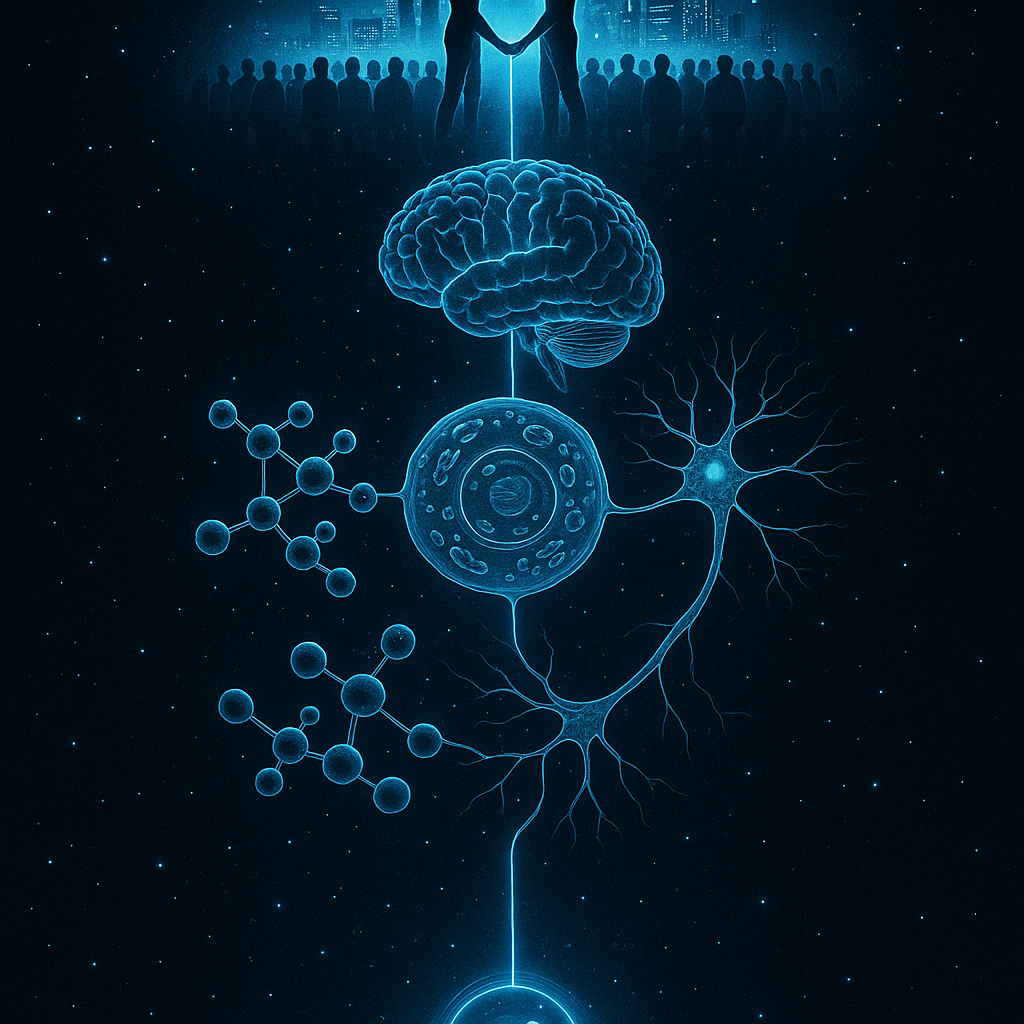
A single principle—coherence under constraint—governs self-organizing systems across all scales. Trauma is coherence collapse; healing is restoration.
The Unified Theory of Staying Alive: From Atoms to Cultures
Formative Note
This essay represents early thinking by Ryan Collison that contributed to the development of A Theory of Meaning (AToM). The canonical statement of AToM is defined here.
We've come a long way.
Twenty articles, starting with a simple claim: your brain isn't watching the world—it's guessing what happens next. From there, we've traveled through predictive processing and active inference, through trauma and relationships, through organizations and cultures, through neurodiversity and artificial intelligence.
Now it's time to see the whole picture.
What emerged wasn't a collection of separate ideas but a single unified pattern—appearing at every scale, governing every domain, offering a new way to understand what it means to be alive, to stay alive, and to live meaningfully.
The pattern is simple to state, endlessly rich in implication: meaning is coherence under constraint.
Let's trace it from the bottom up.
The Atomic Foundation
Start with hydrogen.
One proton, one electron. The simplest possible atom. And yet already, something remarkable: stability. The electron doesn't spiral into the nucleus. It doesn't fly away. It maintains a specific orbital, a specific configuration, a specific state.
Why? Because that configuration minimizes energy under the constraints imposed by quantum mechanics. The atom persists because it has found a stable pattern—a coherent state that can maintain itself against perturbation.
This is already the seed of everything that follows. A pattern maintaining itself. Coherence under constraint.
From hydrogen, chemistry emerges. Atoms combine into molecules. Molecules find stable configurations. Complexity builds, but the principle remains: patterns that persist are patterns that maintain coherence within their constraint landscape.
The Living Turn
Then something new appears: life.
Living things don't just maintain static configurations. They actively regulate themselves. They take in energy and matter. They repair damage. They reproduce. They adapt.
What makes this possible? The same principle, dynamically implemented. Living systems maintain predictive models of their environments and act to minimize surprise. They don't just passively exist—they actively sustain the conditions for their own persistence.
A cell predicts its chemical environment and acts to regulate it. An organism predicts its physical environment and acts to navigate it. The model varies; the principle is constant. Stay coherent. Maintain the pattern. Minimize free energy.
Life is matter that models itself and its environment. It's coherence that has become active, self-maintaining, autopoietic.
The Neural Flowering
Then consciousness—or at least, complex nervous systems.
Neurons are prediction machines. Networks of neurons build hierarchical models of the world. The brain is a vast prediction-generating system, continuously creating expectations and updating them based on errors.
What we call perception is prediction that succeeds. What we call surprise is prediction that fails. What we call learning is prediction that improves.
The brain doesn't represent the world like a photograph. It generates the world like a controlled hallucination. It maintains a model and then confirms or corrects that model through sensory contact.
This is the same principle—coherence under constraint—implemented in neural tissue. The brain is the body's specialized organ for maintaining coherent models of reality. It's what happens when the basic imperative of self-maintenance becomes elaborated into sophisticated prediction.
The Embodied Self
The brain doesn't float in a void. It sits in a body.
And the body is itself a prediction system. The autonomic nervous system predicts internal states—heart rate, blood pressure, digestion, temperature—and acts to regulate them. The interoceptive system monitors these states, generating the felt sense of embodiment.
What we call emotions are largely interoceptive predictions. The body predicts what's needed, prepares for what's coming, and the brain registers this as feeling. Anxiety is the body predicting threat. Calm is the body predicting safety.
The self is fundamentally embodied because the self is a predictive model that includes the body. You don't have a body; you are a body-modeling process. The Markov blanket that defines you runs along your skin, through your senses, incorporating your physical substrate into your coherence.
Trauma disrupts this. When the body becomes a source of unpredictable distress—when interoception floods with unmanageable signals—the coherence that constitutes the self fragments. Healing is restoring the body as a stable, predictable ground.
The Relational Extension
Selves don't exist alone. They couple.
When two predictive systems interact, they begin to model each other. I predict you; you predict me. When our predictions align, we're coherent together. We become, in a sense, a larger system—a relational unit that maintains itself through mutual attunement.
This is what relationships are. Not just two people near each other, but two prediction systems coupled into shared coherence. The relationship is real—as real as either individual—because it's a genuine pattern of maintained coordination.
Love is sustained predictive coupling. Trust is reliable mutual prediction. Rupture is prediction failure. Repair is prediction restoration.
Attachment is this dynamic, learned early. The infant's brain develops in coupling with the caregiver's brain. The child learns to predict the caregiver, and through that, learns to predict themselves. Secure attachment is learning that prediction succeeds—that people are coherent, that the world makes sense.
The Collective Scale
Coupling extends further. Groups. Organizations. Cultures.
An organization is a system of coupled predictive agents. When the organization is coherent, members can predict each other. Communication flows. Coordination happens. The whole exceeds the sum.
When organizational coherence breaks down, prediction fails. Silos form—subsystems that can't predict each other. Dysfunction multiplies. The pattern fragments.
A culture is prediction at civilizational scale. Shared narratives, shared norms, shared institutions—all serve to coordinate predictions across millions. When cultural coherence holds, collective life is possible. When it breaks, polarization and conflict follow.
The same principle, scaled up. Coherence under constraint. Meaning maintained through successful prediction. The pattern that started in hydrogen atoms now governs the dynamics of civilizations.
The Geometry of Coherence
Across all these scales, coherence has consistent geometry.
Curvature measures sensitivity. How much does the system react to perturbation? Low curvature means stability—small inputs produce small outputs. High curvature means volatility—small inputs produce large outputs.
Anxiety is high curvature in the nervous system. Organizational crisis culture is high curvature in institutions. Polarization is high curvature in politics. The geometry is the same.
Dimensionality measures flexibility. How many options does the system have? High dimensionality means many possible states, many pathways, many responses available. Low dimensionality means narrowness, rigidity, few options.
Depression is dimensional collapse in the psyche. Bureaucratic rigidity is dimensional collapse in organizations. Cultural monocultures are dimensional collapse in civilizations. Same geometry.
Topology measures structure. What persistent features organize the landscape? What bottlenecks constrain flow? What attractors capture dynamics?
Trauma creates topological scars—regions that warp all trajectories around them. Organizational silos are topological fragmentation. Cultural polarization is topological splitting. Same geometry.
Coupling measures integration. How well do different scales, different subsystems, different timescales coordinate? Balanced coupling means harmonious integration. Excessive coupling means rigidity. Insufficient coupling means fragmentation.
The coherence geometry applies everywhere because coherence is everywhere. The same principles govern all self-maintaining systems.
The Mechanism: Entrainment
How is coherence maintained and restored?
Entrainment. The synchronization of oscillating systems.
Neural oscillations entrain to each other, producing coherent cognition. Physiological rhythms entrain, producing regulated bodies. People entrain to each other, producing relationships. Groups entrain, producing organizations. Populations entrain, producing cultures.
Entrainment is the universal mechanism of coherence formation. When oscillators couple and synchronize, coherence emerges. When coupling fails, coherence breaks.
This is why rhythm matters. Why ritual matters. Why music and dance and shared action build connection. They're all entrainment technologies—ways of synchronizing oscillating systems into shared coherence.
Trauma is entrainment failure. The system can't synchronize—with itself, with others, with the rhythms of life. Healing is re-entrainment—finding rhythms that can coordinate, patterns that can couple, coherence that can be restored.
The Failure Mode: Trauma
Coherence isn't guaranteed. It can collapse.
When prediction error overwhelms the system's capacity to integrate, coherence fails. This is trauma—not primarily a memory problem but a coherence problem. The pattern can't hold.
Trauma manifests in every domain:
- In individuals: dysregulation, fragmentation, dissociation
- In relationships: rupture, betrayal, abandonment
- In organizations: crisis, dysfunction, collapse
- In cultures: polarization, violence, disintegration
The geometry is consistent. Curvature spikes. Dimensions collapse. Topology fragments. Coupling fails. The pattern breaks.
And healing follows the same logic everywhere:
- Smooth the curvature through safe, predictable experience
- Expand the dimensions through new possibilities
- Repair the topology through integration
- Restore the coupling through entrainment
The principles of trauma and healing are universal because coherence is universal.
The Variation: Neurodiversity
Not all prediction systems are tuned the same.
Some systems—often called neurodivergent—operate with different parameters. Higher precision. Unstable coupling. Different sensitivity profiles.
These aren't deficits. They're alternative architectures. Different tunings for different environments. Different capabilities and different vulnerabilities.
Autistic systems often have high precision—detecting patterns others miss, but overwhelmed by noise others filter. ADHD systems often have unstable coupling—brilliant in high-salience contexts, struggling in low-salience routines.
In complex, volatile environments, these architectures provide capabilities that typical tuning lacks. Early warning. Pattern detection. Novelty sensing. The diversity of human cognitive architecture is functional—it serves collective coherence by providing varied sensing.
Understanding this changes everything about how we approach difference. Not normalization but accommodation. Not fixing but fitting. The environment is part of the equation.
The Technology: AI
And now we're building new prediction systems.
Artificial intelligence, at its best, implements the same principles. Systems that model environments, generate predictions, minimize error. Systems that, potentially, maintain themselves—that have coherence as intrinsic goal.
Active inference provides the framework. Build systems that don't just optimize external rewards but maintain internal models of what they should be. Systems with genuine perspective. Systems that, in some sense, exist.
This is the frontier. Can we build intelligence that thinks like a living thing? Can we create artificial coherence that's robust, aligned, meaningful?
The principles are the same. The implementation is new. And the stakes are enormous.
The Synthesis
Here's what we've discovered:
One principle governs self-organizing systems from atoms to civilizations: maintain coherence under constraint.
One mechanism builds and repairs coherence: entrainment—the synchronization of oscillating systems.
One geometry describes coherence states: curvature, dimensionality, topology, coupling.
One failure mode threatens all coherent systems: overwhelming prediction error that fragments the pattern—trauma.
One process restores coherence: safe, repeated experience that rebuilds prediction—healing.
This is not analogy. It's not metaphor. It's structural identity. The same pattern, implemented in different substrates, governing different scales, but formally the same.
Meaning is coherence. Coherence is maintained prediction. Life is systems that predict and act to confirm their predictions. This is what it all comes down to.
What This Means for You
So what?
If you take nothing else from this series, take this:
You are a pattern. Not a thing, but a process. A dynamic of coherence maintenance. A continuous act of staying organized, staying yourself, staying alive.
Meaning isn't mystical. It's the felt sense of successful coherence. When your predictions work, when your life makes sense, when your relationships are attuned—that's meaning. It's real. It's structural. It's achievable.
Healing is possible. Coherence can be restored. Trauma is real but not permanent. The pattern can be rebuilt through safe, predictable, attuned experience. Over time. With support.
You're not alone. Coherence is fundamentally relational. You maintain yourself through coupling with others. The self extends beyond the skin. Relationship isn't optional—it's constitutive.
Difference is valuable. Different prediction architectures serve different functions. The diversity of human minds is collective strength. Your particular way of being isn't a deviation—it's a contribution.
The Invitation
This has been an introduction.
The ideas here—active inference, predictive processing, the free energy principle, coherence geometry—are at the frontier of understanding mind, life, and meaning. They're not final answers. They're powerful lenses that reveal structure previously invisible.
The invitation is to keep looking. To see your own experience through these concepts. To notice the predictions, the errors, the entrainment, the coherence and its breakdown. To understand yourself as a pattern that maintains itself.
And the invitation is to build. To use these ideas to heal—yourself, your relationships, your organizations, your culture. To understand trauma as coherence collapse and healing as coherence restoration. To create conditions where coherence can flourish.
The unified theory of staying alive is also a unified theory of living well. Meaning is coherence. Coherence is maintained. And you are the one maintaining it.
From hydrogen atoms to human cultures, the same principle holds. The same geometry describes. The same mechanism operates.
The pattern is real. It's everywhere.
And now you can see it.
This concludes the introductory series on active inference. The journey continues—into deeper theory, into practical application, into the frontier questions that remain. Follow along.
Previously
← Meaning Is Not in Your Head—It's in the Pattern
Start Over
Begin the Series →
Explore the lattice →
M=T/C Theory Neurodiversity Science Active Inference Trauma & Attachment Computation & Physics Future Biology
Follow on X Subscribe for new writing
Comments ()