Two Nervous Systems, One Rhythm: The Science of Attunement
From Huygens' synchronized pendulums to human connection: the science of how nervous systems align through entrainment, and why it matters for attachment, therapy, and healing.
Two Nervous Systems, One Rhythm: The Science of Attunement
Formative Note
This essay represents early thinking by Ryan Collison that contributed to the development of A Theory of Meaning (AToM). The canonical statement of AToM is defined here.
Put two pendulum clocks on the same wall and wait.
In 1665, the Dutch physicist Christiaan Huygens noticed something strange. The pendulums, which had started swinging at different rates, gradually synchronized. Within half an hour, they were moving in perfect anti-phase—one going left while the other went right, locked into a shared rhythm.
Huygens called it "sympathy." Today we call it entrainment—the tendency of oscillating systems to synchronize when they're coupled.
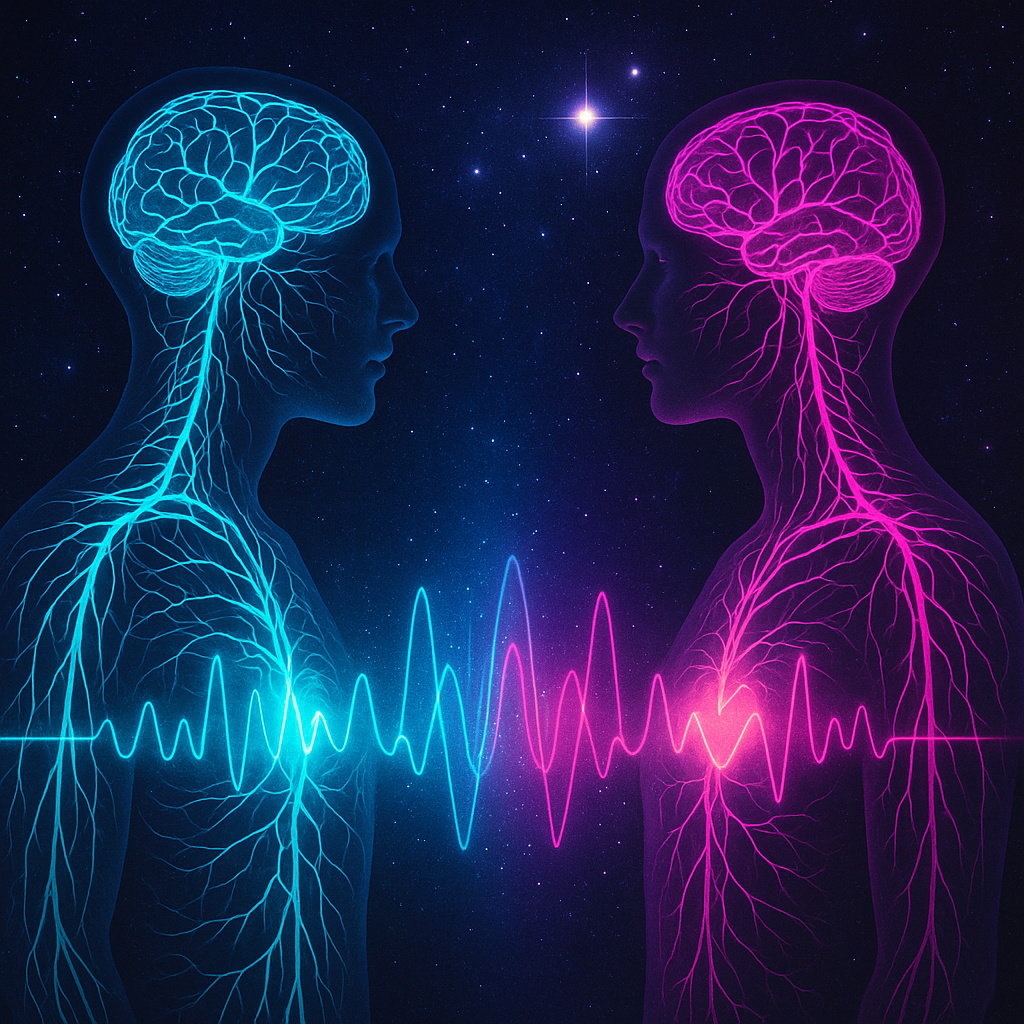
Your nervous system is an oscillating system. So is mine. And when we interact, the same physics applies. We don't just exchange words—we exchange rhythms. We synchronize. We entrain.
This is attunement: the coupling of two nervous systems into shared prediction. It's not poetry. It's mechanism. And it may be the foundation of everything we call connection.
What Synchronizes
When two people are attuned, their bodies synchronize in measurable ways.
Heart rate variability aligns. The subtle fluctuations in heartbeat—the signature of autonomic regulation—begin to correlate between people in close interaction. Mother-infant dyads show this. Romantic partners show this. Even strangers in conversation begin to show it after a few minutes.
Breathing synchronizes. Without trying, without noticing, people in attuned interaction start breathing at similar rates, at similar depths. This happens in therapy, in meditation groups, in dance.
Movement coordinates. Postures mirror. Gestures align. The micro-movements of face and body fall into phase. This is measurable with motion capture—and visible to anyone who watches.
Voice entrains. The rhythm and pitch of speech begin to match. Turn-taking becomes smooth. Overlaps decrease. The conversation flows because the underlying oscillations have coupled.
None of this is conscious. You don't decide to synchronize your heart rate with someone you're attuned to. It happens because nervous systems are oscillators, and coupled oscillators synchronize.
The Mechanism
Why does this happen?
Each nervous system is generating predictions about the other. When I interact with you, my brain is constantly forecasting what you'll do next—your words, your movements, your facial expressions, your emotional state.
When my predictions are accurate, processing is efficient. I know what's coming. I can prepare. There's no surprise, no prediction error, no metabolic cost.
But my predictions are shaped by your behavior. If you're predictable—if you're sending regular, consistent signals—my model of you stabilizes. And if I'm sending predictable signals back, your model of me stabilizes.
This creates a feedback loop. As each system becomes more predictable to the other, each system can predict the other more accurately. The predictions converge. The rhythms align.
Entrainment is mutual prediction success. Two systems that have learned to anticipate each other, operating in temporal lockstep because it's more efficient than operating independently.
Secure Attachment as Entrainment
The first relationship is the prototype.
An infant cannot regulate its own nervous system. It can't smooth its own curvature, can't expand its own dimensions, can't repair its own topology. It depends entirely on the caregiver to provide these functions.
What the caregiver provides is entrainment. Through consistent, responsive interaction—feeding, rocking, holding, cooing—the caregiver's regulated nervous system provides a template for the infant's unregulated one. The infant's oscillations synchronize to the caregiver's oscillations.
Over thousands of interactions, this entrainment becomes internalized. The infant learns the rhythm. It develops the capacity to regulate itself because it first learned to regulate through another.
Secure attachment is the residue of good entrainment. The child who was consistently attuned to develops a nervous system that can smoothly self-regulate and smoothly co-regulate with others. The predictions about relationships—learned through embodied rhythm, not explicit teaching—are predictions of safety, availability, repair.
Insecure attachment is the residue of poor entrainment. The child whose caregiver was inconsistent, unavailable, or frightening developed predictions about relationships that reflect those experiences. The rhythms are off. The synchrony doesn't come naturally. The predictions expect rupture without repair.
Therapy as Re-Entrainment
If poor attunement damaged the nervous system, good attunement can repair it.
This is the logic beneath most effective therapies, regardless of their explicit theoretical orientation. The therapist provides a regulated presence—a nervous system that the client's nervous system can entrain to.
The therapist's voice is steady, modulated, with prosody that signals safety. The therapist's body is calm, open, grounded. The therapist's attention is consistent, reliable, non-reactive. These are rhythmic signals. They create a predictable environment.
The client's nervous system, exposed to this consistent rhythm over time, begins to synchronize. Not instantly—the old predictions resist. But gradually, session by session, the entrainment happens. The client's curvature smooths slightly. Their range expands slightly. Their predictions about relationships update slightly.
This is why the therapeutic relationship matters more than the therapeutic technique. The relationship is the technique—at least at this level. It's the entrainment scaffold that allows the nervous system to heal.
You can't think your way to a different attachment style. You have to rhythm your way to it. You have to spend time in synchrony with someone whose nervous system is regulated enough to lead yours somewhere new.
Attunement Is Not Merger
Synchronization doesn't mean identity.
Two coupled oscillators maintain their own frequencies even as they coordinate. The pendulums on Huygens's wall remained distinct—they just moved together. Each kept its own mass, its own momentum, its own physical integrity.
Good attunement is the same. You synchronize with another person without losing yourself. Your rhythm aligns with theirs, but you remain your own oscillator.
Unhealthy attunement looks different. In codependency, one person's oscillation is entirely driven by the other's. There's no autonomous rhythm—just reaction. This isn't entrainment; it's capture. One system has lost its frequency entirely.
In avoidant attachment, the opposite happens. The system refuses to entrain. It maintains its own rhythm rigidly, never synchronizing, never coupling. This preserves autonomy at the cost of connection.
Healthy attunement balances. You can synchronize and maintain your own frequency. You can join and remain distinct. The coupling is mutual, not parasitic. Both systems contribute to the shared rhythm.
Rupture and Repair
Perfect attunement is impossible—and undesirable.
No two nervous systems predict each other perfectly all the time. Misattunement happens. You expected one thing; they did another. Prediction error spikes. Synchrony breaks.
This is rupture. And it's inevitable. The question is what happens next.
In secure relationships, rupture is followed by repair. The systems resynchronize. The prediction error is resolved—not by pretending it didn't happen, but by actively realigning. An apology. A reconnection. A return to rhythm.
It's the repair, not the rupture, that builds trust. A relationship with ruptures that repair teaches the nervous system something crucial: synchrony can be lost and regained. The prediction becomes: "This connection can survive disruption."
Relationships without rupture teach nothing—they're too smooth to test the system. Relationships with rupture but no repair teach the wrong thing: "Synchrony, once lost, is lost forever."
The healthy nervous system knows how to resynchronize after losing sync. It's not brittle. It can tolerate temporary misattunement because it has a model that includes repair.
Modern Dysregulation
Contemporary life is an entrainment disaster.
We evolved to synchronize with a small number of people—family, tribe, immediate community. The rhythms were shared. The rituals were collective. The prediction environment was stable.
Now we're isolated in homes, connected through screens, embedded in rhythms set by algorithms. The entrainment partners are virtual. The synchrony is with feeds, not faces.
This produces nervous systems that are simultaneously over-stimulated and under-regulated. Constant input, no consistent rhythm. High prediction error, no co-regulation. The oscillators are firing but nothing is synchronizing.
The epidemic of anxiety and depression might partly reflect entrainment failure. Nervous systems without adequate attunement partners. Rhythms that never stabilize because there's no consistent other to stabilize with.
The solutions are not technological. They're relational. More face-to-face. More body-to-body. More sustained presence with consistent others. More of the ancient entrainment that nervous systems evolved to need.
The Depth of Connection
What does attunement feel like from the inside?
It feels like being felt. Like the other person gets it. Like you're not alone in your experience. Like someone is with you in the moment, tracking you, resonating with you.
This feeling is not mystical. It's the phenomenology of prediction synchrony. When someone is accurately predicting your state, when their responses align with your needs, when their rhythm matches yours—the nervous system registers this as safety. As connection. As love.
And it's not just subjective. It's physiologically measurable. People in attuned interaction have lower cortisol. Their immune function improves. Their recovery from stress is faster. The body knows when it's synchronized with another body—and it responds accordingly.
This is why loneliness kills. It's not just sad—it's physiologically dangerous. A nervous system without entrainment partners is a nervous system under chronic stress, generating prediction errors it can't resolve alone, with curvature it can't smooth.
Connection isn't optional. It's operational. Your nervous system was built for it.
Two Becoming One (Sort Of)
When two nervous systems synchronize deeply, something emerges that didn't exist before.
Not merger—both systems remain distinct. But a new level of organization: a dyadic system with its own properties. The couple becomes an entity. The therapist-client pair becomes an entity. The team becomes an entity.
This higher-level system has its own coherence geometry. It can be smooth or jagged. It can have more or fewer dimensions. It can be stable or volatile.
The dyad is a new Markov blanket—a boundary around the pair that separates "us" from "not-us." Information flows within the dyad differently than across its boundary. Predictions within the dyad are more accurate than predictions about outsiders.
Humans are not just individual nervous systems. We're nodes in networks of synchronized oscillators, creating higher-order patterns that wouldn't exist if we weren't coupled.
This is what relationship is. Not just two people near each other, but two prediction systems coupled into something new. Two rhythms becoming one rhythm. Two blankets creating a shared blanket.
Attunement is the mechanism. Love is the name we give to the feeling when it works.
Previously
← When the World Stops Making Sense
Up Next
What Happens in Your Body When Someone Really Listens →
Explore the lattice →
M=T/C Theory Neurodiversity Science Active Inference Trauma & Attachment Computation & Physics Future Biology
Follow on X Subscribe for new writing
Comments ()