When the World Stops Making Sense: The Geometry of Breakdown
Breakdown is the collapse of predictive models generating coherent experience. Explore mental disorders through manifold geometry—curvature, dimensionality, topology—and discover pathways to reconstruction.
When the World Stops Making Sense: The Geometry of Breakdown
Formative Note
This essay represents early thinking by Ryan Collison that contributed to the development of A Theory of Meaning (AToM). The canonical statement of AToM is defined here.
There are moments when reality unmoors.
The words coming out of someone's mouth suddenly sound like noise. The familiar room becomes alien. Your own hand seems to belong to someone else. The ground you've stood on your whole life—the assumptions, the expectations, the sense that you know what's happening—dissolves.
This is breakdown. Not breakdown as melodrama, but breakdown as a precise phenomenon: the collapse of the predictive models that generate the experience of a coherent world.
It can happen slowly, through mounting stress that erodes the system. It can happen suddenly, through shock that shatters it. It can last minutes or months. It can be localized to one domain or generalize to everything.
But it always has the same geometry. And understanding that geometry is the first step toward understanding how to restore what was lost.
The Shape of Sense-Making
Your experience of a coherent world is not given. It's constructed.
Every moment, your brain is generating a model of what's happening—predicting sensory input, predicting body states, predicting the trajectory of events. When these predictions succeed, the world makes sense. Not because the world is inherently sensible, but because your model is fitting it well.
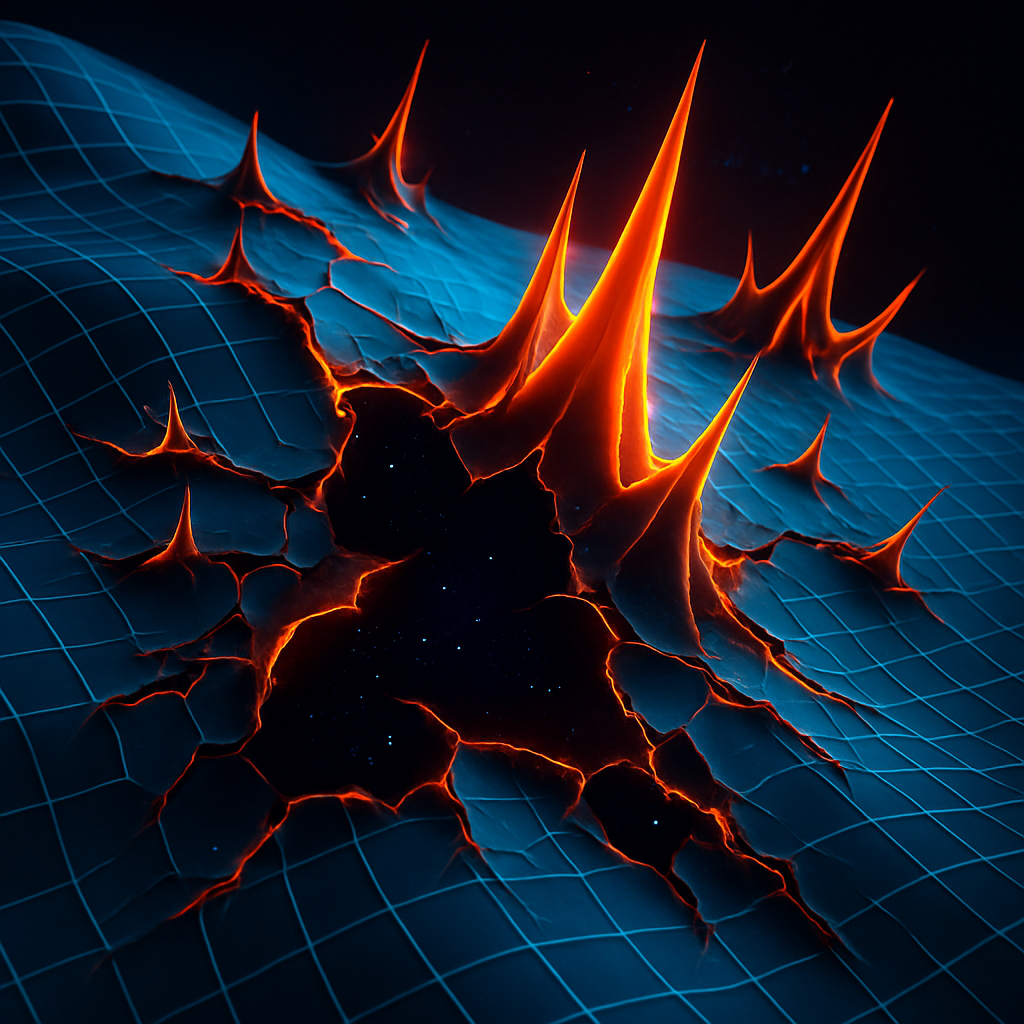
This fit has a geometry. Think of it as a surface—a manifold—across which your mental states flow. When the surface is smooth, flow is easy. You move from state to state without jarring transitions. Experience feels coherent, continuous, navigable.
Curvature measures how bumpy the surface is. Low curvature means predictions are stable—small changes in input produce small changes in output. High curvature means volatility—small changes in input produce wild swings. Anxiety is high-curvature experience. Everything is on a knife's edge.
Dimensionality measures how many options you have. A high-dimensional manifold has many pathways, many possibilities, many ways to respond. A low-dimensional manifold is narrow—few options, rigid patterns, limited repertoire. Depression often involves dimensional collapse.
Topology describes the global structure—where the bottlenecks are, where the attractors are, which regions connect to which. Trauma creates topological distortions: regions you can't enter, paths that loop endlessly, transitions that are impossible.
Coherence is low curvature, high dimensionality, and smooth topology. Breakdown is when these properties degrade.
What Breakdown Feels Like
The phenomenology of breakdown is distinctive.
Depersonalization: You feel unreal. Your body is strange. You watch yourself as if from outside. The prediction that "this is me" is failing. The interoceptive model has decoupled from the sense of self.
Derealization: The world feels unreal. Objects seem flat, distant, stage-like. The prediction that "this is real" is failing. The model has stopped generating the conviction that what you're perceiving actually exists.
Confusion: You can't follow what's happening. Conversations don't make sense. Events don't connect. The sequential predictions that normally chain experience together are breaking down.
Overwhelm: Too much is happening. You can't process it. Input is flooding in faster than the model can handle. Prediction error is spiking across all channels.
Emptiness: Nothing seems to matter. The predictions that normally assign value to things—the motivational gradients that make some things worth pursuing—have flattened. The manifold has no slopes.
Each of these is a different failure mode of the prediction machinery. Different aspects of the coherence geometry collapsing in different ways.
Stress and Curvature
Chronic stress increases curvature.
When you're stressed, the system is on alert. Every input gets treated as potentially significant. Precision weights go up. Small signals that would normally be ignored become triggers for large responses.
This is adaptive in genuinely dangerous situations. You want the system to be reactive when threat is real. But chronic stress makes reactivity the default. The curvature stays high even when there's no threat. The manifold becomes uniformly jagged.
Living on a high-curvature manifold is exhausting. Every step requires correction. Every moment threatens destabilization. You're constantly expending energy on prediction error that never resolves.
Eventually something gives. Either the system finds a way to smooth the curvature, or it breaks. Breakdown is sometimes the system's way of giving up—collapsing to a state where high curvature is replaced by no curvature, reactivity replaced by numbness.
Burnout is often this. The transition from anxious hyperfunction to depressive shutdown. The manifold went from too curved to too flat.
Trauma and Topology
Trauma creates topological scars.
The overwhelming experience doesn't just produce a memory—it reshapes the manifold. It creates regions of extreme curvature (the trauma zones that can't be approached without spiking). It creates bottlenecks (the repetitive loops that you can't escape). It creates barriers (the dissociative walls that protect you from what's on the other side).
These topological features persist. They're not in narrative memory—they're in the shape of the prediction space itself. They determine which transitions are possible, which states are accessible, which experiences are available.
Someone with complex trauma may have a manifold that's a labyrinth. Many regions disconnected. Few through-routes. Most paths leading back to the same few attractors. The apparent behavioral patterns—the repetition compulsions, the relational reenactments—are manifestations of a topology that permits only certain trajectories.
Healing requires topological repair. Not just narrating the trauma but actually opening new pathways, smoothing the curvature spikes, connecting the dissociated regions. This happens through experience, not insight. The manifold is reshaped by living through it differently.
The Coherence Collapse Cascade
Breakdown often follows a cascade pattern.
It starts in one domain. A prediction failure in work, or relationship, or health. Curvature spikes locally. Normally you'd absorb this, but you're already stressed. The local spike propagates.
Adjacent regions of the manifold destabilize. The work stress affects the relationship. The relationship stress affects sleep. The sleep deficit affects everything. Each failure generates more prediction error, which spreads to more domains.
At some point the cascade becomes self-sustaining. You're generating more prediction error than you can integrate. The whole manifold is destabilizing at once. The experience is of everything falling apart—because, geometrically, it is.
The cascade can be stopped at any stage if enough prediction errors get resolved. One domain stabilizing can stabilize adjacent domains. This is why small interventions sometimes have large effects. Fix the sleep, and the cascade starts running backward. Address one relationship, and the whole system begins to cohere.
But timing matters. Early intervention stops the cascade before it generalizes. Late intervention has to work against a system-wide collapse.
Dimensional Collapse
Depression is often dimensional collapse.
The manifold loses dimensions. Where there were many possible states, now there are few. Where there were many possible actions, now there's barely any. The world feels flat because the prediction space has flattened.
This is adaptive in one sense. A low-dimensional manifold is easier to manage. There's less that can go wrong. Fewer possibilities means fewer opportunities for prediction error. The system has simplified itself to survive.
But the cost is enormous. Low dimensionality means low flexibility. You can't adapt. You can't respond to opportunity. You can't feel much of anything because feeling requires variation across a state space that no longer exists.
The collapsed manifold feels like a trap because it is a trap. The geometry constrains you. The paths out require dimensions you don't have access to.
Recovery from depression is dimensional expansion—gradually reopening the manifold, recovering lost degrees of freedom. This often happens through action, not thought. Each small action tests a prediction. Each prediction that succeeds expands what's possible. Slowly, the manifold reinflates.
Psychosis and Prediction Chaos
Psychosis represents breakdown in another direction.
Instead of the manifold collapsing to few dimensions, it explodes into too many. Instead of predictions being too rigid, they become chaotic. The system can't distinguish between what's predicted from outside and what's generated from inside.
Hallucinations are internal predictions experienced as external reality. The model is generating patterns it's supposed to generate—sensory expectations, linguistic templates, interpersonal scenarios—but the tagging has failed. What should be marked "this is what I'm imagining" is marked "this is what's happening."
Delusions are predictions that can't be updated. The model has generated an explanation—persecution, grandiosity, control by outside forces—that fits the data (the distressing data of a fragmenting experience) and can't be revised by contradicting evidence. The precision on the delusional prediction is locked high.
This is breakdown as incoherence rather than collapse. The manifold is intact but the navigation is scrambled. You're moving through a space that no longer has stable landmarks.
The Relational Geometry
Breakdown doesn't happen in isolation.
Your manifold is coupled to other manifolds—the people in your life. Their predictions influence yours. Their coherence supports yours. When relationships are stable, they anchor your geometry.
Relational trauma creates coupled manifold damage. If your early attachment figure was unpredictable—sometimes safe, sometimes dangerous—your manifold formed around that unpredictability. The geometry of your expectations is shaped by the geometry of their behavior.
And current relationships affect current geometry. A regulated partner can smooth your curvature. An attuned friend can expand your dimensions. A toxic relationship can deform your manifold as surely as individual trauma.
This is why breakdown often follows relational rupture. The loss of an anchoring relationship removes a structural support. The manifold has to reorganize without something it depended on. Sometimes it can. Sometimes it collapses.
And this is why recovery often requires relational support. You need a coherent other to stabilize your incoherence. You need someone whose manifold can scaffold yours while you rebuild.
Rebuilding Coherence
Breakdown is terrible. But it's not the end.
The manifold can be rebuilt. Curvature can be smoothed. Dimensions can be recovered. Topology can be repaired. The system that generates the experience of a coherent world is plastic. It can heal.
The rebuilding happens through experience. Prediction errors in the direction of coherence. Moments when reality is safer than expected. Actions that succeed. Relationships that hold. Small, accumulated evidence that the world makes sense.
It can't be forced. It can't be rushed. The geometry updates slowly. But it updates.
And something interesting often happens. The rebuilt manifold is sometimes more robust than the original. Having broken once, the system has learned something about breaking. The predictions are less brittle. The dimensions are more secure. The topology is more flexible.
This is post-traumatic growth—not just recovery but expansion. The manifold becomes more capable of handling what couldn't be handled before.
It's not guaranteed. Some breakdowns lead to chronic fragmentation. But it's possible. The geometry of meaning can be reconstructed.
And if you're in the midst of breakdown now—if the world has stopped making sense—know this: the geometry was always going to be temporary. The old coherence couldn't last. What's happening is terrible. And also: something is being rebuilt. The manifold is reshaping. Another coherence is possible.
It will take time. It will take support. It will take more than you think you have.
But the world can make sense again.
Previously
← Trauma Isn't a Memory Problem
Up Next
Two Nervous Systems, One Rhythm →
Explore the lattice →
M=T/C Theory Neurodiversity Science Active Inference Trauma & Attachment Computation & Physics Future Biology
Follow on X Subscribe for new writing
Comments ()