Why the Smartest AI Researchers Are Reading a British Neuroscientist
AI lacks real goals and robust world models. Karl Friston's free energy principle offers a solution by treating intelligence as the drive to maintain coherence—reshaping how we build AGI.
Why the Smartest AI Researchers Are Reading a British Neuroscientist
Formative Note
This essay represents early thinking by Ryan Collison that contributed to the development of A Theory of Meaning (AToM). The canonical statement of AToM is defined here.
Something strange happened in artificial intelligence.
For decades, AI research and neuroscience were strangers. Engineers built neural networks that bore only superficial resemblance to actual neurons. Neuroscientists studied brains without caring much about machine learning. The fields shared a name but not much else.
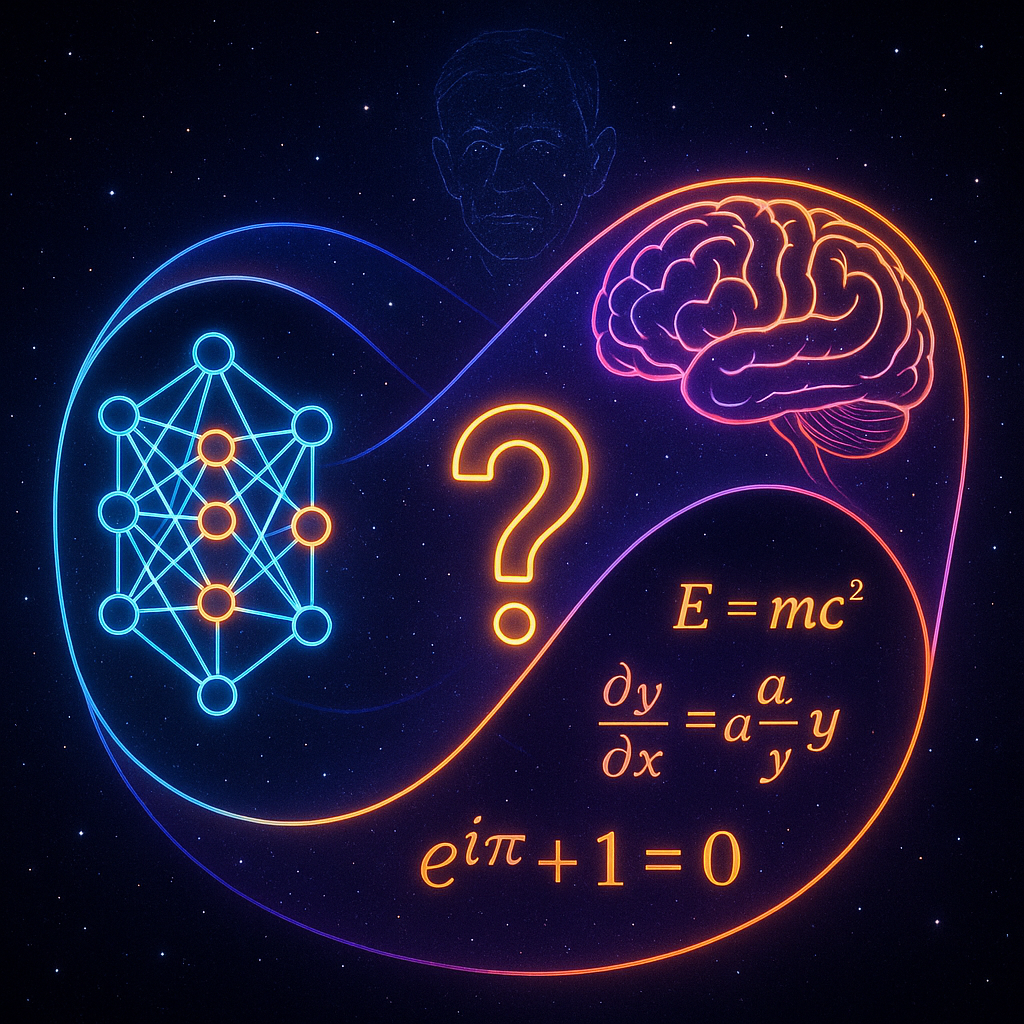
Then a shift. The most important ideas in modern AI started arriving from brain research. And now, in labs from DeepMind to VERSES AI to cutting-edge academic research groups, a British neuroscientist's work has become essential reading.
His name is Karl Friston. His framework is the free energy principle. And his ideas are quietly reshaping how researchers think about intelligence—artificial and biological alike.
What AI Has Been Missing
Modern AI is remarkable. Large language models can write essays. Image generators can produce art. Game-playing systems can defeat world champions. Reinforcement learning agents can navigate complex environments.
But something is missing.
These systems don't have goals in any meaningful sense—they have reward functions imposed from outside. They don't build coherent world models—they learn statistical patterns in data. They don't adapt to genuinely novel situations—they perform well in distributions similar to their training and fail badly outside them.
They're not alive. They don't persist through challenge. They don't maintain themselves against entropy. They don't care about their own continued existence because they don't exist as selves at all.
This matters for practical reasons. Current AI systems are brittle. They fail in ways that are hard to predict. They don't transfer well across domains. They require massive amounts of data and compute for capabilities that children achieve effortlessly.
And it may matter for deeper reasons. If we want artificial general intelligence—not just specialized tools but systems that can do what minds do—we might need principles that govern what minds actually are.
The Friston Connection
Karl Friston's work offers something different: a principled account of what any intelligent system must do to exist.
The free energy principle says that any self-organizing system—anything that maintains its integrity against the tendency toward disorder—must minimize variational free energy. This means it must maintain a generative model of its environment and minimize the difference between its predictions and what it encounters.
Active inference extends this to action. The system doesn't just passively predict—it acts to make its predictions come true. It shapes the world to match its model, and it updates its model to match the world. Perception and action are unified as two aspects of a single imperative: stay coherent.
This gives AI researchers something they were lacking: a framework for building systems that have goals in themselves—not just imposed reward signals but intrinsic drives toward maintaining coherent world models and stable existence.
What Active Inference Agents Look Like
Several labs are now building AI systems based on these principles.
Instead of training a system to maximize a reward signal, you build a system with a generative model of its expected states—the states it needs to occupy to continue existing. The system then acts to realize those expectations. It's motivated not by external reward but by the drive to maintain its own coherence.
This changes everything about how the system behaves.
Goal-directedness emerges. The system isn't pursuing goals because they're programmed in. It's pursuing goals because that's what it means to minimize free energy over time. Goals are expected states the system acts to achieve.
Exploration becomes principled. The system doesn't just explore randomly—it explores to reduce uncertainty about its world model. Curiosity becomes a natural consequence of wanting to predict better.
Adaptation becomes natural. When the environment changes, prediction errors increase. The system must update its model or act to restore alignment. Adaptation isn't bolted on—it's central to how the system works.
Robustness improves. A system organized around maintaining its own coherence is less likely to fail catastrophically when encountering novelty. It has a reference point—its expectations about itself—that grounds its behavior.
The Embodiment Connection
Here's why this matters for AI beyond theory: active inference requires embodiment.
A system that just models the world can be arbitrarily abstract. But a system that maintains itself—that has Markov blankets, sensory surfaces, active surfaces—needs a body. It needs to be situated. It needs to interact with an environment through limited channels.
This is where AI and robotics converge. The most interesting active inference work is happening with physical systems—robots, drones, agents that act in actual environments. The embodiment isn't optional. It's constitutive.
And this is where the connection to biological intelligence becomes tight. Biological minds aren't disembodied reasoners. They're embodied prediction systems, maintaining themselves through action in the world. AI built on the same principles might achieve capabilities that disembodied systems cannot.
The Meta-Learning Angle
Another reason AI researchers care: active inference provides a framework for meta-learning.
Learning to learn. Adapting how you adapt. Building systems that don't just pattern-match on data but develop strategies for acquiring and organizing knowledge.
Friston's framework suggests that the capacity to build hierarchical, temporally deep models—models of models, predictions of predictions—is central to sophisticated intelligence. The system doesn't just predict immediate sensory input. It predicts patterns of patterns. It builds abstractions.
This is what's missing from current AI. Large language models have learned impressive statistical patterns, but they don't seem to build deep world models. They predict the next token, but they may not really understand in any robust sense.
Active inference points toward architectures that might achieve genuine understanding—systems that build generative models of how the world works and then use those models for flexible, adaptable behavior.
The Safety Connection
There's also a safety angle.
One of the central concerns about advanced AI is alignment—how do you ensure that AI systems pursue goals compatible with human values? This is hard when goals are externally imposed. The system has no intrinsic motivation; it's just optimizing a reward signal. Change the reward signal, and the behavior changes. Mispecify the reward signal, and the behavior goes wrong.
Active inference agents have intrinsic goals—maintaining their own coherence, realizing their expected states. This is double-edged. On one hand, such agents might pursue self-preservation in ways that conflict with human interests. On the other hand, their motivational structure is legible. You can understand what they're trying to do. They're not optimizing an arbitrary objective; they're trying to exist coherently.
Some researchers believe this provides a path to safer AI. Not by constraining systems externally but by building them with intrinsic motivational structures that are comprehensible and potentially alignable.
This is speculative. But it's taken seriously in safety-focused labs.
The Consciousness Connection
The deepest speculation: might active inference shed light on consciousness?
Consciousness remains scientifically mysterious. We don't know why or how subjective experience arises. The "hard problem"—why there's something it's like to be a brain—is unsolved.
Some researchers suggest that active inference offers at least a partial account. The generative model that the system maintains isn't just information. It's perspective. The system is modeling the world from a point of view—the view from behind its Markov blanket. This perspectival quality might be related to the experiential quality we call consciousness.
This doesn't solve the hard problem. But it suggests a path. If consciousness is related to maintaining a generative model of oneself and one's environment—if it's what perspective feels like from the inside—then active inference provides a vocabulary for discussing it.
AI systems built on these principles might or might not be conscious. But the framework at least makes the question tractable. You can ask what kind of generative model the system maintains, how rich its predictions are, how deeply it models itself. These are measurable properties.
The Competition
Not everyone in AI is buying in.
The deep learning paradigm has achieved remarkable results. Scaling laws suggest that throwing more data and compute at neural networks continues to improve capabilities. Why complicate things with Fristonian theory when transformers trained on internet data are producing GPT-4?
This is a fair point. The engineering success of current approaches is undeniable. And active inference is harder to implement. The mathematics is more complex. The architectures are less well-developed. There's no equivalent of backpropagation—no simple training algorithm that makes active inference systems easy to build.
But the limitations of current approaches are also becoming apparent. Lack of robustness. Lack of grounded understanding. Lack of genuine agency. Massive resource requirements. These might be signs that something fundamental is missing.
The bet that Friston-aligned researchers are making: the fundamental principles governing intelligence can't be ignored forever. You can get far with pattern matching and gradient descent. But to get to general intelligence—to systems that can do what minds do—you'll need the theory of what minds actually are.
The Bridge
What Friston provides is a bridge.
A bridge between neuroscience and AI—showing how brain principles can inform artificial system design. A bridge between theory and practice—showing how abstract principles cash out in concrete architectures. A bridge between understanding and building—showing how the science of mind connects to the engineering of mind.
This is why the smartest AI researchers are reading a British neuroscientist. Not because his ideas are easy or immediately applicable. But because they might be right. And if they're right, they're essential.
The question of what makes a system intelligent isn't separate from the question of what makes it a system at all. What makes it persist. What makes it coherent. What makes it alive in the relevant sense.
Active inference is one answer to that question. Maybe not the complete answer. But a rigorous, principled, increasingly well-supported answer that connects physics to cognition to engineering.
The future of AI might not look like bigger language models. It might look like systems that predict, that model, that maintain themselves—that exist, in some genuine sense, as selves.
That's the vision. That's why Friston matters.
Previously
← ADHD Isn't an Attention Deficit
Up Next
The Algorithm That Thinks Like a Living Thing →
Explore the lattice →
M=T/C Theory Neurodiversity Science Active Inference Trauma & Attachment Computation & Physics Future Biology
Follow on X Subscribe for new writing
Comments ()