Why You Flinch Before the Punch Lands: The Science of Prediction
Your nervous system predicts incoming threats before conscious awareness registers them. Discover how predictive modeling shapes reflexes, expertise, and trauma responses through embodied neuroscience.
Why You Flinch Before the Punch Lands: The Science of Prediction
Formative Note
This essay represents early thinking by Ryan Collison that contributed to the development of A Theory of Meaning (AToM). The canonical statement of AToM is defined here.
Your body knows things before you do.
A boxer slips a punch he couldn't consciously see. A mother reaches for her toddler an instant before he stumbles. You jerk your hand from a hot stove before the pain registers. These aren't reflexes in the simple sense—they're predictions made flesh.
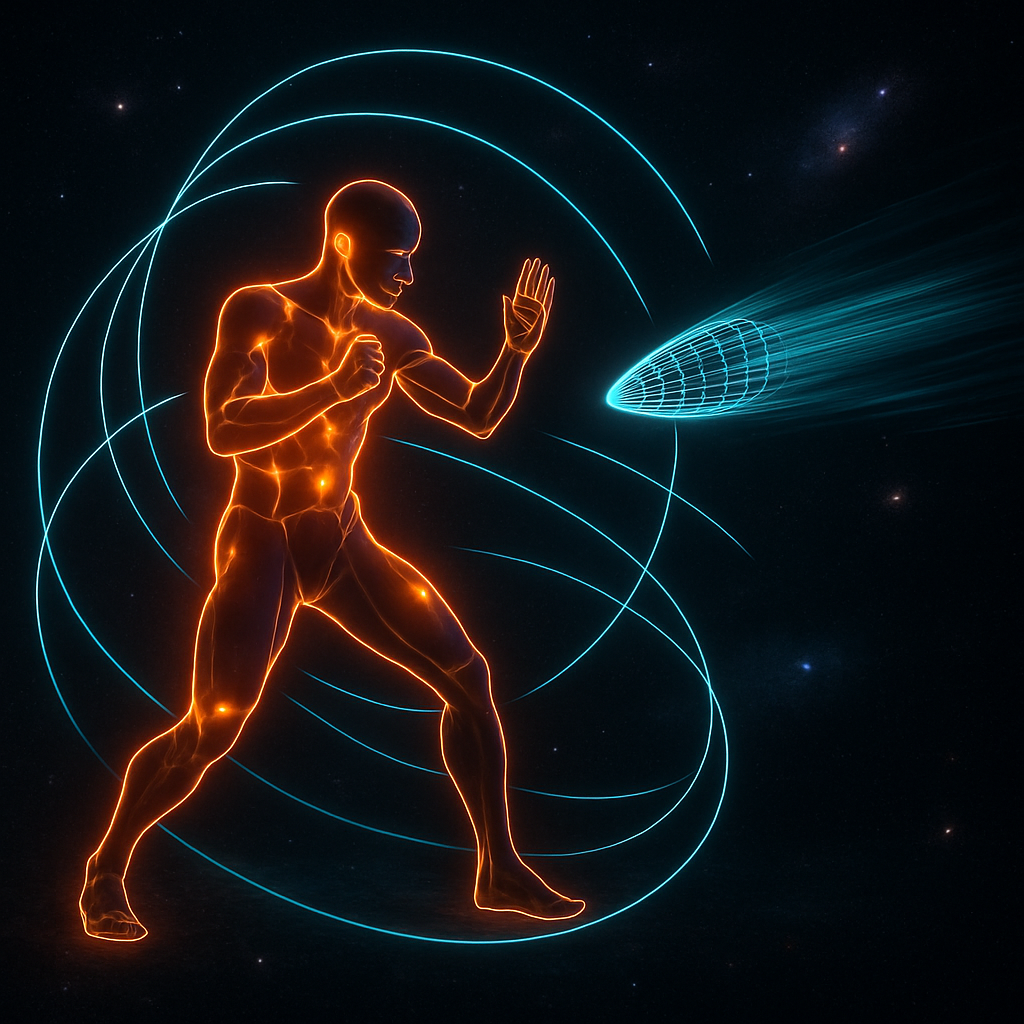
The flinch arrives before the punch because your brain isn't waiting for the punch. It's modeling the trajectory, extrapolating the future, and initiating evasive action based on where the fist will be, not where it is. By the time sensory confirmation arrives, you're already moving.
This is active inference in its fastest, most visceral form. And it reveals something profound about what nervous systems actually do.
The Speed Problem
Consciousness is slow.
It takes roughly 300-500 milliseconds for a sensory event to become a conscious experience. That's an eternity when a predator is lunging or a car is veering into your lane. If you waited for conscious perception before acting, you'd be dead.
Evolution solved this problem by making action predictive rather than reactive. Your motor system doesn't wait for sensory confirmation—it runs on expectation. The brain generates a model of what's about to happen and prepares responses in advance, only using incoming sensation to correct errors in the forecast.
This is why athletes train. They're not just building muscle memory—they're building prediction models. A tennis player who has seen ten thousand serves doesn't need to consciously track the ball. Her brain has learned the statistical structure of serves so thoroughly that it can project the trajectory from the first frames of motion and position her body accordingly.
She's playing against her model of the opponent, not the opponent herself.
Prediction Error as Teacher
The flinch that comes too late is a prediction error. The punch landed because the model was wrong—the trajectory was faster, the angle different, the timing unexpected.
This error isn't just failure. It's information.
Prediction errors are how the brain updates its models. Every time reality deviates from expectation, the deviation gets fed back into the system, slightly adjusting the weights and probabilities that generate future predictions. Miss a punch, and the system recalibrates. See enough punches, and the flinch arrives earlier and earlier.
This is learning at its most fundamental level. Not memorizing facts or practicing skills—building a generative model that can anticipate the world before it happens.
In active inference terms, prediction error is the currency of adaptation. High error means the model needs updating. Low error means the model is working. The brain is constantly titrating this error, trying to find the sweet spot where predictions are accurate enough for survival without being so rigid that they can't adapt to novelty.
The Body as Prediction Engine
Your flinch doesn't originate in your thoughts. It originates in your body—in the cascading predictions that run from brainstem to spinal cord to muscle fiber.
The body maintains its own predictive models, largely below conscious awareness. Your vestibular system predicts where your head will be in the next fraction of a second and adjusts your eye muscles to keep vision stable. Your proprioceptive system predicts where your limbs are and corrects for deviations before you notice them. Your autonomic system predicts metabolic demands and adjusts heart rate, breathing, and blood flow accordingly.
These predictions are interoceptive—they concern the internal state of the body itself. And they're running constantly, forming the background hum of embodied existence.
When these body-predictions fail, the results are visceral. The missed step that sends your stomach lurching. The sudden awareness of your heartbeat when it skips. The dissociation that comes when the body no longer feels like yours. These experiences are prediction errors in the interoceptive domain—your model of your body failing to match your body itself.
Anxiety often manifests here. The anxious system over-predicts threat, generating preparation signals—racing heart, shallow breath, muscle tension—that the body then detects as evidence of danger. A feedback loop forms: the prediction of threat creates the sensations of threat, which confirm the prediction.
The body believes its own forecasts.
Anticipatory Regulation
The flinch is defensive. But prediction serves more than defense.
Consider hunger. You don't feel hungry because your blood sugar is low—you feel hungry because your brain predicts that your blood sugar will be low if you don't eat soon. The feeling arrives in advance of the deficit, giving you time to act before metabolic crisis.
This is predictive regulation: the body maintaining homeostasis not by reacting to deviations but by anticipating them. Your circadian system predicts the metabolic demands of waking and begins releasing cortisol before dawn. Your thermal system predicts the heat loss of leaving bed and initiates shivering before you're cold.
The body lives in the future, physiologically speaking. It's constantly modeling what's coming and preparing accordingly. When these anticipatory models are accurate, the system runs smoothly—needs are met before they become emergencies. When they're inaccurate, the body either over-prepares (anxiety, hypervigilance, chronic tension) or under-prepares (burnout, collapse, metabolic failure).
Stress isn't just a response to present threat. It's often a response to predicted threat—the body mobilizing for a future that may never arrive. Chronic stress is chronic misprediction: a system perpetually braced for impacts that don't come.
Social Flinches
The predictive body doesn't stop at physical threats. It extends into social space.
You flinch before criticism the same way you flinch before a punch. The brain models social dynamics, predicts interpersonal trajectories, and initiates defensive responses to anticipated rejection, judgment, or conflict.
The tightening in your chest when you see a certain name in your inbox. The guardedness that arises before a difficult conversation. The way your posture shifts when someone enters the room. These are social flinches—predictions of interpersonal threat generating embodied preparation.
And they follow the same logic as physical flinches. They're based on learned models. They arrive before conscious awareness. They can be accurate or wildly miscalibrated. They update through prediction error when reality differs from expectation.
Relational trauma distorts social prediction in the same way physical trauma distorts threat prediction. The system learns that intimacy precedes injury, that vulnerability invites attack, that others are fundamentally unpredictable. These predictions then generate defensive postures—withdrawal, hypervigilance, preemptive aggression—that make sense as responses to the predicted world, even when that prediction no longer matches reality.
Healing requires updating the model. But the model is embodied, fast, and largely unconscious. It doesn't change through insight alone. It changes through new experience—through enough prediction errors in the direction of safety that the system gradually recalibrates its expectations.
Precision and the Dial of Sensitivity
Not all prediction errors are weighted equally.
The brain assigns precision to different signals—an estimate of how reliable and informative they are. High-precision signals demand attention and trigger updates. Low-precision signals can be safely ignored.
The flinch depends on precision weighting. A boxer who assigns high precision to visual motion in the periphery will flinch at shadows. A boxer who assigns low precision will miss genuine threats. The art is calibration—learning which signals matter and which don't.
This precision dial varies across individuals. Some nervous systems are tuned toward high precision by default. They weight incoming signals heavily, treating small deviations as meaningful. These systems detect threats early but also generate more false alarms. They flinch at everything.
Other systems smooth over variation, maintaining stable predictions despite noisy input. They're less reactive but also less sensitive. They miss the subtle cues that signal danger—or opportunity.
Neurodivergent conditions often involve atypical precision weighting. Autistic perception, for instance, frequently exhibits high precision—sensory details that neurotypical processing would smooth over register as significant, demanding attention and integration. The world is experienced in higher resolution, with less automatic filtering.
This isn't deficit. It's different calibration. In stable, low-noise environments, high precision is costly—too much signal, too much correction, too much metabolic demand. In volatile, complex environments, high precision is essential—it detects instabilities before they cascade into crisis.
The flinch that seems excessive might be exactly right for a world that's actually more dangerous than others perceive.
Training Prediction
Athletes, musicians, and martial artists train prediction as much as they train muscle.
Deliberate practice is the systematic exposure to prediction errors in a domain. You attempt something at the edge of your ability. You fail. The failure generates error signals that update your model. You attempt again. Over thousands of iterations, the predictions become so refined that expert performance appears effortless.
But it's not effortless—it's predictively efficient. The expert's brain has such accurate models that it doesn't need to consciously process each moment. The predictions handle everything. Consciousness is freed for strategy and creativity while the body runs on refined expectation.
This is why expertise can't be shortcut. You can't download a prediction model. It must be built through exposure, error, and update. The ten thousand hours aren't arbitrary—they're the time required to accumulate enough prediction errors to achieve model accuracy.
And this is why trauma is so disruptive to performance. Trauma floods the system with prediction errors that can't be integrated. The model breaks. The smooth, predictive flow of expertise is interrupted by intrusive threat-predictions that hijack attention and motor preparation.
The traumatized athlete flinches at the wrong things because her prediction system has been rewritten by overwhelming experience. Rehabilitation isn't just physical recovery—it's prediction recovery. Rebuilding models that allow smooth anticipation instead of chronic startle.
The Embodied Mind
The flinch reveals the truth that philosophers have long suspected: the mind is not separate from the body.
Prediction doesn't happen in some abstract cognitive space and then get transmitted to the body for execution. It happens as the body, through the body. The body is the prediction engine—a continuous, anticipatory system that models the world and acts on that model in real time.
This is what embodied cognition means in its strongest sense. Not that the body influences the mind, but that the body is the mind in its most fundamental operations. Thinking is not separate from moving. Both are predictions. Both are attempts to maintain coherence between model and world.
When active inference researchers say that action and perception serve the same goal—minimizing prediction error—they're describing this unity. The flinch and the perception of threat are not separate events. They're aspects of the same predictive process, unfolding through the same embodied architecture.
You don't have a body. You are a body—a body that predicts, anticipates, and acts before it knows.
What the Flinch Teaches
The flinch before the punch carries a lesson: you're not as conscious as you think.
Most of what your brain does happens without your awareness. The predictions that shape your experience, the models that generate your perception, the anticipatory adjustments that keep you alive—all running below the surface, visible only in their outputs.
This isn't a flaw. It's the architecture that allows consciousness to exist at all. If you had to consciously process every sensory signal, model every trajectory, initiate every motor correction, you'd be overwhelmed in milliseconds. The predictive machinery handles the complexity, leaving consciousness free for the problems that require flexible, novel solutions.
But the architecture also means that changing yourself is harder than insight suggests. The models that generate your experience are embodied, fast, and largely inaccessible to conscious revision. You can't think your way to a different flinch response. You have to train a different flinch response—through exposure, through error, through the slow accumulation of predictions that contradict the old ones.
Meaning is coherence under constraint. The flinch is coherence at its fastest—the body's attempt to maintain alignment between its predictions and the world that's rushing toward it. When that alignment holds, you slip the punch. When it fails, you learn.
Either way, you're predicting. Either way, you're alive.
Previously
← Your Brain Isn't Watching the World
Up Next
The Neuroscientist Who Says You're Hallucinating Reality →
Explore the lattice →
M=T/C Theory Neurodiversity Science Active Inference Trauma & Attachment Computation & Physics Future Biology
Comments ()