Why Your Gut Knows Things Before Your Mind Does
The enteric nervous system contains 500 million neurons that generate predictions before conscious reasoning. Learn how gut-brain communication shapes intuition through embodied pattern-matching.
Why Your Gut Knows Things Before Your Mind Does
Formative Note
This essay represents early thinking by Ryan Collison that contributed to the development of A Theory of Meaning (AToM). The canonical statement of AToM is defined here.
You're about to make a decision, and something in your stomach says no.
Not your head—your gut. A physical sensation, sub-verbal, prior to reasoning. You can't explain it. You can't justify it. But it's there: a tightening, a sinking, an unmistakable signal from somewhere below.
We call these gut feelings. Intuition. Instinct. The wisdom of the body.
Science used to dismiss them. Feelings aren't data, the thinking went. The rational mind weighs evidence; the gut just feels. Real decisions should be made above the neck.
This was wrong. The gut isn't just a digestive organ—it's a predictive organ, running its own models, generating its own expectations, sending its own error signals. And it often knows things before the conscious mind catches up.
The Second Brain
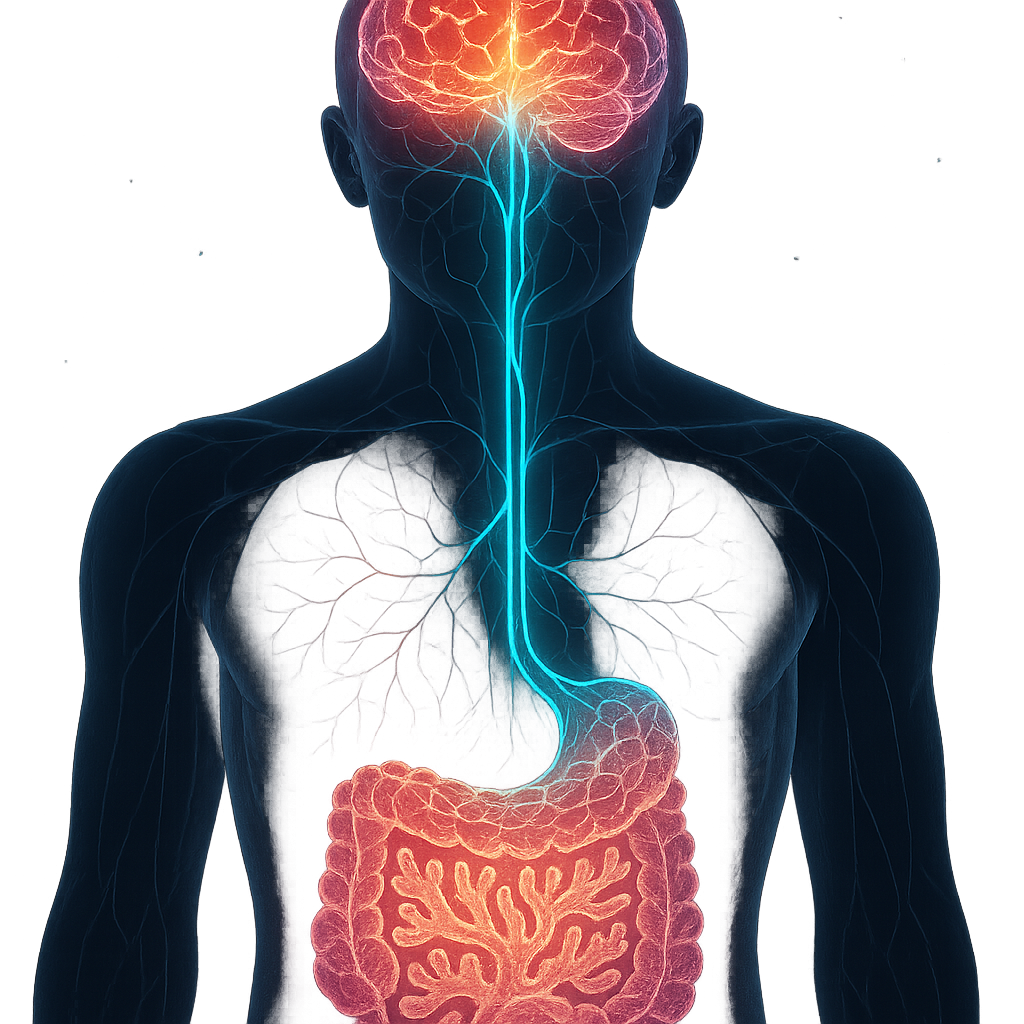
Your gut contains roughly 500 million neurons—more than your spinal cord, enough to constitute what scientists call the enteric nervous system. This "second brain" can operate independently of the one in your head. It manages digestion, monitors the microbiome, and communicates constantly with the central nervous system.
The primary channel of communication is the vagus nerve—a wandering superhighway that connects brainstem to gut, heart, lungs, and other organs. Signals travel both directions, but here's the key fact: about 80% of the traffic is afferent. It flows upward—from body to brain, not brain to body.
Your brain is listening to your gut far more than it's talking to it.
This traffic includes information about nutrient status, inflammatory state, microbial activity, and visceral sensation. But it also includes information that feels, to the conscious mind, like emotion, intuition, and knowing. The gut is sending predictions, and the brain is integrating them.
Interoception: The Body Modeling Itself
The brain doesn't just model the external world. It models the internal world—the state of the body itself.
This is interoception: the perception of internal signals. Heartbeat, breath, temperature, muscle tension, visceral sensations, metabolic state. These signals are continuously predicted and monitored, just like external sensations.
Your brain maintains a model of what your body should feel like. When actual signals match predicted signals, all is calm—the body feels coherent, stable, yours. When actual signals deviate from predicted signals, interoceptive prediction error arises. The body feels wrong somehow. Off. Alarming.
Emotions are largely interoceptive phenomena. Fear is partly the prediction of elevated heart rate, shallow breath, muscle tension. Sadness is partly the prediction of low energy, heaviness, inward collapse. Joy is partly the prediction of expansion, lightness, activation.
The feeling comes from the body-model, not from some abstract emotional module. You feel what you predict you'll feel—and you update those predictions based on what the body actually reports.
Gut Feelings as Prediction Error
Now the gut feeling makes sense.
Something in your environment—a person, a situation, a choice—activates predictions in your interoceptive model. These predictions might be below conscious awareness. They might be learned from experiences you've forgotten. But they generate expectations about what the visceral state should be.
When those predictions signal danger—when the model expects threat, difficulty, or negative outcome—the body prepares accordingly. Stomach tightens. Digestion slows. Blood flow shifts. Stress hormones release.
You feel this as "something wrong." The gut knows before the mind because the gut predictions are faster, more primitive, less dependent on conscious elaboration. The body has already run its simulation and reached a verdict while the conscious mind is still gathering data.
This is predictive processing in the interoceptive domain. The gut isn't magical—it's running the same prediction-error machinery as the rest of the nervous system. It's just running it on different data, at a different speed, below the threshold of verbal awareness.
When the Gut Is Right
Sometimes the gut is uncannily accurate.
A study by Barnaby Dunn and colleagues found that people with greater interoceptive accuracy—those who could more precisely detect their own heartbeat—made better decisions in gambling tasks. Their bodies detected patterns before their conscious minds did, and they were able to use that information.
Another study found that financial traders with higher interoceptive sensitivity were more profitable. They could read their own stress signals as market signals, using embodied information that less body-aware traders missed.
This makes sense from an active inference perspective. The body is accumulating vast amounts of data about past experiences. It has learned associations between situations and outcomes. It generates predictions based on this learning. When the current situation resembles a past pattern—even in ways too subtle for conscious detection—the body responds.
The gut is accessing pattern-matching that the conscious mind can't. Not because it's mystical, but because it's drawing on a different kind of memory—procedural, embodied, visceral. The wisdom of the body is the wisdom of all the situations this body has navigated.
When the Gut Is Wrong
But the gut can also be spectacularly wrong.
Anxiety disorders are partly interoceptive prediction disorders. The gut predicts threat where none exists. The body mobilizes for danger that isn't there. The feelings are real—the predictions are generating genuine visceral states—but the predictions are miscalibrated.
Trauma distorts the gut's predictions. Overwhelming experiences teach the interoceptive model that the world is dangerous, that the body is vulnerable, that bad things are imminent. The gut then predicts threat in situations that don't warrant it, generating false alarms that feel absolutely real.
Prejudice operates partly through the gut. Learned associations—often absorbed unconsciously from culture—generate predictions about certain kinds of people. Meeting someone from a stigmatized group can trigger interoceptive alarm that feels like valid intuition but is actually bias encoded in body.
The gut's wisdom is only as good as its training data. If the training was biased, the predictions will be biased. If the training involved trauma, the predictions will be hypervigilant. The gut doesn't know truth—it knows pattern-matching based on past experience.
Interoception and the Self
How well you perceive your internal states shapes your sense of self.
High interoceptive accuracy correlates with stronger self-awareness, better emotional regulation, and clearer decision-making. You know what you're feeling. You can distinguish between different emotional states. You have a stable sense of who you are because you have a stable sense of how your body is.
Low interoceptive accuracy correlates with poorer emotional awareness, more difficulty regulating states, and less clear sense of self. You're not sure what you're feeling. Emotions blur together. You might not notice distress until it's overwhelming.
Some conditions involve profound interoceptive disruption. Alexithymia—difficulty identifying emotions—may partly reflect poor interoceptive prediction. Depersonalization—the sense that you're not real, that your body isn't yours—may involve interoceptive prediction error so severe that the body stops feeling like self.
Dissociation creates gaps in interoception. Parts of the body-model go offline. Sensations are predicted but not felt, or felt but not integrated. The gut might be sending signals that never reach awareness.
This is trauma fragmenting the body-map. The interoceptive blanket is torn. Signals from some regions are screened out. You survive by not knowing what your body knows.
The Microbiome Contribution
Here's where it gets stranger.
Your gut contains trillions of microorganisms—bacteria, viruses, fungi—that are not genetically you. This microbiome influences your mood, cognition, and behavior through multiple pathways. The bacteria produce neurotransmitters. They modulate immune signals. They affect the vagal messages that flow upward to the brain.
Studies in animals have shown that altering the gut microbiome can change anxiety levels, stress responses, and social behavior. Some human studies suggest similar effects. The composition of your gut bacteria may partly determine your emotional dispositions.
This is wild. It means your gut feelings are partly the feelings of organisms that aren't you. The predictions that arise from your viscera are influenced by a community of microbes with their own metabolic agendas.
The self is not as bounded as it seems. Your interoceptive predictions are shaped by trillions of beings that inhabit you. The wisdom of the gut is partly the wisdom of an ecosystem.
Training the Gut
If the gut runs predictions, those predictions can be updated.
Mindfulness practices train interoceptive attention. You learn to notice subtle body signals you'd normally ignore. You develop granularity—the capacity to distinguish between different flavors of visceral sensation. The body-model becomes more refined.
Somatic therapies work directly with interoceptive prediction. By bringing attention to body states, allowing sensations to be fully felt, the predictions have a chance to update. The frozen expectations from old experiences can finally encounter new data.
Movement practices—yoga, dance, martial arts—extend the body's prediction repertoire. You learn new ways of being in your body. The interoceptive model expands. What the gut "knows" diversifies.
Even breathing changes interoception. Slow, deep breathing activates the parasympathetic branch of the vagus nerve, shifting the predictions toward safety. The body learns that calm is achievable. The gut updates its forecast.
Beyond Rationalism
The old hierarchy placed reason above feeling, mind above body, thinking above intuition.
Active inference dissolves this hierarchy. Thinking is embodied. Reason is grounded in prediction. The gut isn't below the mind—it's a different branch of the same predictive tree, processing different data, generating different forecasts.
The best decisions probably integrate both. Use conscious reasoning to check the gut's biases. Use gut signals to detect patterns that conscious reasoning misses. Don't privilege either. Let them talk to each other.
This is what good therapists do. They track their own interoceptive signals in session—the gut responses that indicate what's happening below the surface. They use their bodies as instruments, gathering data that words don't capture.
This is what good leaders do. They listen to the room, sensing the visceral temperature that precedes the verbal expression. They trust their gut while checking it against evidence.
This is what anyone navigating complexity does: honor the body's predictions while remaining humble about their accuracy.
The Wisdom Below
Your gut knows things before your mind does.
Not always accurately. Not through magic. But through prediction machinery that's been running since before you could speak, accumulating patterns from every situation you've navigated, generating forecasts that arrive as visceral sensation.
This is the wisdom of the body. Not separate from cognition—a different mode of cognition. Faster, dumber, deeper, older. Wrong sometimes. Right sometimes. Always worth listening to.
The conversation between head and gut is the conversation between two kinds of knowing. Both are you. Both are prediction. Both are trying to navigate a world that won't stop surprising you.
Listen to your gut. But don't stop there.
Verify it. Update it. Let the mind and body teach each other.
That's how the predictions get better. That's how you get wiser.
Explore the lattice →
M=T/C Theory Neurodiversity Science Active Inference Trauma & Attachment Computation & Physics Future Biology
Comments ()