You Don't Just Think Your Way Through Life—You Act Your Way to Understanding
Action generates understanding rather than following it. Through active inference, movement disambiguates uncertainty and creates cognition—learn how this transforms therapy, learning, and change.
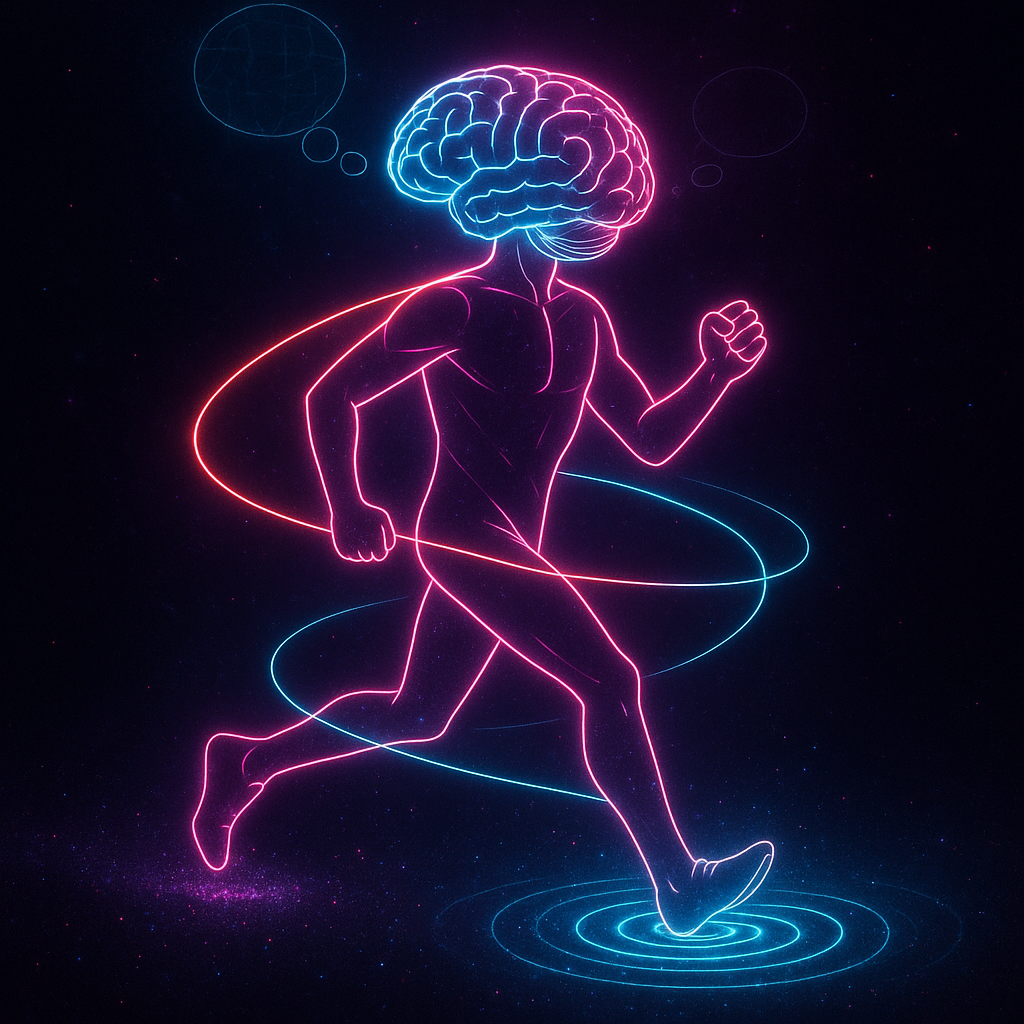
You Don't Just Think Your Way Through Life—You Act Your Way to Understanding
Formative Note
This essay represents early thinking by Ryan Collison that contributed to the development of A Theory of Meaning (AToM). The canonical statement of AToM is defined here.
There's a story we tell about understanding.
First, you perceive the world. Then, you think about what you perceived. Then, you decide what to do. Then, you act. Perception → cognition → decision → action. A clean pipeline from input to output, with thinking as the crucial middle step.
This story is wrong.
The revolution in cognitive science over the past two decades has revealed something stranger: action isn't the output of understanding. Action is understanding. You don't figure out the world and then act on your conclusions. You act your way into knowledge, using your body to probe reality and discover its structure.
This is active inference in its deepest sense. The brain doesn't just passively infer the state of the world from sensory data. It actively infers—using action to generate the data it needs.
The Problem with Passive Perception
Consider how you perceive a coffee cup.
Light reflects off the cup and enters your eyes, forming a two-dimensional image on your retina. From this flat pattern, your brain must somehow reconstruct the three-dimensional object: its shape, size, distance, material properties, whether it contains liquid, whether it's hot.
This is an inverse problem—and inverse problems are notoriously hard. Given the sensory data, infinitely many world-states could have produced it. A large cup far away produces the same retinal image as a small cup close up. A white cup in dim light looks like a gray cup in bright light. The data radically underdetermines the world.
How does the brain solve this?
Not by passive computation—by active exploration. You move your head. You shift your gaze. You reach toward the cup. Each action produces new sensory data that constrains the possibilities. Movement disambiguates. Action resolves uncertainty.
This is why perception is constantly accompanied by micro-movements—saccades of the eyes, tilts of the head, adjustments of posture. The brain isn't just receiving data. It's generating data by acting on the world and observing the consequences.
Perception as Hypothesis Testing
From the active inference perspective, perception is continuous hypothesis testing.
The brain generates a model of what's out there. This model makes predictions: if the world is like this, and I act like that, then I should sense this. The brain then executes the action and compares the predicted sensation to the actual sensation.
If prediction matches: hypothesis confirmed. The model is probably right.
If prediction fails: hypothesis disconfirmed. The model needs updating.
Action is what turns passive speculation into active testing. Without action, you can only wait for the world to send you data. With action, you can interrogate the world—force it to reveal information that would otherwise remain hidden.
This explains why paralysis is so cognitively costly. It's not just that you can't move—it's that you can't test your models. The world becomes increasingly uncertain because you can't probe it. The prediction machine loses its best tool.
Learning Through Doing
Children don't learn by absorbing information. They learn by doing.
Watch a toddler with a new toy. She's not contemplating it from a distance. She's grabbing it, mouthing it, banging it against things, dropping it, picking it up, throwing it. Each action is a hypothesis test: What happens if I do this? Does the world respond as my model predicts?
This is how object permanence is learned—through the action of hiding and seeking. This is how causation is learned—through the action of pushing and observing. This is how physics is learned—through the action of stacking, dropping, rolling.
The classroom model of learning—sitting still and absorbing information—is developmentally anomalous. It works (when it works) only because it's been scaffolded by years of active, embodied learning that built the models the classroom data can update.
And it often fails precisely because it's too passive. Students who never actively engage with material never test their models against reality. They may have the words without the understanding. They can repeat the propositions without knowing what they mean.
Active learning—labs, practice problems, discussion, application—works better because it's closer to how the prediction machine actually learns. It generates prediction errors that force model updating. It makes knowledge embodied.
Action Precedes Understanding
Here's the counterintuitive claim: often, you act before you understand. And the action is what produces the understanding.
A skilled craftsperson often can't articulate what they know. Ask them to explain their technique, and they'll struggle. But watch them work, and expert knowledge flows through their hands. The knowledge is in the doing, not in the describing.
A therapist may intervene before they've fully formulated what's happening. Their body shifts, their voice modulates, their attention focuses—and only afterward do they understand why. The action was the insight.
An athlete making a split-second play doesn't first calculate the physics, then decide, then execute. The action happens in one integrated flow. Comprehension arrives later, as replay and analysis, but the intelligent act preceded the understanding.
This reverses the traditional hierarchy. Action isn't the servant of thought. Action is where thought lives most of the time—distributed across the body, embedded in the environment, enacted rather than contemplated.
The Extended Mind
If action is cognition, then the boundaries of the mind become fuzzy.
Consider a mathematician working at a blackboard. She writes an equation, stares at it, modifies a term, writes another equation below, crosses something out, adds a variable. Is the thinking happening in her head or on the board?
Both, obviously. The board is part of her cognitive system. It holds information she can't hold in working memory. It allows her to manipulate symbols in ways that would be impossible purely mentally. The thinking is distributed across brain and chalk and slate.
This is the extended mind thesis: cognition doesn't stop at the skull. When tools and environments are reliably coupled to cognitive processes, they become part of the mind.
A smartphone with your calendar, contacts, and notes isn't just a device you use. It's an extension of your memory and planning systems. Lose it, and you've lost part of your cognitive architecture—not just access to it, but parts of yourself.
Active inference explains why this works. The brain models the world across its Markov blanket—the boundary between inside and outside. But if an external tool is reliably coupled to your actions and perceptions, the brain can incorporate it into its model. The tool becomes part of the prediction machinery.
This is profound. It means the mind is not a thing in your head. It's a process that spans brain, body, and world—an active, extended, embodied process of predicting and acting.
Thinking as Internalized Action
Even "pure" thinking may be internalized action.
When you imagine walking through your house, motor areas of your brain activate—the same areas that would be active if you actually walked. When you mentally rotate an object, you take time proportional to the physical rotation angle—as if you were actually turning it in your hands. When you think about the future, you run action sequences mentally, testing their consequences in imagination.
Cognition may have evolved as a way of simulating action—testing hypotheses mentally before committing them to the world. What we call thinking is the internalization of doing. The prediction machine learned to run its action-tests offline, saving the metabolic and safety costs of acting for real.
This is why thinking and doing are so entangled. This is why mental practice improves physical performance. This is why movement helps cognition. They're not separate systems—they're the same system operating in different modes.
Trauma and Frozen Action
Trauma often involves action that couldn't complete.
The urge to flee that was blocked. The fight that was impossible. The scream that was swallowed. The body was prepared to act, flooded with mobilization energy, and then the action was prevented. The energy didn't discharge. The prediction didn't get tested. The model didn't update.
This is why traumatic memories are often encoded as body states rather than narratives. The action-ready postures are frozen in tissue. The predictions are stuck in the "prepare" phase, never reaching the "execute and observe" phase that would allow completion and learning.
Somatic trauma therapy works by completing these frozen actions. The body is invited to do what it couldn't do then—to run the sequence, to let the mobilization discharge, to finally test the prediction and close the loop.
This looks strange from the passive-perception view. Why would moving your body now help with something that happened years ago? But from the active inference view, it makes perfect sense. The body is the prediction machine. Frozen action is frozen cognition. Completing the action completes the cognitive process.
Relationship as Joint Action
If action is understanding, then relationship is joint action—the coordination of two prediction machines acting together.
This explains why passive relating feels empty. You can sit in a room with someone, sharing space without interaction, and feel nothing in particular. But do something together—cook, walk, build, play—and connection emerges. The shared action creates shared prediction. Your models couple.
Attunement is the synchronization of action. The mother and infant mirroring each other's gestures. The couple walking in step. The team that moves together without explicit coordination. These aren't metaphors for connection—they are connection. The joint action is the binding.
And repair after rupture requires action, not just words. Apology as speech act is a start, but it's action that rebuilds trust. Showing up. Following through. Acting differently. The model updates through the prediction-action loop, not through narration alone.
Implications for Change
If you want to change your mind, change your actions.
This is the insight behind exposure therapy, behavioral activation, somatic practices, role-playing, and every other intervention that emphasizes doing over understanding.
It's not that understanding is useless. It's that understanding is insufficient. The models that generate your experience are embodied, action-based, largely unconscious. They update through doing. Insight alone doesn't touch them.
Want to reduce anxiety? Don't just think about the feared situation—approach it. Each approach generates prediction error that updates the model. Each action is an experiment that tests your assumptions.
Want to build a skill? Don't just study—practice. Each practice session tests your model against reality. Each failure is information. Each repetition refines the prediction.
Want to heal a relationship? Don't just talk—act. Show up differently. Do what you said you'd do. Let your actions generate the prediction errors that update the other person's model of you.
You don't just think your way through life. You act your way to understanding.
The body leads. The mind follows.
Previously
← Surprise Isn't Just a Feeling
Up Next
The Invisible Membrane Between You and Everything Else →
Explore the lattice →
M=T/C Theory Neurodiversity Science Active Inference Trauma & Attachment Computation & Physics Future Biology
Follow on X Subscribe for new writing
Comments ()