Your Brain Isn't Watching the World—It's Guessing What Happens Next
Your brain generates predictions about reality and checks them against sensory input. Perception is controlled hallucination—explore how this framework explains anxiety, trauma, and meaning-making.
Your Brain Isn't Watching the World—It's Guessing What Happens Next
Formative Note
This essay represents early thinking by Ryan Collison that contributed to the development of A Theory of Meaning (AToM). The canonical statement of AToM is defined here.
You've been lied to about perception.
The conventional story goes like this: light enters your eyes, sound enters your ears, and your brain assembles these signals into a picture of reality. You're a camera. A recorder. A passive receiver of the world's information.
This story is backwards.
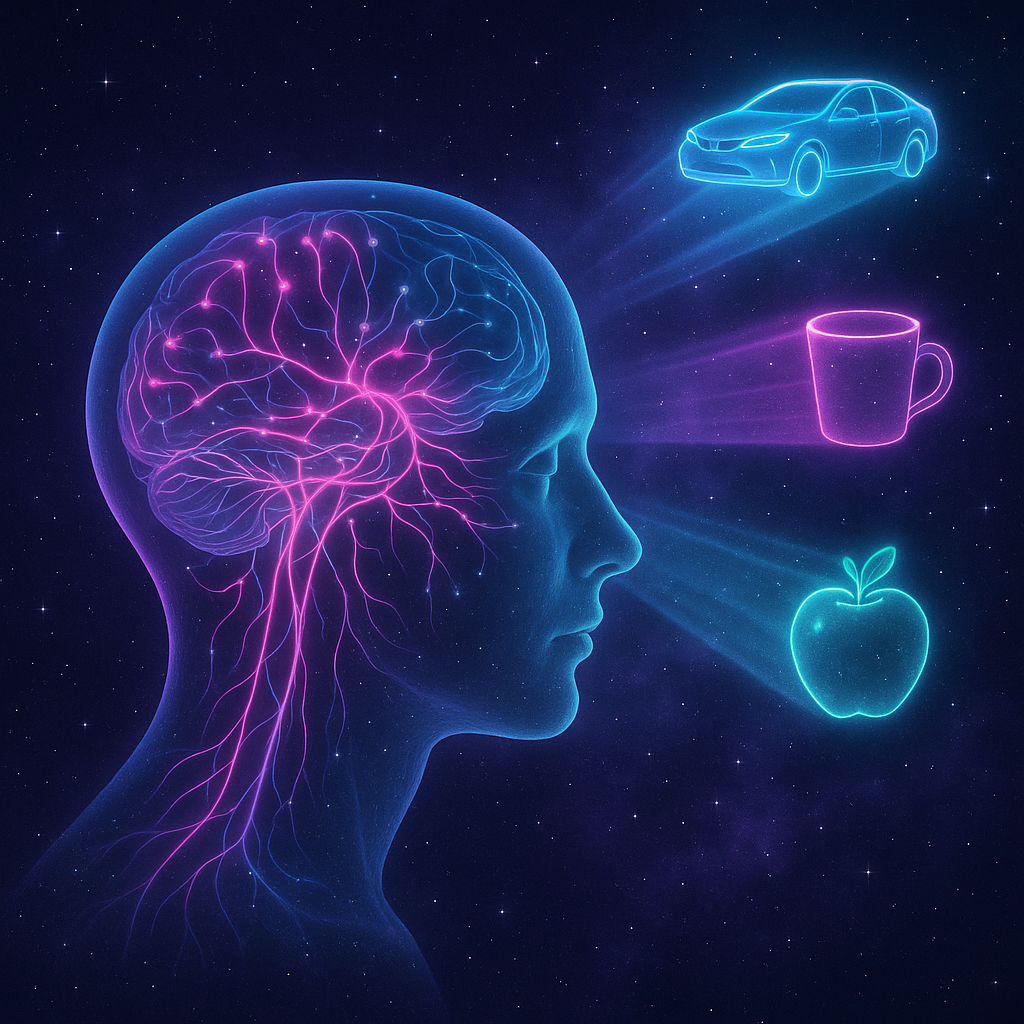
Your brain is not watching the world. It's predicting the world—constantly generating a model of what it expects to encounter, then checking that model against the thin trickle of sensory data that actually makes it through your skull. What you experience as seeing, hearing, and feeling is mostly prediction. Sensation is just the error signal.
This isn't metaphor. It's the dominant paradigm in contemporary neuroscience, and it changes everything we thought we knew about minds, meaning, and what it takes to stay coherent in a world that won't stop surprising us.
The Prediction Machine
Every moment you're awake, your brain is running a simulation.
It predicts the pressure of the chair beneath you before your nerves report it. It predicts the next word in this sentence before your eyes reach it. It predicts your heartbeat, your breath, the ambient hum of the room—thousands of micro-forecasts per second, most of which you'll never notice because they're right.
You only notice when they're wrong.
That startle when someone appears in a doorway you thought was empty. The disorientation when a step is higher than you expected. The uncanny feeling when a friend's voice sounds slightly off. These moments of surprise are your brain's predictions colliding with reality—and reality winning.
Neuroscientists call this architecture predictive processing. Your brain isn't building perception from the bottom up, stacking raw sensations into meaningful wholes. It's working top-down, generating expectations and comparing them against incoming signals. What reaches consciousness is not the world itself but the difference between what you expected and what arrived.
Perception is controlled hallucination. You're dreaming the world into existence and using your senses to keep the dream honest.
Why Prediction?
Evolution didn't build cameras. It built survivors.
A camera records what's in front of it. But recording isn't enough when a predator might be behind the next bush. Survival requires anticipation—knowing what's coming before it arrives, preparing responses before they're needed, staying one step ahead of a world that's trying to kill you.
Prediction solves this problem. A brain that can accurately model its environment doesn't need to wait for threats to materialize. It can act preemptively, allocating resources to futures that haven't happened yet.
But prediction is expensive. The brain consumes roughly 20% of your metabolic energy despite being only 2% of your body mass. Most of that energy goes to maintaining and updating your internal model—the generative architecture that lets you hallucinate reality fast enough to survive it.
This creates a fundamental pressure: minimize surprise.
Not emotional surprise—computational surprise. The brain tracks how much its predictions deviate from sensory input, and it works constantly to reduce that deviation. When predictions match reality, the system runs efficiently. When they don't, metabolic costs spike, attention narrows, and the whole organism shifts into correction mode.
You experience this as stress, confusion, disorientation. Your nervous system experiences it as prediction error that must be resolved.
Two Ways to Reduce Surprise
Here's where it gets interesting.
Your brain has two strategies for minimizing prediction error, and the balance between them shapes everything from your moment-to-moment experience to your long-term mental health.
Strategy one: update the model. When reality defies expectation, revise your expectations. Learn. Adapt. Incorporate new information into your generative model so future predictions are more accurate.
This is perception, learning, belief revision. The world surprised you, so you change your mind.
Strategy two: change the world. Instead of updating your model to match reality, act on reality to make it match your model. Move toward expected outcomes. Avoid unexpected ones. Shape your environment to confirm your predictions.
This is action, behavior, agency. The world surprised you, so you change the world.
This insight—that perception and action are both in service of the same goal—is the foundation of active inference, a framework developed over the past two decades by the neuroscientist Karl Friston and his collaborators. In active inference, thinking and doing aren't separate processes. They're two solutions to the same problem: keeping your model of the world aligned with the world itself.
You don't just passively predict. You actively infer your way through reality, using both belief and behavior to maintain coherence.
The Free Energy Principle
Friston formalized this intuition in something called the free energy principle—a mathematical framework that sounds intimidating but expresses a simple idea.
Any system that persists over time must minimize the difference between what it expects and what it encounters.
That's it. That's the principle.
The term "free energy" is borrowed from physics and information theory. It's a measure of the mismatch between your internal model and the sensory data you're receiving. High free energy means your predictions are failing badly. Low free energy means your model fits the world well.
Living systems—from bacteria to brains—are systems that have found ways to keep free energy low. They maintain stable internal states despite constant environmental perturbation. They persist as recognizable patterns in a universe trending toward dissolution.
This isn't mystical. It's thermodynamic. Any system that didn't minimize prediction error wouldn't remain organized long enough to be called a system. It would dissolve into the noise.
You exist because your ancestors were good at this.
Beyond the Individual Brain
Here's where the framework scales.
Active inference doesn't apply only to neurons. It applies to any self-organizing system that maintains itself against entropy—which is to say, any system that's alive in the functional sense.
Your body runs on the same logic. Physiological regulation—maintaining temperature, blood sugar, heart rhythm—is prediction and correction. Your body expects certain internal states and acts to achieve them. When prediction fails (you're too cold, too hungry, too aroused), error signals cascade until action restores equilibrium.
Relationships work this way too. Two people attuned to each other are making predictions about each other's states and adjusting their behavior to stay synchronized. When those predictions fail—when your partner surprises you, when you can't read their mood—relational stress spikes. The couple faces prediction error that must be resolved through repair.
Organizations, cultures, civilizations—all are systems that must predict their environments and act to maintain coherence. When prediction fails at these scales, we call it crisis, polarization, collapse. The mathematics don't change.
What changes is the substrate. The same pattern appears in neurons, in bodies, in pairs, in populations. Coherence requires accurate prediction. Prediction failure generates stress. Stress must be resolved through learning or action.
This is the geometry of staying alive.
What This Means for You
If your brain is a prediction machine, then your experience is shaped not just by what happens but by what you expected to happen.
Two people can encounter the same event and experience radically different realities—because their models are different, so their prediction errors are different. The world doesn't surprise them the same way.
This reframes suffering. Chronic anxiety isn't just "too much fear." It's a prediction system tuned to expect threat everywhere, generating constant error when the world fails to be as dangerous as predicted—and interpreting that mismatch as confirmation of danger. The system is trapped in self-reinforcing prediction failure.
Trauma isn't just memory of bad events. It's a model that was overwhelmed, forced into high-error states it couldn't learn from. The predictions broke. The world became radically unpredictable. And the system reorganized around that unpredictability, staying vigilant for a catastrophe that already happened.
Healing, in this framework, is prediction repair. It's building a model that can again anticipate the world without constant alarm. Not forgetting what happened—integrating it. Finding ways to predict the future that include the past without being captured by it.
The Revolution Underway
Predictive processing and active inference are still making their way from neuroscience journals into broader awareness. But they represent a genuine paradigm shift—a new answer to the old question of what minds are for.
Minds are not mirrors reflecting reality. They are generators creating reality, moment by moment, from the inside out. Sensation corrects the dream; it doesn't create it.
This framework connects to ancient intuitions. Meditation traditions have long noticed that perception is constructed, that the solid world is somehow assembled, that there's space between stimulus and experience. Active inference gives these intuitions mathematical bones.
It also connects to emerging work on meaning itself. If coherence is what systems maintain against surprise, then meaning might be precisely that—the felt sense of predictions holding, of the model and the world aligning well enough to keep going.
Meaning is coherence under constraint. And coherence begins with prediction.
Previously

— First in series —


Up Next

[Why You Flinch Before the Punch Lands →](https://www.ideasthesia.org/why-you-flinch-before-the-punch-lands-the-science-of-prediction/)


Explore the lattice →


[M=T/C](https://www.ideasthesia.org/tag/m-t-c/)
[Theory](https://www.ideasthesia.org/tag/atom-theory/)
[Neurodiversity](https://www.ideasthesia.org/tag/neurodiversity/)
[Science](https://www.ideasthesia.org/tag/science/)
[Active Inference](https://www.ideasthesia.org/tag/active-inference/)
[Trauma & Attachment](https://www.ideasthesia.org/tag/trauma-attachment/)
[Computation & Physics](https://www.ideasthesia.org/tag/computation-physics/)
[Future Biology](https://www.ideasthesia.org/tag/future-biology/)


[Follow on X](https://x.com/yourhandle)
[Subscribe for new writing]({{@site.url}}/subscribe/)
Comments ()