Your Company Has a Nervous System - And It Might Be Dysregulated
Organizations are prediction machines that enter defensive states when forecasts fail. Learn how collective dysregulation mirrors individual trauma responses—and what leaders can do about it.
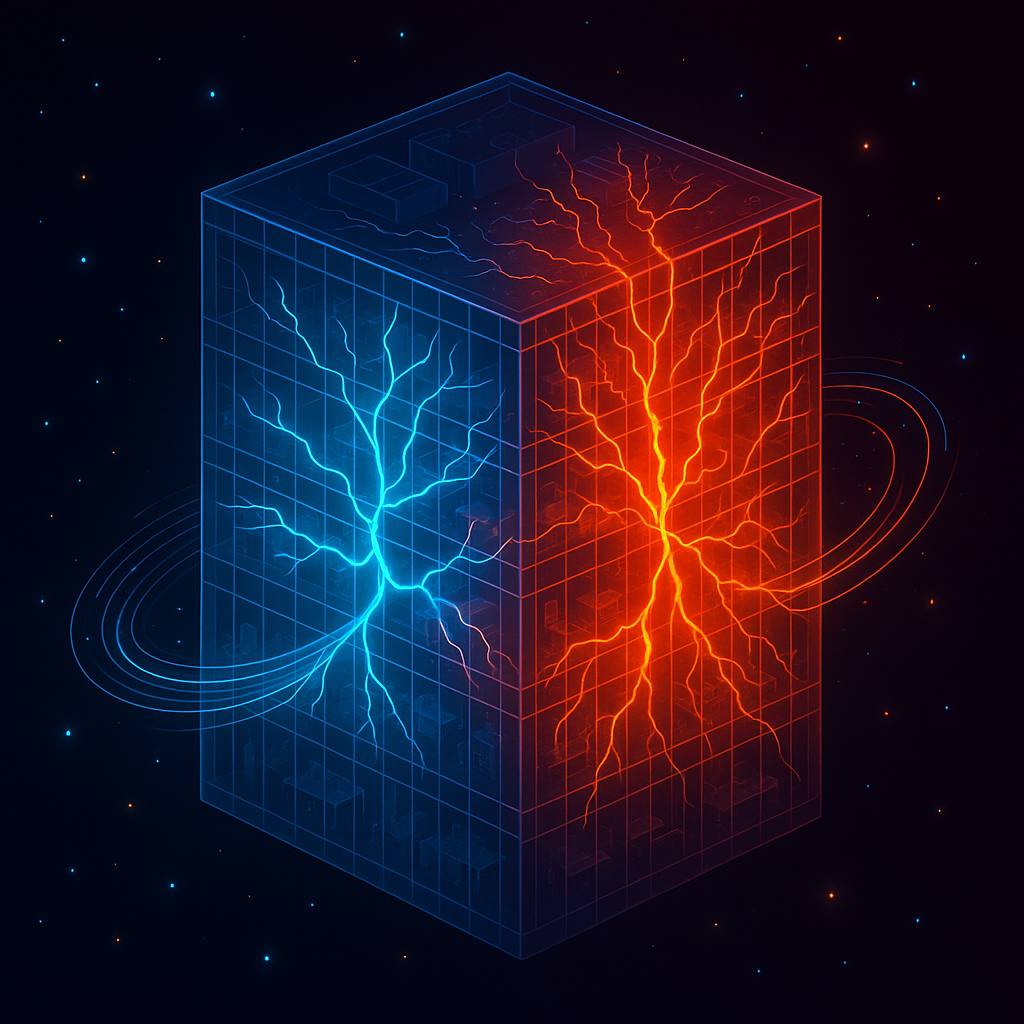
Your Company Has a Nervous System - And It Might Be Dysregulated
Formative Note
This essay represents early thinking by Ryan Collison that contributed to the development of A Theory of Meaning (AToM). The canonical statement of AToM is defined here.
Walk into a dysfunctional organization and you can feel it.
Before anyone explains the org chart or the quarterly numbers, your body knows something is wrong. The tension in the air. The way people move—too fast, too careful, too checked out. The conversations that happen in hallways versus the conversations that happen in meetings. The gap between what's said and what's meant.
You're detecting something real. Not just "culture" in the vague sense, but a measurable pattern of collective dysregulation. The organization has a nervous system—a distributed prediction-and-response network that spans its members, its processes, its communication patterns—and that system is in a defensive state.
This isn't metaphor. It's mechanism. And understanding it changes how we think about organizational health, dysfunction, and repair.
The Organizational Blanket
Every organization maintains a boundary—a Markov blanket that separates inside from outside.
The blanket includes the interfaces through which the organization senses its environment: customer feedback, market research, competitive intelligence, regulatory signals. These are the organization's sensory surfaces—how it perceives the world.
The blanket also includes the interfaces through which the organization acts on its environment: products, services, communications, lobbying, hiring. These are the organization's motor outputs—how it shapes the world.
Inside the blanket are the organization's internal states: its beliefs about the market, its strategies, its culture, its informal knowledge. These internal states generate predictions about what the organization will encounter and what actions will produce what outcomes.
When predictions succeed—when the organization accurately anticipates customer needs, market shifts, competitive moves—it operates efficiently. Low prediction error. Smooth function.
When predictions fail—when the market surprises, when customers defect, when strategies misfire—the organization experiences something analogous to stress. High prediction error. Mobilization. Response.
Organizational Prediction Failure
What does prediction failure look like at organizational scale?
Strategic surprise. The market moved in ways leadership didn't anticipate. The product flopped. The competitor launched something unexpected. The technology shifted. The organization's model of its environment turned out to be wrong.
Operational friction. Processes that should work smoothly keep jamming. Handoffs fail. Information gets lost. Things take longer than they should. The internal predictions about how work flows are systematically inaccurate.
Coordination breakdown. Departments make plans that conflict. Resources get double-allocated. Left hand doesn't know what right hand is doing. The organization's model of itself is fragmenting.
Cultural dissonance. Espoused values don't match lived reality. Leaders say one thing and do another. What gets rewarded contradicts what gets preached. The organization's predictions about its own norms are failing.
Each of these is prediction error at collective scale. And just like individual prediction error, organizational prediction error triggers response—often defensive, often dysregulated.
The Three Organizational States
Organizations, like individuals, operate in different regulatory states.
Engaged and adaptive. The organization is in its equivalent of social engagement. Communication flows freely. Problems get surfaced and addressed. Innovation is possible. People take appropriate risks. There's psychological safety—employees can speak up without fear. The organizational nervous system is regulated.
Mobilized and reactive. The organization has shifted into fight-or-flight mode. Crisis dominates. Everything is urgent. Long-term thinking evaporates. People protect their positions. Blame gets assigned. The organization is responding to threat, real or perceived, and the response crowds out normal function.
Frozen and checked out. The organization has collapsed into shutdown. Nobody tries anymore. Problems get ignored rather than solved. Learned helplessness pervades. People do the minimum. Innovation is impossible because nobody believes it matters. The organizational nervous system has given up.
Most dysfunctional organizations oscillate between mobilized and frozen—crisis mode alternating with collapse, with rare intervals of genuine engagement.
Organizational Curvature
The coherence geometry applies.
High organizational curvature means the organization overreacts to small perturbations. A minor customer complaint triggers a company-wide initiative. A competitor's announcement sparks panic. Leadership changes produce whiplash. Every input gets treated as a crisis.
This is organizational anxiety—a system stuck in hypervigilance, unable to distinguish signal from noise, treating every variation as threat.
Low organizational curvature—too low—means the organization underreacts. Warning signs get ignored. Market shifts don't register. Customer feedback bounces off. The system is too rigid to respond to genuine threats.
This is organizational complacency—or organizational freeze. Either way, the predictions aren't updating when they should.
Healthy curvature is calibrated. Proportionate response to actual conditions. Small issues get small responses. Big issues get big responses. The system can tell the difference.
Organizational Dimensionality
High organizational dimensionality means strategic flexibility. Multiple viable paths forward. Resource reserves. Skill diversity. The ability to pivot. When one approach fails, others are available.
Low organizational dimensionality means rigidity. One product. One strategy. One way of doing things. All eggs in one basket. When that basket breaks, there are no alternatives.
Startups often have high dimensionality—they're still figuring out what they are, so many options remain open. Mature organizations often lose dimensionality—they've optimized for their niche so thoroughly that they can't adapt when the niche changes.
Trauma can reduce organizational dimensionality just as it reduces individual dimensionality. A company that nearly failed may become risk-averse—closing down possibilities that feel too dangerous, even if they're necessary for growth. The manifold narrows around survival.
Organizational Topology
Organizations develop topological features—bottlenecks, attractors, barriers—that shape what's possible.
Bottlenecks are places where flow constricts. Everything has to go through one person, one system, one process. If that point fails, function collapses. Organizations often know their bottlenecks but don't address them because addressing them would require rethinking something fundamental.
Attractors are states the organization tends toward. Some are healthy—stable operating rhythms, reliable processes. Some are pathological—crisis loops, blame cycles, patterns that repeat regardless of intention. Organizational attractors can persist for decades, surviving leadership changes, surviving strategic pivots, because they're encoded in structure, not just people.
Barriers are regions the organization can't enter. Certain conversations that are taboo. Certain innovations that are unthinkable. Certain changes that would threaten too many interests. The organizational manifold has no-go zones that shape everything around them.
Organizational trauma creates all three. The near-death experience creates a bottleneck around caution. The past failure creates an attractor of risk-aversion. The wounds create barriers around anything that might reopen them.
Silos as Fragmentation
Silos are organizational dissociation.
What should be one coherent system has split into parts that don't communicate. Each part maintains its own predictions, its own priorities, its own culture. The organizational manifold has fragmented into disconnected regions.
This happens for reasons that made sense at some point. Specialization enables depth. Differentiation enables focus. But without maintained coupling, differentiation becomes disconnection.
The marketing department develops predictions about customers that don't match the predictions held by product development. Sales operates on assumptions that contradict operations. Each silo optimizes locally while the global system drifts into incoherence.
Breaking silos isn't primarily a communication problem—it's a synchronization problem. The subsystems need to entrain. Their predictions need to align. Their rhythms need to couple.
This requires more than cross-functional meetings. It requires genuine integration: shared goals, shared data, shared accountability, shared prediction. The topology needs repair.
Organizational Trauma
Organizations can be traumatized.
A near-bankruptcy. A product disaster. A scandal. A hostile takeover attempt. A beloved leader's departure or betrayal. A mass layoff. A market collapse. Any event that overwhelms the organization's capacity to predict and cope can leave lasting deformation.
The trauma shows up in organizational patterns:
Hypervigilance. Excessive monitoring. Paranoid risk-aversion. The system scanning constantly for the next catastrophe.
Avoidance. Topics that can't be discussed. Decisions that keep getting deferred. Regions of the organization's possibility space that are simply off-limits.
Intrusion. The past event keeps coming up. Every challenge gets interpreted through the lens of that trauma. "We can't do that because remember what happened when..."
Constriction. Narrowed range of acceptable action. Rigid procedures. Fear of deviation. The organizational dimensionality has collapsed.
Like individual trauma, organizational trauma isn't just memory—it's prediction. The organization learned that catastrophe is possible, and it continues to predict catastrophe even when circumstances have changed.
Leadership as Nervous System Regulation
What does leadership actually do?
From this perspective: leaders regulate the organizational nervous system.
A calm leader smooths curvature. When crisis hits, they absorb the shock, preventing it from cascading through the system. They respond proportionately. They model measured reaction. The organization can stay regulated because the leader is regulated.
A panicked leader amplifies curvature. Their anxiety spreads. Their overreaction becomes the organization's overreaction. The system escalates because the leader escalates.
A checked-out leader permits freeze. Without leadership energy, the organization drifts into inertia. Problems don't get addressed. Dysfunction persists. The system has no regulatory signal to entrain to.
This is why "leadership presence" matters. It's not mystical—it's regulatory. The leader's nervous system is a reference signal. The organization, whether consciously or not, tracks that signal and adjusts accordingly.
Organizational Entrainment
Healthy organizations entrain.
Temporal entrainment. Daily standups, weekly reviews, quarterly planning, annual retreats. These rhythms synchronize activity across the organization. Everyone is on the same time.
Communicative entrainment. Shared vocabulary. Common metrics. Aligned understanding of what matters. The predictions across departments are compatible because they're built on shared language.
Behavioral entrainment. Norms that actually hold. Consistent expectations about how people act. Predictable responses to predictable situations. The organizational culture is a synchronization mechanism.
When entrainment fails, the organization fragments. Different rhythms. Different languages. Different norms. The subsystems oscillate independently, creating interference rather than harmony.
Rebuilding entrainment requires the same thing it requires at the individual level: consistent, predictable, regulated input over time. Leadership providing stable rhythm. Processes providing reliable structure. Culture providing shared prediction.
Organizational Repair
If organizations have nervous systems, organizations can heal.
Curvature smoothing. Stabilizing routines. Proportionate response protocols. Leadership modeling measured reaction. Recovery time between crises. The system learns that not everything is an emergency.
Dimensional expansion. Strategic optionality. Resource reserves. Skill diversification. The organization rebuilds its capacity for flexibility, its ability to pursue multiple paths.
Topological repair. Cross-functional integration. Knowledge management. Relationship rebuilding. The fragments reconnect. The silos dissolve. The bottlenecks open.
Entrainment restoration. Rhythmic consistency. Communication alignment. Cultural coherence. The subsystems resynchronize.
This isn't quick. Organizational trauma, like individual trauma, leaves lasting deformation. The repair happens through accumulated experience—enough moments of safety, enough functional responses, enough successful coordination—that the predictions gradually update.
The Collective Body
Organizations are not just collections of individuals. They're collective bodies with their own regulatory dynamics.
The individual bodies within the organization affect and are affected by the organizational body. A dysregulated organization dysregulates its members. A regulated organization supports member regulation.
This is why organizational health matters for individual wellbeing. You can't be fully healthy in a sick system. The organizational curvature becomes your curvature. The organizational freeze becomes your freeze. The organizational trauma resonates in your body.
And this is why individual healing sometimes isn't enough. You do the therapy. You learn to regulate. And then you walk back into a dysregulated organization and your nervous system activates all over again. The context is part of the condition.
Healing happens at multiple scales. Individual and collective. Person and organization. Both need to move toward coherence for coherence to hold.
Diagnosing Your Organization
You can sense organizational dysregulation before you can name it. That feeling you have walking into certain offices—your body already knows.
But you can also map it. Look for the symptoms:
How does the organization respond to bad news? (Curvature)
How many strategic options are genuinely available? (Dimensionality)
Where does information get stuck? (Topology)
Are there topics that can't be discussed? (Trauma)
Is leadership calm or reactive? (Regulation)
Do different departments tell compatible stories? (Entrainment)
The diagnosis points to the intervention. High curvature needs calming. Low dimensionality needs expansion. Fragmented topology needs integration. Trauma needs processing. Dysregulated leadership needs either support or change.
The organization is a nervous system. It can be healthy or sick. And it can heal.
← What Happens When Someone Really Listens Why Polarization Feels Like the World Is Ending →
Part of: Active Inference Series — Article 13 of 20
Explore more: Active Inference
Comments ()