4E and Trauma: The Unspoken Failure Case
4E cognition excels at describing healthy distributed cognition but lacks vocabulary for trauma. This article introduces coherence collapse as the missing concept for understanding how embodied, embedded, enactive, and extended systems break down.
4E and Trauma: The Unspoken Failure Case
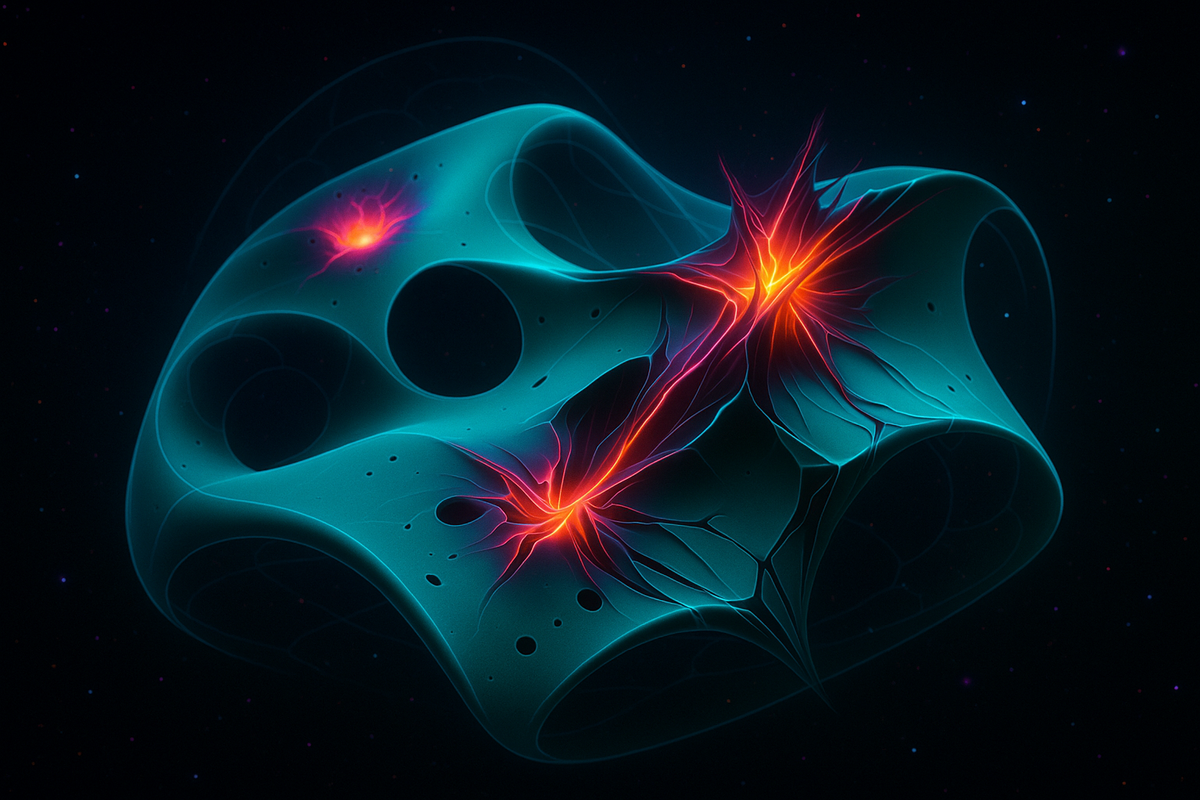
The distributed system deforms under overwhelming pressure—and 4E has almost nothing precise to say about it---Trauma is the test case that 4E cognition doesn't discuss.The previous articles in this series examined each E individually: embodied cognition and its missing stability condition, embedded cognition and environmental fragility, enactive cognition and the problem of collapse, extended cognition and the scaling problem. Each revealed the same pattern—the framework describes distributed cognition well but lacks principled accounts of when distribution succeeds versus fails.Trauma brings all these pressures together. It's not a failure of embodiment alone, or embedding alone, or enaction alone, or extension alone. It's a failure of the entire distributed system—a comprehensive deformation that affects body, environment-relationship, sense-making, and social connection simultaneously.If 4E cognition is the right framework for understanding how mind works, it should have something to say about what happens when mind is overwhelmed. But the 4E literature is remarkably quiet about trauma. The word rarely appears. The phenomenon is not analyzed. The vast clinical and empirical literatures on traumatic stress remain largely unconnected to the theoretical apparatus of embodied, embedded, enactive, and extended cognition.This silence is revealing. It suggests that 4E's conceptual resources are built for describing successful function, not systematic breakdown. The gap isn't accidental—it reflects a structural limitation in the framework.---Trauma Is Fully 4EBefore exploring what 4E lacks, it's worth noting what it could offer.Trauma is quintessentially embodied. The body stores traumatic experience in ways that persist long after the event. Muscle tension, autonomic hyperarousal, startle responses, freeze patterns—these are bodily states that encode threat and maintain vigilance. The traumatized body isn't simply carrying psychological wounds; it has reorganized itself around the reality of danger.Trauma is quintessentially embedded. The environment that once felt neutral becomes charged with threat. Locations, sounds, smells, and situations that are objectively safe trigger defensive responses because they share features with the traumatic context. The survivor's environment is not the same environment that others inhabit; it's been transformed by association into a landscape of potential danger.Trauma is quintessentially enactive. The sense-making process itself has been disrupted. Traumatic experience often exceeds the capacity for meaning—it cannot be assimilated into the ongoing narrative of self and world. The survivor continues making sense, but the sense-making is fragmented, avoidant, or distorted around the traumatic core.Trauma is quintessentially extended. Relationships, which should serve as extensions of regulatory capacity, become sites of threat or disappointment. Social connection, which should scaffold recovery, is undermined by distrust, withdrawal, or reenactment. The extended cognitive system that normally supports human function becomes attenuated or toxic.If any phenomenon should be illuminated by 4E cognition, it's trauma. The framework's core insights—that cognition spans body, environment, action, and social connection—map directly onto trauma's distributed nature.And yet the 4E literature offers almost nothing specific about trauma. Why?---The Conceptual GapThe gap exists because 4E's conceptual vocabulary is built for emergence and function, not for deformation and pathology.Embodied cognition describes how the body shapes thought—but it lacks vocabulary for how the body can become a trap. The traumatized body doesn't merely shape cognition differently; it shapes cognition in ways that maintain suffering and prevent recovery. This isn't a failure of embodiment; it's a pathological success—the body doing exactly what it evolved to do (protect against threat) in contexts where that protection has become counterproductive.Embedded cognition describes how environments scaffold thought—but it lacks vocabulary for how environments become minefields. The trauma survivor isn't merely embedded in a different environment; they're embedded in an environment transformed by danger that no longer exists. The affordances they perceive are real affordances—the environment genuinely offers threat—but the threats are historical echoes, not present realities.Enactive cognition describes how meaning emerges through interaction—but it lacks vocabulary for how meaning can break. Traumatic experience is often characterized precisely by its meaninglessness—its refusal to integrate into coherent sense-making. The survivor isn't failing to enact meaning; they're confronting experience that exceeds the meaning-making apparatus.Extended cognition describes how mind spans social connection—but it lacks vocabulary for how connection can become danger. The traumatized person hasn't simply lost extension; they've learned that extension itself is risky. Relationship, the primary human extension, has become associated with harm.Each E describes a dimension of cognition that trauma disrupts. But the descriptions are built for normal function, not for the systematic deformation that trauma produces. The framework sees that cognition is distributed; it doesn't see what happens when the entire distribution collapses under overwhelming pressure.---What Trauma Actually IsTrauma is not merely a bad experience. It's a structural transformation.The system doesn't just fail to process an event; it reorganizes around the failure. The non-processing becomes a permanent feature, shaping everything that follows. The deformation persists long after the original pressure is removed.Consider the specific features that characterize trauma:Hyperarousal. The system remains activated beyond the duration of the threat. The body maintains vigilance, ready for danger that has passed. This isn't a failure of calming; it's a success of threat-detection that won't stop running.Avoidance. The system develops ways of not encountering the traumatic material—behavioral avoidance of reminders, cognitive avoidance of memories, emotional avoidance of feelings. This isn't weakness; it's protective. But the protection comes at a cost: entire regions of experience become inaccessible.Intrusion. The unprocessed material erupts into consciousness unbidden—flashbacks, nightmares, triggered reactions. The system can neither integrate nor fully exclude the traumatic content. It remains, undigested, intruding into present experience.Dissociation. The system partitions. Different aspects of experience that should connect become separated. Memory fragments. Time distorts. The self divides. This isn't disorganization; it's a specific kind of organization—one that sacrifices integration for protection.Negative alterations. Beliefs about self, others, and world shift toward the negative and rigid. Trust erodes. Hope diminishes. The future closes down. These aren't irrational distortions; they're conclusions drawn from evidence—but evidence that has become the lens through which everything is interpreted.These features don't represent absence of cognition. They represent cognition reorganized around catastrophic experience. The system is still embodied, embedded, enactive, extended—but every dimension has been warped by overwhelming pressure.---Geometric LanguageThe clinical literature on trauma has developed increasingly precise language for what happens. Phrases like "window of tolerance," "allostatic load," "polyvagal states," and "structural dissociation" point toward something important: trauma is geometric.Window of tolerance describes the range of arousal within which coherent cognitive function is possible. Too much arousal produces hyperactivation—panic, rage, chaos. Too little produces hypoactivation—freeze, collapse, dissociation. The window can narrow under trauma, leaving the person ping-ponging between extremes with no stable middle.Allostatic load describes cumulative stress that exceeds the system's capacity to maintain equilibrium. The metaphor is of a system that bends under weight—adaptive at first, then straining, then deforming permanently when load exceeds structural limits.Polyvagal theory describes the nervous system as having multiple states—ventral vagal (social engagement), sympathetic (mobilization), dorsal vagal (immobilization)—with characteristic patterns of transition. Trauma can lock the system in defensive states or produce chaotic switching between states.Structural dissociation describes the division of personality into parts that don't fully communicate—typically an "apparently normal" part that manages daily life and an "emotional" part that carries traumatic material. This isn't metaphor; it's description of actual functional organization.Each of these concepts is geometric in character. They describe shapes, ranges, loads, states, boundaries, and structures. They characterize trauma not as content but as form—not as what happened but as how the system has reorganized.This is the kind of language 4E cognition needs but doesn't have. The clinical literature has developed it because clinicians need to understand and intervene on traumatic deformation. Theoretical frameworks built to describe normal function don't generate this vocabulary on their own.---Why 4E Missed ThisSeveral features of the 4E paradigm explain why it developed without engaging trauma.Philosophical origins. 4E cognition emerged from phenomenology, ecological psychology, and philosophy of mind. These traditions focused on perception, expertise, and the structure of normal experience. Psychopathology wasn't their subject matter.Oppositional positioning. The 4E paradigm defined itself against classical cognitivism's disembodied, decontextualized picture of mind. The contrast case was healthy function in context—expert performance, skilled coping, developmental achievement. Failure cases weren't what the argument required.Example selection. Theoretical work proceeds through examples. The examples that became canonical in 4E—chess expertise, tool use, navigation, language—were examples of successful distributed cognition. Selecting different examples (panic attacks, dissociative episodes, traumatic flashbacks) would have surfaced different questions.Disciplinary boundaries. Trauma is studied primarily in clinical psychology and psychiatry. 4E cognition developed primarily in philosophy and cognitive science. The disciplines don't talk to each other as much as they should. Concepts developed in one domain don't automatically transfer to others.Success bias in theory. Theories that explain how things work are easier to develop than theories that explain how things break. Emergence is conceptually attractive; failure is messy. A framework built to show that cognition extends naturally highlights extension; it doesn't naturally surface the conditions under which extension fails.These explanations don't excuse the gap—they illuminate it. The gap is structural, not accidental. Filling it requires adding something that the original framework wasn't built to provide.---What Would Fill the GapA 4E-compatible account of trauma would need to specify how distributed cognition deforms under overwhelming pressure.Such an account would need to describe:Embodied deformation. Not just that the body shapes cognition, but how traumatic experience reorganizes the body—creating hyperarousal as stable state, encoding defensive patterns in muscle and posture, establishing interoceptive signals that perpetuate threat-perception.Embedded transformation. Not just that environments scaffold cognition, but how trauma transforms environment—making previously neutral features into threat cues, narrowing the range of tolerable contexts, establishing avoidance patterns that progressively restrict the life-world.Enactive fragmentation. Not just that meaning is enacted, but how trauma exceeds meaning-making capacity—producing experience that cannot be assimilated, narratives with holes, sense-making that splits around unprocessable cores.Extended disconnection. Not just that cognition spans relationships, but how trauma undermines extension—eroding trust, triggering withdrawal, installing expectations of harm that prevent the very connection that would support recovery.Cross-dimensional interaction. Trauma doesn't affect these dimensions independently. Bodily hyperarousal amplifies environmental threat-perception. Fragmented sense-making impedes relational repair. Extended disconnection removes regulatory scaffolding that would stabilize embodiment. The deformation is systemic—each dimension affecting the others.Most importantly, such an account would need to specify what maintained coherence before trauma and what fails to maintain coherence after. If distributed cognition normally holds together, what made that holding-together possible? And if trauma is the failure of that holding-together, what exactly has failed?This is where 4E cognition needs the concept it has been circling without naming: coherence.---Trauma as Coherence CollapseTrauma is what happens when the distributed cognitive system can no longer maintain coherent function under the load it faces.Before trauma, the system maintains integration—not perfectly, but sufficiently. The body's states are manageable. The environment is navigable. Sense-making proceeds. Relationships provide support. The pieces hold together.During trauma, the load exceeds capacity. The event produces demands—arousal, information, meaning-requirement—that the system cannot process while maintaining integration. Something has to give.After trauma, the system has reorganized around the failure to integrate. The unprocessed material is walled off but present. The defensive adaptations persist. The geometry of the system has been deformed.Recovery is the gradual restoration of coherence. The therapy process—whatever specific modality—works by helping the system re-integrate what was split, process what was avoided, and restore flexibility where there was rigidity. The body learns to settle. The environment becomes tolerable. Sense-making reconnects. Relationships become possible again.This framing—trauma as coherence collapse, recovery as coherence restoration—would let 4E cognition engage the vast clinical literature on traumatic stress. It would connect the philosophical framework to empirical findings. And it would surface the central question: what maintains coherence when it's present, and what restores it after collapse?---The Clinical LeverageThe gap matters because 4E could contribute to trauma treatment if it had the right conceptual tools.4E's core insight—that cognition spans body, environment, action, and relationship—maps directly onto effective trauma treatment. The best trauma therapies work on multiple dimensions: somatic approaches for bodily reorganization, environmental work for expanding tolerance, meaning-making for narrative integration, relational approaches for restoring connection.But without a coherence framework, the connection between theoretical insight and clinical application remains implicit. Clinicians do integrative work because it helps; they don't have theoretical backing that explains why it helps.A 4E account of coherence would provide that backing. It would explain why treating only one dimension is often insufficient—why cognitive therapy alone doesn't resolve body-based trauma, why exposure alone doesn't restore relational capacity. The distributed nature of deformation requires distributed intervention. Coherence must be restored across the full system.It would also explain why certain interventions work despite theoretical puzzlement—why EMDR's bilateral stimulation helps, why somatic experiencing's pendulation helps, why relational approaches work when nothing else does. These interventions make sense if they're understood as coherence-restoration techniques operating on different dimensions of a distributed system.---The Bridge Needed4E cognition describes distributed mind. Trauma is distributed mind under catastrophic pressure.The framework has the right structure to engage trauma—cognition spanning body, environment, action, relationship—but lacks the vocabulary to describe how that structure deforms.What's needed is an addition: a principled account of coherence and its collapse. Not replacing 4E, but completing it. Not abandoning the insight that cognition is distributed, but adding the capacity to describe what happens when distribution fails.This addition would need to:Define coherence in terms applicable to distributed systems—what properties determine whether body, environment, action, and relationship integrate into functional wholeCharacterize collapse patterns—how coherence fails under different pressures and in different dimensionsSpecify recovery conditions—what restores coherence after collapse and what determines recovery versus persistent deformationConnect to clinical practice—bridging theory and the accumulated wisdom of trauma treatmentTrauma is the unspoken failure case in 4E cognition. But it doesn't have to remain unspoken.Coherence gives us the vocabulary to speak it.---Next week: Part 7—Attachment as a 4E System---Series NavigationThis is Part 6 of a 10-part series reviewing 4E cognition and its structural limits.4E Cognition Under Strain (Series Introduction)Why Cognition Escaped the SkullEmbodied Cognition and the Missing Stability ConditionEmbedded Cognition and Environmental FragilityEnaction, Sense-Making, and the Problem of CollapseExtended Cognition and the Scaling Problem4E and Trauma: The Unspoken Failure Case ← you are hereAttachment as a 4E SystemNeurodivergence and Precision MismatchLanguage, Narrative, and the Limits of Sense-MakingWhy Coherence Becomes Inevitable
Comments ()