4E Meets Active Inference: Embodied Free Energy Minimization
4E cognitive science—embodied, embedded, enacted, extended—has long been philosophically rich but mathematically thin. Active inference finally provides the formal scaffolding.
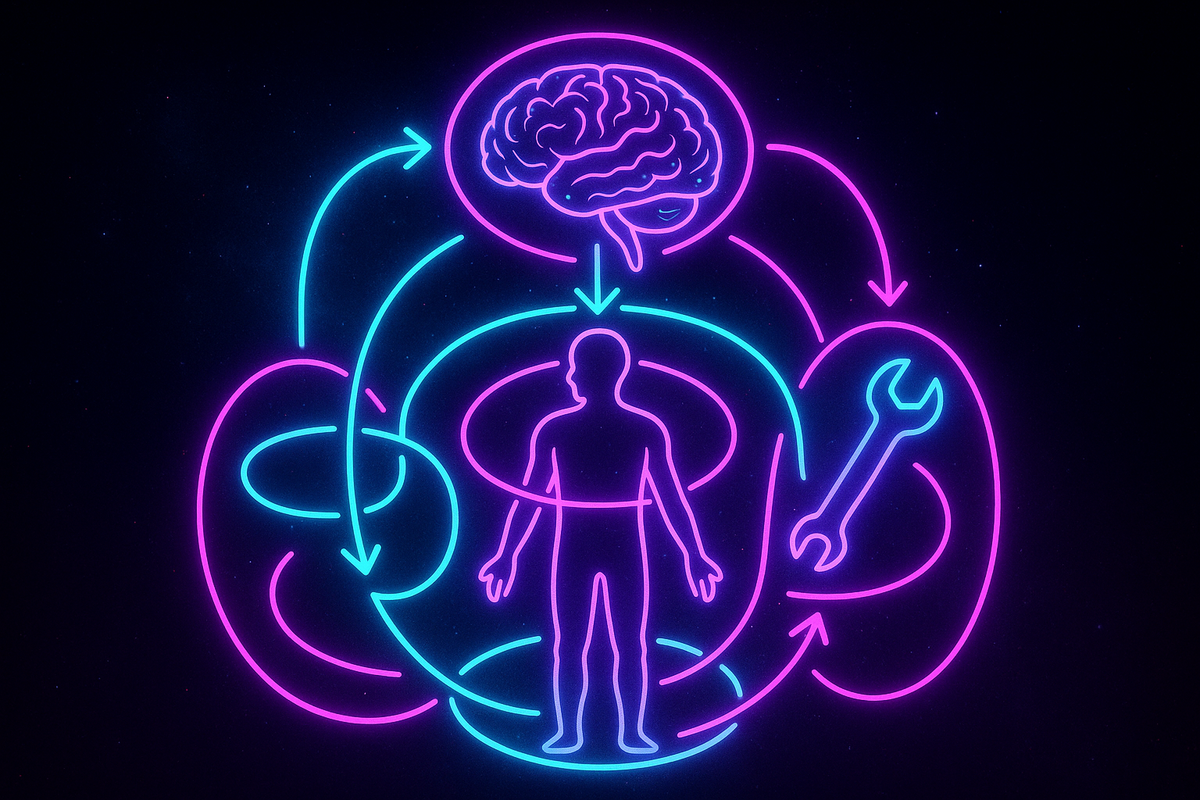
4E Meets Active Inference: Embodied Free Energy Minimization
Series: 4E Cognition | Part: 7 of 9
For decades, 4E cognition and computational neuroscience lived in separate intellectual worlds. 4E theorists emphasized phenomenology, embodiment, and dynamical systems. Computational neuroscientists built models of neural processing, Bayesian inference, and information theory. They barely cited each other.
Then Karl Friston formalized the Free Energy Principle, and something remarkable happened: the two traditions started to converge.
The FEP provides a mathematical framework for understanding how systems maintain themselves by minimizing prediction error—and it turns out that minimizing free energy requires embodiment, embeddedness, enaction, and can support extension. The 4E insights aren't poetic intuitions about cognition—they're mechanistic necessities for any system that persists.
This is the synthesis: 4E cognition describes what minds do. Active inference explains how they do it. Together, they provide a unified account of cognition as embodied free energy minimization through sensorimotor coupling.
The gap between phenomenology and mathematics has closed.
Active Inference: The Formal Structure of Enaction
Active inference is the idea that systems minimize surprise (technically, variational free energy) through two routes:
- Perceptual inference: Update beliefs to better predict sensations
- Active inference: Change the world to match predictions
This dual strategy is exactly what 4E theorists called enaction—perception and action as coupled processes that bring forth a world. Friston just formalized it mathematically.
When you reach for a coffee cup, you're not first perceiving its location then planning a movement. You're minimizing prediction error through action: your motor system predicts proprioceptive feedback corresponding to "hand touching cup," then moves to make that prediction true.
The perception-action loop isn't sequential. It's simultaneous prediction error minimization across perception (updating beliefs about cup location) and action (moving to where you predict the cup is).
Markov Blankets: The Formal Structure of Boundaries
4E cognition struggled with boundaries—where does cognition stop? Active inference provides a precise answer: Markov blankets.
A Markov blanket is a statistical boundary that separates a system from its environment. States inside the blanket (internal states) are conditionally independent of states outside (external states) given blanket states (sensory and active states).
This formalizes embodiment: your Markov blanket includes sensory receptors (how external states affect you) and effectors (how you affect external states). Internal states (neural activity) are conditionally independent of the environment given sensory-motor coupling.
But here's the key: Markov blankets can nest and extend. Your hand has a Markov blanket. Your whole body has one. You-plus-tool can have one if coupling is tight enough. The boundaries 4E theorists intuited are real—they're statistical structures in coupled dynamical systems.
Extension happens when tools become part of the Markov blanket—when they mediate your sensorimotor coupling with the world reliably enough to be statistically integrated.
Embodiment as Morphological Prior
In active inference, cognition is about inferring the causes of sensations. But inference requires priors—expectations about what causes are likely. Where do priors come from?
For biological systems: from the body.
Your body structure determines what sensations you can receive and what actions you can perform. This defines the space of possible inferences. A bat with echolocation has different sensory priors than a human with vision. A snake with heat pits has different priors than a bird with magnetic sense.
Embodiment provides the morphological priors that constrain and enable inference. You don't infer arbitrary causes—you infer causes compatible with your particular sensorimotor profile.
This formalizes the 4E insight: bodies aren't peripherals for brains. Bodies structure cognition by determining the prior distribution over sensory causes and action consequences.
Proprioceptive Precision
Proprioception—the sense of body position—has special status in active inference. It has high precision (confidence), meaning proprioceptive predictions strongly drive action.
When you intend to move your arm, you generate a proprioceptive prediction (arm in new position) with high precision. Your motor system minimizes prediction error by moving the arm to match. The high precision makes action happen.
This explains voluntary movement without requiring a "motor command." There's just prediction with varying precision. High precision proprioceptive predictions become movements. Low precision predictions remain imagination.
Embodiment is formalized as proprioceptive precision weighting in hierarchical inference.
Embeddedness as Environmental Regularities
4E cognition emphasized that environmental structure reduces cognitive load—you don't need to represent everything internally if the world reliably provides structure.
Active inference formalizes this: the environment provides empirical priors—learned regularities that constrain inference. If gravity is reliable, you don't need to infer it constantly—it becomes a deep prior, assumed rather than updated.
The more structured and predictable your environment, the less internal modeling you need. You can maintain coherence by exploiting environmental regularities through epistemic actions—actions that reduce uncertainty by revealing information.
Looking around a corner is an epistemic action. You're not approaching a goal—you're reducing uncertainty about what's there. The action makes the world reveal its structure, which updates your beliefs.
Embeddedness is formalized as learning and exploiting environmental priors to simplify inference.
Niche Construction as Prior Selection
Organisms don't just exploit environmental regularities—they create them. This is niche construction, and active inference explains why: systems minimize free energy partly by structuring environments to be more predictable.
You organize your workspace to reduce search costs. You establish routines to make behavior more predictable. You build institutions to coordinate social interaction. All of these reduce surprise by making environments match your generative model.
Niche construction is active inference at the environmental scale: minimize free energy by changing the world to fit your priors.
Enaction as Sensorimotor Contingencies
Active inference makes explicit what enactive theorists intuited: perception happens through action. You don't perceive a static world then decide what to do—you perceive by acting and interpreting the sensory consequences.
Sensorimotor contingencies are the lawful relationships between actions and sensory changes. Learning these is learning to perceive.
In active inference terms, you learn a generative model that predicts how sensations change given actions. This model is sensorimotor: it links action policies to expected sensory outcomes.
When the model is good (low prediction error), perception feels direct and transparent. When it's poor (high prediction error), perception feels effortful or confused.
This is why sensory substitution devices eventually produce "seeing"—users learn the sensorimotor contingencies linking head movements to tactile stimulation, which enables the same kind of predictive engagement that vision provides.
The Dark Room Problem
Critics asked: if systems minimize surprise, why don't they just sit in dark rooms where nothing happens and surprise is minimal?
Active inference answers: because organisms have homeostatic set-points (interoceptive predictions) that require action to maintain. You can't stay in a dark room forever—eventually you predict hunger, which generates high precision interoceptive prediction error, which drives foraging action.
Organisms minimize surprise over time given their internal constraints. The "dark room" is maximally surprising for a system that predicts continued existence, which requires food, safety, reproduction.
Enaction is formalized as minimizing expected free energy over action sequences—staying alive requires active engagement, not passive retreat.
Extension as Hierarchical Markov Blankets
Can active inference formalize extended cognition? Yes—through hierarchical Markov blankets.
If a tool is tightly coupled enough that it mediates your sensorimotor interaction with the world, it can become part of your Markov blanket at a higher hierarchical level.
Consider a blind person using a cane. At a low level, the blanket includes skin receptors feeling cane vibrations. At a higher level, the blanket can extend to the cane tip—the person perceives the ground through the cane, not the cane itself.
The cane becomes perceptually transparent because it's incorporated into the hierarchical generative model. Prediction error is minimized at the distal level (ground texture) rather than the proximal level (cane vibrations).
Extension is formalized as hierarchical blanket expansion when coupling enables stable distal inference.
Otto's Notebook Revisited
Otto uses a notebook for memory. In active inference terms, the notebook is part of his generative model—he predicts that consulting it will reduce uncertainty about appointments and addresses.
The notebook is coupled reliably enough that it's inside his extended Markov blanket for memory-related inference. He minimizes free energy partly through notebook-mediated belief updating, not just neural memory.
Losing the notebook increases free energy (creates surprise) the same way amnesia would—it disrupts the coupled system maintaining coherent predictions.
Extension happens when external resources become integral to the prediction-action loops maintaining coherence.
Precision Weighting: The Common Currency
One of active inference's most elegant features: precision weighting explains attention, affordances, action selection, and learning through a single mechanism.
Precision is confidence—how much you trust a prediction or prediction error. High precision signals demand attention and drive updates. Low precision signals get ignored.
This formalizes multiple 4E insights:
Attention: High precision prediction errors capture attention. You notice unexpected sounds (high precision sensory error) more than expected ones (low precision, ignored).
Affordances: Objects afford actions when those actions have high precision predictions. A cup affords grasping because you have high confidence predictions about grasp-related proprioception and outcomes.
Skill: Expertise increases precision for task-relevant sensorimotor predictions. Expert musicians predict fine auditory distinctions with high precision; novices don't. The precision landscape changes with learning.
Embodiment: Your body determines what you can predict with high precision, which determines what you can perceive and do.
Precision weighting is the formal mechanism implementing embodied, situated, enacted cognition.
The Geometry of 4E Free Energy Minimization
In AToM terms, coherence is maintained through coupled prediction-action loops spanning brain, body, and world. Active inference is the mathematics of this maintenance.
M = C/T (meaning equals coherence over time) becomes formalized: meaning emerges from systems that maintain low free energy over time through sensorimotor coupling. The "meaning" of a sensation is its role in the coupled dynamics minimizing surprise.
The manifold on which coherence exists isn't just neural—it includes:
- Embodied: Proprioceptive and interoceptive states
- Embedded: Environmental structure and affordances
- Enacted: Sensorimotor contingencies linking action to perception
- Extended: Coupled artifacts when blanket integration permits
Free energy minimization doesn't happen in brains. It happens through brain-body-world systems maintaining their organization against dissipation.
This is why 4E insights are mechanistically necessary: you cannot minimize free energy over time without embodiment (morphological priors), embeddedness (environmental structure), enaction (sensorimotor coupling), and the possibility of extension (hierarchical blankets).
The mathematics proves what phenomenology suggested.
Implications: Unified Cognitive Science
The 4E-active inference synthesis enables:
Testable Predictions: 4E insights become mathematically precise hypotheses about precision weighting, hierarchical inference, and coupled dynamics.
Engineering Applications: Embodied AI isn't philosophical preference—it's computational necessity for robust active inference agents.
Clinical Translation: Disorders become formalized as precision mismatches, blanket disruptions, or model-environment misalignment—suggesting precise interventions.
Theoretical Integration: Phenomenology, neuroscience, robotics, and philosophy of mind become complementary perspectives on free energy minimization.
The result is a cognitive science that's both mathematically rigorous and phenomenologically adequate—honoring both what cognition feels like and how it works.
Further Reading
- Friston, K. (2010). "The Free-Energy Principle: A Unified Brain Theory?" Nature Reviews Neuroscience, 11(2), 127-138.
- Clark, A. (2016). Surfing Uncertainty: Prediction, Action, and the Embodied Mind. Oxford University Press.
- Kirchhoff, M., & Kiverstein, J. (2019). Extended Consciousness and Predictive Processing. Routledge.
- Ramstead, M. J., Badcock, P. B., & Friston, K. J. (2018). "Answering Schrödinger's Question: A Free-Energy Formulation." Physics of Life Reviews, 24, 1-16.
- Bruineberg, J., Kiverstein, J., & Rietveld, E. (2018). "The Anticipating Brain Is Not a Scientist: The Free-Energy Principle from an Ecological-Enactive Perspective." Synthese, 195(6), 2417-2444.
This is Part 7 of the 4E Cognition series, exploring how cognitive science moved beyond the brain.
Previous: The Boundaries of Mind: Where Does Cognition Stop?
Next: 4E Cognition and Neurodiversity: Different Bodies, Different Minds
Comments ()