The Alcubierre Drive: Warp Speed Without Breaking Laws
The Alcubierre Drive: Warp Speed Without Breaking Laws
Series: Spacetime Physics | Part: 6 of 9 Primary Tag: FRONTIER SCIENCE Keywords: Alcubierre drive, warp drive, faster-than-light, exotic matter, spacetime manipulation
Nothing can travel faster than light. This is usually stated as a fundamental limit, derived from special relativity.
But that statement needs refinement. What special relativity actually says is: nothing can travel faster than light through space. Spacetime itself has no speed limit.
In 1994, physicist Miguel Alcubierre asked a provocative question: what if you didn't move through space, but moved with space? What if space itself carried you along?
His answer was the Alcubierre warp drive—a theoretical construct where a bubble of flat spacetime moves through the universe at arbitrary speed, carrying its contents along for the ride.
The Loophole
The speed of light limit applies to objects moving through spacetime. But spacetime itself can expand faster than light—it already does.
Distant galaxies are receding from us faster than the speed of light. This isn't because they're moving through space at superluminal speeds. It's because the space between us and them is expanding, and at sufficient distances, that expansion exceeds c.
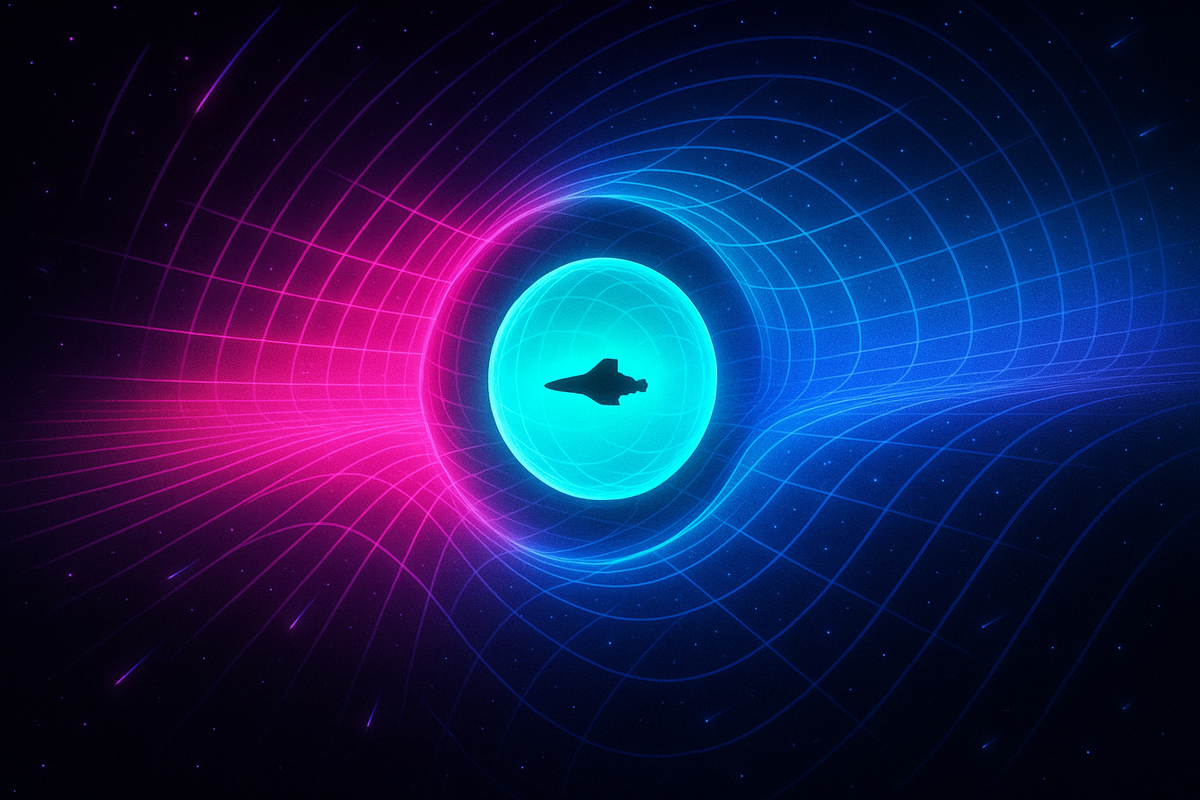
Alcubierre's insight: exploit this. Create a bubble of flat spacetime. Contract space in front of the bubble. Expand space behind it. The bubble surfs along a wave of expanding/contracting spacetime.
Inside the bubble, nothing is moving faster than light relative to the local spacetime. The occupants feel no acceleration. But the bubble as a whole moves faster than light relative to distant objects.
It's like a moving walkway in an airport: you can walk at normal speed on the walkway while being carried faster than walking speed relative to the ground. Except the "walkway" is spacetime itself.
The Math
Alcubierre specified a metric—a mathematical description of spacetime geometry—that produces this effect.
The key feature is a "warp bubble": a region of flat spacetime (where passengers would be) surrounded by a shell where spacetime is highly curved. In front, space contracts. Behind, space expands.
The metric is:
ds² = -dt² + (dx - v_s × f(r_s) × dt)² + dy² + dz²
Where v_s is the velocity of the bubble (which can exceed c) and f(r_s) is a function that defines the shape of the warp bubble.
The metric is a legitimate solution to Einstein's field equations. The math works. General relativity permits this geometry.
The Problem: Exotic Matter Again
You've encountered this issue before with wormholes. To create the Alcubierre geometry, you need exotic matter with negative energy density.
Lots of it.
Original estimates suggested the required negative energy would exceed the mass-energy of the entire observable universe. Later refinements reduced this somewhat—some calculations suggest Jupiter-mass amounts might suffice with optimized bubble geometries—but it's still enormous, and we don't know how to produce macroscopic negative energy.
The exotic matter requirement isn't a minor technicality. It's the fundamental obstacle. Without it, the warp bubble doesn't form.
Additional Problems
Even if exotic matter were available, the Alcubierre drive faces other challenges:
Creating the bubble: How do you establish the warp field in the first place? You'd need to manipulate spacetime ahead of your ship before the bubble forms. But without faster-than-light signaling, you can't prepare spacetime ahead of your journey.
Hawking radiation inside the bubble: Some calculations suggest that the bubble walls would generate intense radiation that fries anything inside. The occupants might not survive even if the bubble forms.
Accumulation of particles: The bubble might sweep up interstellar particles as it moves. When the bubble decelerates, those particles could be released in a devastating burst. Your arrival might sterilize your destination.
Causality problems: A working warp drive could be combined with special relativistic effects to create closed timelike curves—time machines. If chronology protection operates, it might forbid the warp drive itself.
Control from inside: Once inside the bubble, you might not be able to control or deactivate it. You're causally disconnected from the bubble wall by definition.
These aren't necessarily fatal objections—various researchers have proposed modifications and solutions—but they compound the difficulty.
Is It Physically Possible?
The spectrum of opinions:
Optimists point out that the metric is mathematically consistent with general relativity. We don't know that negative energy can't exist in large amounts. History shows that "impossible" technologies sometimes become possible.
Pessimists note that exotic matter in the required quantities is pure speculation. The energy requirements are absurd by any foreseeable standard. The additional problems (control, radiation, causality) may be insurmountable.
Agnostics acknowledge that physics hasn't ruled it out, but the obstacles are so severe that practical realization is far beyond any foreseeable technology. It's interesting theoretically but not a realistic near-term prospect.
The honest assessment: the Alcubierre drive is permitted by general relativity's math but requires physics we don't have access to. It's not known to be impossible, but it's also not known to be possible.
Recent Developments
The warp drive hasn't been abandoned as a research topic. Some recent developments:
Reduced energy requirements: Researchers have explored modified bubble geometries that might reduce the exotic matter requirements. Harold White's work at NASA's Eagleworks Laboratory explored designs that might be testable in principle.
Positive-energy variants: Some researchers have investigated whether warp-like solutions might exist with positive energy densities only. Early results are mixed—the original promise was overstated, but research continues.
Fundamental investigations: Even if the warp drive itself is impractical, studying it teaches us about general relativity's boundaries and connections to quantum gravity.
Laboratory analogues: While we can't create actual warp bubbles, some researchers are exploring laboratory systems that mimic aspects of the geometry, helping test the physics.
None of this means warp drives are imminent. It means the topic is being taken seriously as theoretical physics, even if practical applications are distant or impossible.
What It Would Mean
If the Alcubierre drive were possible:
The galaxy opens: Travel time to nearby stars would be measured in days or weeks, not millennia. Alpha Centauri is 4 light-years away; at 10c, you'd arrive in about 5 months.
Causality complications: With warp drives, special relativistic effects could create time travel paradoxes. Physics would need to incorporate some mechanism (many-worlds, self-consistency, chronology protection) to remain coherent.
Energy civilization: A civilization that can manipulate Jupiter-masses of negative energy is operating on scales that dwarf anything we can contemplate. The warp drive might be possible only for entities so advanced that our conceptions don't apply.
Universe structure changes: If warp travel is common at some advanced level of development, the universe's causal structure is different than we assume. The Fermi paradox takes on new dimensions.
The Sci-Fi Inspiration
Alcubierre explicitly drew inspiration from Star Trek's warp drive. His paper asked whether the fictional technology could be grounded in real physics.
The answer was: sort of. There's a loophole in relativity that permits faster-than-light motion without violating the local speed limit. But exploiting that loophole requires exotic matter we can't produce.
It's a common pattern in theoretical physics: ideas from science fiction prompt serious analysis, which reveals that reality is more complicated than fiction imagines. The Alcubierre drive is both more physically grounded than most FTL concepts and more impractical than Star Trek's writers envisioned.
The Takeaway
The Alcubierre warp drive shows that faster-than-light travel isn't straightforwardly forbidden by relativity. There's a loophole: move spacetime itself rather than moving through spacetime.
But the loophole requires exotic matter—negative energy density in macroscopic quantities. We have no idea how to produce this. The energy requirements are astronomical. Additional problems involving control, radiation, and causality compound the difficulty.
Is warp drive possible? Unknown. Physics hasn't proven it impossible. But "not proven impossible" is a long way from "feasible."
The warp drive lives in the speculative frontier—mathematically permitted, physically dubious, technologically impossible for now, and possibly forever. It might be a genuine possibility for a vastly more advanced civilization. It might be a mathematical curiosity that can never be realized. We don't know enough to say.
Further Reading
- Alcubierre, M. (1994). "The warp drive: hyper-fast travel within general relativity." Classical and Quantum Gravity. - Van Den Broeck, C. (1999). "A 'warp drive' with more reasonable total energy requirements." Classical and Quantum Gravity. - White, H. (2012). "Warp Field Mechanics 101." NASA Technical Reports. - Bobrick, A. & Martire, G. (2021). "Introducing physical warp drives." Classical and Quantum Gravity.
This is Part 6 of the Spacetime Physics series. Next: "The Multiverse: Many Worlds or Many Nonsense?"

Comments ()