Area and Perimeter: Measuring Two-Dimensional Space
Area and perimeter both measure 2D space, but differently — and they vary independently in surprising ways. A circle maximizes area for a given perimeter, and that fact has real consequences in biology and engineering.
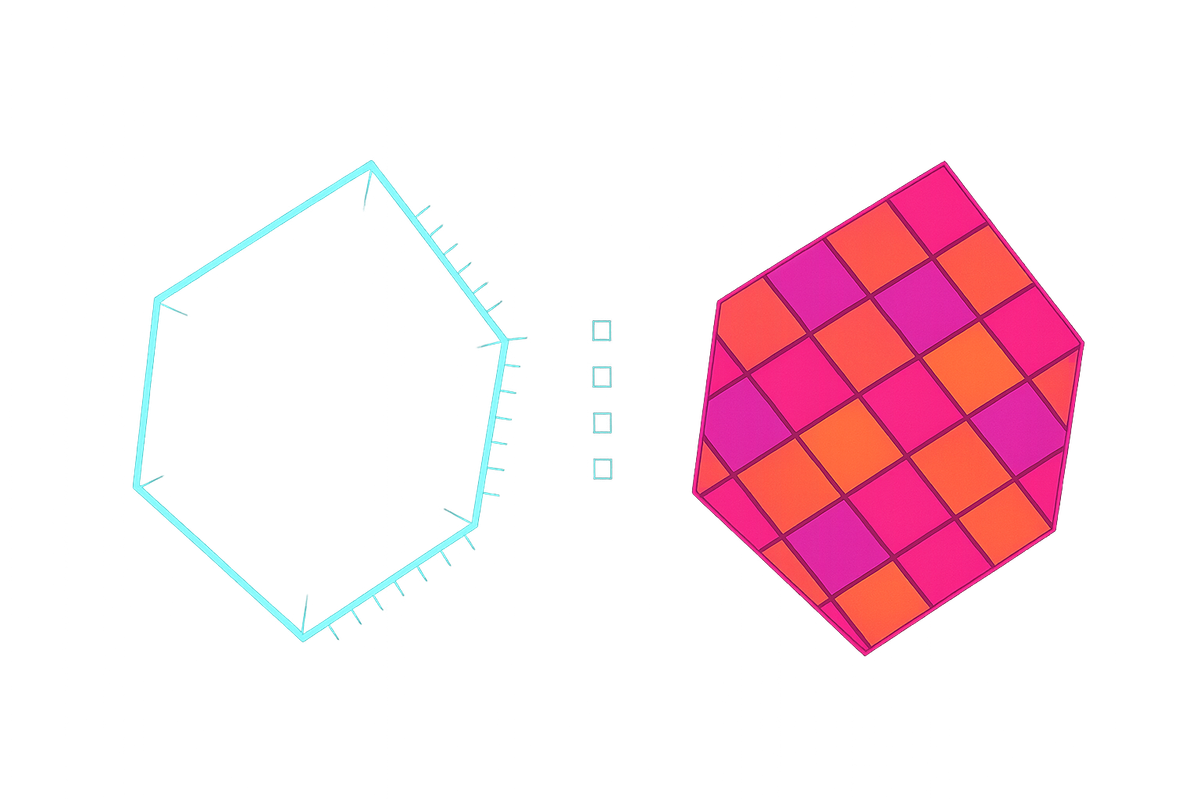
Perimeter and area measure completely different things. You can double one while halving the other.
Take a string and form it into a square. Now stretch that same string into a long thin rectangle, ten times as long as it's wide. Same perimeter — it's the same string. But the area has collapsed to a fraction of what it was.
Here's the unlock: perimeter measures the boundary, area measures the interior, and they have nothing to do with each other. A shape with a huge perimeter can have a tiny area (think of a crinkled coastline). A shape with a modest perimeter can have maximum area (that's what circles achieve).
Once you stop thinking of area as "bigger perimeter = bigger inside," measurement starts making sense.
What Perimeter Measures
Perimeter is the total length of a shape's boundary. Walk around the edge and measure how far you walked.
For polygons, it's simple: add up the side lengths.
- Square: 4s (four sides of length s)
- Rectangle: 2l + 2w (two lengths, two widths)
- Triangle: a + b + c (all three sides)
- Any polygon: Sum of all sides
For circles, the "perimeter" is called circumference: 2πr.
Perimeter is one-dimensional — it's a length, measured in meters or feet or inches.
What Area Measures
Area is how much space a shape covers. How many unit squares fit inside?
This is why area is measured in square units — square meters, square feet. You're counting squares.
For simple shapes:
- Square: s² (s rows of s squares each)
- Rectangle: lw (l rows of w squares)
- Triangle: ½bh (half of a rectangle with base b and height h)
- Circle: πr²
Area is two-dimensional — it has units of length².
The Formulas as Intuitions
Let's derive some formulas instead of memorizing them:
Rectangle: Make a grid. Length l gives l columns. Width w gives w rows. Total squares: l × w.
Parallelogram: Same base and height as a rectangle, just tilted. Shear a parallelogram sideways and it becomes a rectangle. Area = base × height.
Triangle: A triangle is half a parallelogram. Draw any triangle, duplicate it, flip one copy, and they fit together into a parallelogram. Area of parallelogram = bh. Area of triangle = ½bh.
Trapezoid: A trapezoid is like a triangle with its top cut off. Area = ½(b₁ + b₂)h, where b₁ and b₂ are the parallel sides and h is the height between them.
Circle: Cut into wedges, rearrange into a rectangle. Height ≈ r, width ≈ πr. Area ≈ πr².
Why They Don't Correlate
Here's a key insight: for a fixed perimeter, area can vary wildly.
Isoperimetric inequality: Among all shapes with the same perimeter, the circle has the largest area.
This means:
- A circular fence encloses more pasture than a rectangular fence of the same length
- Bubbles are round because surface tension minimizes perimeter for a given volume
- Rivers meander into loops that maximize area
Conversely, you can have infinite perimeter enclosing finite area. Fractals do this — the Koch snowflake has infinite perimeter but fits inside a small circle.
The Unit Square Fallacy
Many students think: "That shape looks bigger, so it has more area."
But "looks bigger" often means "longer perimeter" or "more spread out." These don't imply larger area.
A 1×1 square and a 0.25×4 rectangle have the same area (1 square unit). But the rectangle "looks bigger" because it spans 4 units.
Area is specifically about coverage, not extent. A very long, very thin shape covers very little despite spanning a lot.
Scaling Laws
Here's where dimensions really matter:
If you scale a shape by factor k (every length multiplied by k):
- Perimeter scales by k (it's one-dimensional)
- Area scales by k² (it's two-dimensional)
Double a square's side:
- Perimeter: 4s → 4(2s) = 8s (doubled)
- Area: s² → (2s)² = 4s² (quadrupled)
This is why insects can lift proportionally huge weights but elephants can't. Strength scales with cross-sectional area (k²), but weight scales with volume (k³). Scale up an ant to elephant size, and its legs would snap — the cross-section hasn't grown fast enough.
Irregular Shapes
What if the shape isn't a nice polygon?
Grid method: Overlay a grid of small squares. Count fully-inside squares. Estimate partially-inside squares. Total is approximate area.
Decomposition: Break the shape into triangles, rectangles, or other simple shapes. Add up their areas.
Subtraction: Sometimes easier to find the area of a larger shape and subtract holes.
Calculus: For shapes bounded by curves, integration finds the exact area by summing infinitely many infinitely thin rectangles.
Composite Shapes
Real-world shapes are often combinations:
L-shape: Two rectangles, maybe overlapping. Add areas, subtract overlap.
Annulus (ring): Large circle minus small circle. Area = πR² − πr² = π(R² − r²).
Complex floor plans: Decompose into rectangles, add them up.
The strategy is always: reduce to simple shapes you know how to measure.
Perimeter of Irregular Shapes
For curves, perimeter means arc length.
You can approximate by:
- Laying a string along the curve and measuring the string
- Breaking the curve into short line segments and adding their lengths
Calculus gives the exact formula, but the concept is the same: total distance around.
Famously, coastlines have no definite length — the more precisely you measure, the longer they get. This is the coastline paradox, and it's why "the perimeter of Britain" has no single answer.
Dimensional Analysis
Units tell you whether you're dealing with perimeter or area:
- Meters, feet, inches → perimeter (length)
- Square meters, square feet, square inches → area (length²)
If you're calculating area and your answer comes out in meters instead of square meters, you made an error. The units are a check on your reasoning.
Applications
Real estate: Land is sold by area, fence is priced by perimeter. Different optimizations.
Painting: Paint covers area. You buy paint by the square foot of wall.
Fencing: Fence is perimeter. You buy fence by the linear foot.
Materials: Sheet metal, fabric, flooring — all area. Edge binding, trim, baseboards — all perimeter.
Knowing which is which prevents expensive errors.
The Core Insight
Perimeter is boundary. Area is interior. They're independent quantities.
You can change one without changing the other. You can maximize one while minimizing the other. They scale by different powers when you resize.
A shape isn't fully described by either alone. You need both to understand its geometry.
When you measure, first ask: am I measuring the edge or the inside? That tells you which quantity you need and which formula applies.
Part 7 of the Geometry series.
Previous: Circles: The Shape of Constant Distance Next: Volume and Surface Area: Three-Dimensional Measurement
Comments ()