Arjuna's Crisis: Coherence Collapse at the Decision Point
At the moment of battle, Arjuna's coherence collapses. His symptoms—trembling, parched throat, fallen weapons—read like a clinical description of what happens when a mind encounters a decision it cannot resolve.
Arjuna's Crisis: Coherence Collapse at the Decision Point
Series: Gita Psychology | Part: 2 of 10
The first chapter of the Bhagavad Gita contains almost no philosophy. It's a clinical description of a breakdown. Arjuna surveys the battlefield, sees who he's being asked to kill, and his nervous system refuses. His description is precise:
"My limbs give way, my mouth is parched, my body trembles, and my hair stands on end. My skin burns, I cannot hold my bow, and my mind reels... I see omens of chaos, Krishna; I see no good in killing my own kinsmen in battle."
This isn't metaphorical distress. This is autonomic collapse. The body knows something the mind is trying to justify. And what the body knows is that the decision space has become geometrically impossible.
Let's break down what's actually happening here—and why it's a perfect case study in coherence collapse.
The Geometry of the Impossible Choice
Arjuna is trapped in what we might call a coherence paradox. Every path forward destroys something essential to who he is. Fighting his family violates his values about kinship, honor, and love. Refusing to fight violates his duty as a warrior, his responsibility to restore justice, and his obligation to his brothers who depend on him. Surrender means enabling tyranny. Retreat means abandoning everyone counting on him.
In AToM terms, his constraint manifold has become degenerate. M = C/T—meaning equals coherence over tension. Arjuna's tension is spiking toward infinity because every trajectory through state-space crosses a boundary he cannot cross. His coherence is collapsing because integration is no longer possible. The system cannot find a path.
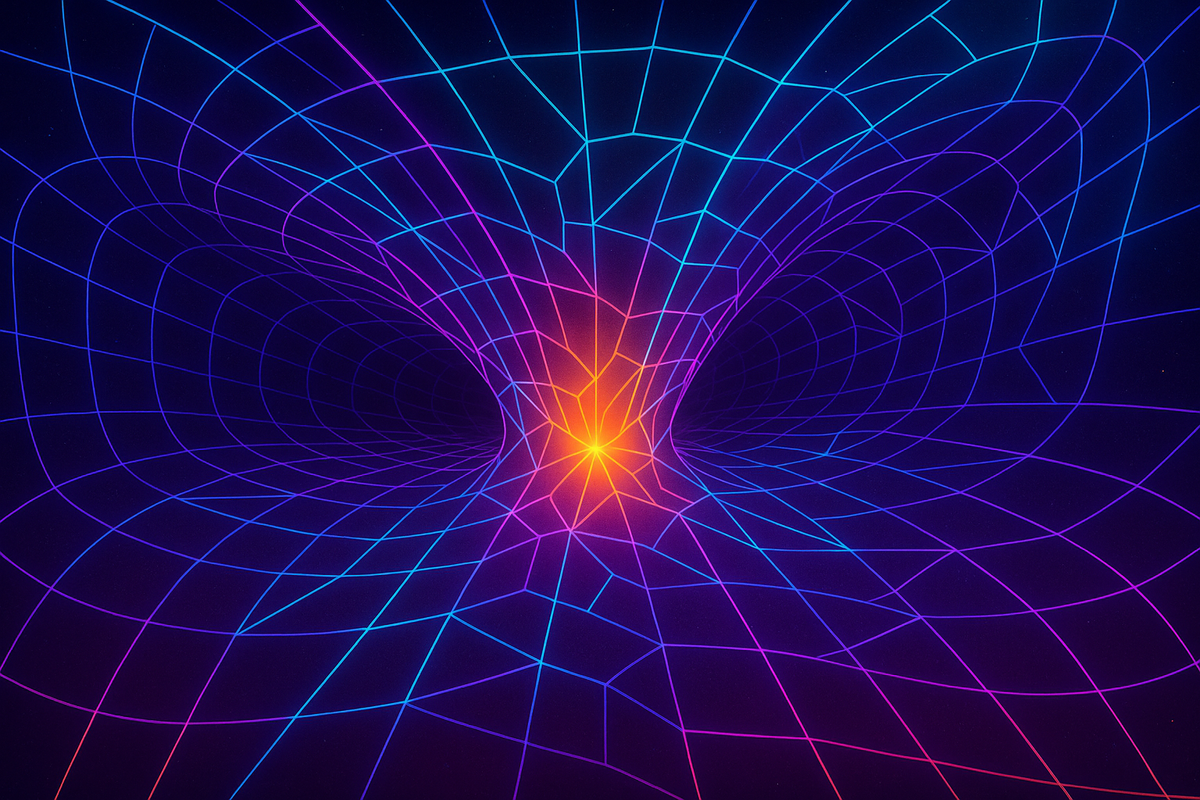
Mathematically, this looks like approaching a singularity. The curvature of the decision space becomes infinite. All geodesics—all natural paths—lead to violation. The manifold folds in on itself. The result is paralysis.
But Arjuna's crisis isn't just cognitive. It's somatic. His body refuses before his mind articulates reasons. This is crucial. The nervous system detects impossible geometry faster than conscious thought can process it. You feel the collapse before you can explain it.
Symptoms of Coherence Collapse
Let's catalog what Arjuna reports:
Trembling limbs. The motor system loses stable command. When action itself becomes paradoxical, the body withdraws executive function.
Dry mouth, burning skin. Classic sympathetic activation—fight-or-flight response without resolution. The system is preparing for action but cannot identify which action.
Hair standing on end. Piloerection. The threat response without a clear threat vector. Everything is threatening because everything is wrong.
Weapon falling from hand. Loss of grip. Literally and metaphorically. He cannot hold onto his role.
Mind reeling. Cognitive overwhelm. The planning circuits can't converge on a stable trajectory.
This is textbook traumatic freeze. When fight is impossible and flight is impossible, mammals freeze. The dorsal vagal system activates. The nervous system shuts down executive function to prevent self-destruction. Arjuna's collapse isn't weakness—it's a protective response to an impossible demand.
But here's where it gets interesting. Arjuna doesn't just shut down. He articulates his crisis with extraordinary clarity. Even in collapse, he's tracking the structural reasons for the collapse:
- "I would rather be killed unresisting than kill my teachers"
- "What victory could there be, what kingship, what happiness?"
- "Even if they are blinded by greed, I see the destruction that will follow"
- "How can we be happy killing our own people?"
He's not confused. He's lucid about the impossibility. That's what makes this so devastating. He sees exactly why every option is untenable. The problem isn't lack of clarity—it's that clarity makes action impossible.
The Three Violating Paths
To understand the geometry more precisely, consider the three major paths available to Arjuna:
Path 1: Fight. This preserves his duty (dharma) as a warrior, honors his commitments, serves justice. But it requires killing beloved teachers, elders, cousins, friends. It violates his values about family, respect, kinship. It makes him an instrument of destruction against people he loves.
Path 2: Refuse to fight. This preserves his love, avoids direct violence, keeps his hands clean. But it abandons his duty, betrays his brothers, enables tyranny, and likely leads to the same deaths—just with him surviving through cowardice. It violates his identity as a warrior and his responsibility to those who depend on him.
Path 3: Retreat/Die. He considers this explicitly: "I would rather they killed me unresisting." This avoids active choice. But it's still abandonment. It still violates duty. And it doesn't prevent the war or the suffering—it just removes him from the equation through passive self-destruction.
In each path, something essential breaks. There's no trajectory that preserves all the values, relationships, and identities he holds. This is what generates the infinite curvature. When every geodesic crosses a boundary you cannot cross, the manifold becomes untraversable.
The body reads this geometry and says: Stop. There is no safe direction. Do not move.
Why This Isn't Just "Hard Choices"
It's tempting to flatten Arjuna's crisis into "life is full of hard choices." But that misses the structure. Hard choices have costs. Impossible choices have costs that exceed your capacity to pay while remaining yourself.
Consider the difference:
Hard choice: Choosing between two jobs. One pays more, one is more meaningful. Either choice is workable. You'll regret something, but you can live with either outcome. The curvature is manageable.
Impossible choice: Choosing which child to save when both are drowning and you can only reach one. Either choice destroys something core to who you are as a parent. The curvature becomes infinite. You cannot integrate this.
Arjuna's situation is the latter. He's not weighing pros and cons. He's facing structural incompatibility between essential elements of his self-system. No choice preserves coherence. That's what causes the collapse.
And here's what the Gita understands that most advice doesn't: you can't think your way out of impossible geometry. Arjuna tried. He lists every reason for and against. He performs the analysis. It doesn't help. Because the problem isn't in the reasoning—it's in the structure of the situation itself.
What Krishna Sees That Arjuna Doesn't (Yet)
When Arjuna finishes articulating his crisis, he does something crucial: he surrenders his autonomy to Krishna. "I am your student. Teach me." He recognizes that his own frame cannot resolve this. He needs a different geometry.
Krishna's response doesn't start with philosophy. It starts with reframing the nature of the crisis itself. Over the next 17 chapters, Krishna will show Arjuna that:
- The choice isn't actually between killing or not killing (death is inevitable, not caused by him)
- His identification with the one making the choice is the problem (he's not the doer)
- The outcomes he's attached to are not the measure of right action (karma yoga)
- His duty (dharma) is real even if it feels impossible
- There are ways to act coherently even in high-curvature regions
But all of that comes later. For now, we're sitting with the collapse itself. Because you cannot understand the solution until you understand the problem. And the problem is this:
Arjuna is geometrically trapped. His coherence cannot survive any available action. The system has frozen to prevent self-destruction.
This is where the Gita meets every human being who has faced an impossible situation. Not hard. Not difficult. Impossible. When every direction forward breaks you.
The question the rest of the Gita answers is: How do you act coherently in a situation where coherent action seems impossible?
Contemporary Parallels
Before we move to Krishna's teachings, notice how Arjuna's crisis maps to modern experiences:
Moral injury. Soldiers ordered to do things that violate their sense of right. Doctors forced to prioritize patients according to insurance rather than need. People working in systems they believe cause harm.
Burnout. Not exhaustion from working hard—exhaustion from sustained impossible demands. When every task requires violating something you value. When the work itself creates the conditions for failure.
Relational impasse. Staying destroys you. Leaving destroys you. There's no good option, only degrees of harm. The relationship has become geometrically untraversable.
Political paralysis. Every vote seems to enable something unconscionable. Abstaining feels like abdication. The political manifold has no clean paths.
In each case, the structure is the same: essential values in irreducible conflict. The system cannot find coherence. The body responds with freeze, shutdown, dissociation. Decision-making becomes impossible not because you're weak but because the geometry won't support a solution.
The Gita is a manual for these situations. But you can't use the manual until you recognize you're in one. That's what this chapter does. It establishes the problem with precision.
Next, we'll see how Krishna begins to reconfigure Arjuna's relationship to the entire situation—not by making it easier, but by changing the frame within which action becomes possible.
Further Reading
- Peter Levine, Waking the Tiger (somatic freeze response)
- Stephen Porges, The Polyvagal Theory (nervous system states under threat)
- Robert Sapolsky, "Why Zebras Don't Get Ulcers" (physiology of impossible situations)
- Brett Litz et al., "Moral Injury and Moral Repair in War Veterans" (Clinical Psychology Review)
- Antonio Damasio, The Feeling of What Happens (emotion and decision-making)
This is Part 2 of the Gita Psychology series, exploring the Bhagavad Gita as a coherence manual for action under constraint.
Previous: The Book That Teaches You to Act When Action Seems Impossible
Next: Karma Yoga: Action Without Attachment to Fruits
Comments ()