Astrology: The Persistence of an Unfalsifiable System
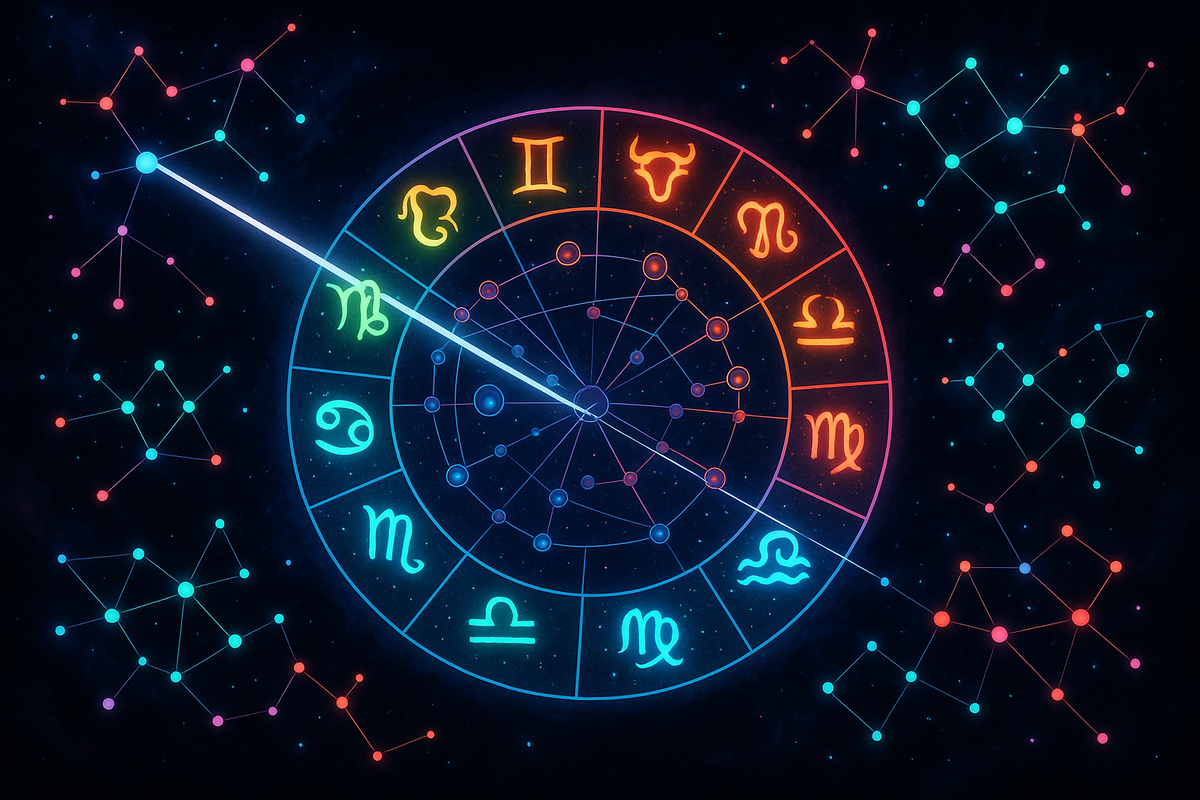
Controlled studies have repeatedly failed to validate astrological predictions. Yet astrology is more popular than ever. The real question is why it persists — and what that reveals about how minds seek meaning.
Astrology: The Persistence of an Unfalsifiable System
In 1985, physicist Shawn Carlson published a double-blind experiment in Nature—one of the world's most prestigious scientific journals.
He gave astrologers natal charts and asked them to match each chart to the correct personality profile from a set of three options. The astrologers selected the subjects. They agreed on the methodology in advance. They were confident they would succeed.
They performed at chance level. 33%, no better than random.
The study should have been the end of it. Rigorous methodology, prestigious venue, clear negative result. Astrology doesn't work.
Forty years later, astrology is more popular than ever. Apps like Co-Star and The Pattern have tens of millions of users. Astrology memes dominate social media. Publications that once mocked horoscopes now run them prominently.
What's going on? Why does a demonstrably false system persist—and flourish?
The Unfalsifiability Problem
Here's astrology's first line of defense: it's unfalsifiable.
If your horoscope says you'll have a challenging day and you do—astrology works. If you have a great day—well, you must have handled the challenges well. Or the influence was subtle. Or it will manifest later.
If a Scorpio acts like a typical Scorpio—see? If a Scorpio doesn't act like a typical Scorpio—they must have other chart influences. Check their rising sign. Check their moon sign. Check their Mercury placement.
The system has enough degrees of freedom that any observation can be accommodated. There's no outcome that would count as evidence against it.
This isn't unique to astrology. It's common to pseudosciences. But it's important to understand: unfalsifiability doesn't make something false. It makes it outside the domain of empirical testing. You can't prove astrology wrong because astrology has structured itself to be immune to disproof.
The Carlson study tested a specific claim: astrologers can match charts to personalities better than chance. That claim is falsifiable, and it was falsified. But "astrology as a whole" slides away from any specific test by redefining what it claims.
The Barnum Effect, Again
Return to Forer's experiment. Vague statements feel personally accurate.
"You have a need for other people to like and admire you." Who doesn't?
"You have a tendency to be critical of yourself." This describes most humans.
"You have found it unwise to be too frank in revealing yourself to others." Universal.
Horoscopes are Barnum statements optimized through cultural evolution. Astrologers have been writing them for centuries. The statements that resonate—that feel meaningful to the most people—survive and propagate. The statements that fall flat disappear.
Modern horoscopes are evolutionary products—the surviving variants of millions of iterations of vague-but-resonant language.
When you read your horoscope and think "that's so accurate," you're experiencing the Barnum effect layered on top of selection pressure. The statement feels accurate because it was designed to feel accurate through decades of reader feedback.
Identity Scaffolding
But Barnum effects only explain why horoscopes aren't laughed out of existence. They don't explain why people actively seek astrological identity.
For that, we need to understand what astrology provides: a framework for self-understanding.
"I'm a Virgo" is an identity statement. It comes with associated traits: analytical, detail-oriented, perfectionist, critical, helpful. It comes with compatibility claims: good with Taurus, difficult with Sagittarius. It comes with a community of other Virgos who share your alleged traits.
This is personality infrastructure. When you adopt an astrological identity, you get: - A vocabulary for describing yourself - An explanation for your tendencies - A group membership (other [sign]s) - A compatibility framework for relationships - A narrative about your life path
None of this requires astrology to be empirically true. The framework functions regardless.
Compare: "I'm an introvert." Is introversion "real"? The trait exists on a continuum, the measurement is imprecise, the concept is culturally constructed. But "I'm an introvert" still functions as useful self-description. It explains why parties exhaust you. It connects you to others who share the experience. It shapes your life choices.
Astrological identity works the same way, just with less empirical grounding.
The Appeal of External Attribution
Here's something astrology provides that self-help doesn't: external attribution.
"I'm moody because I have a Cancer moon." "I struggle with commitment because I have Venus in Sagittarius." "My Mars in Aries makes me impulsive."
These statements externalize traits. They place the cause outside the self—in the stars, determined at birth, not your fault.
This is psychologically comforting. It's much easier to say "my chart makes me this way" than "I made choices that led to these patterns." External attribution relieves responsibility. It also relieves shame—if you were born prone to jealousy, it's not a moral failing.
This is both the appeal and the danger. External attribution can reduce shame and increase self-acceptance. It can also prevent growth by making traits seem fixed when they're actually changeable.
The person who says "I can't help being jealous, I'm a Scorpio" has found an excuse—not an insight.
The Cosmic Significance Gambit
Astrology offers something else: your life matters cosmically.
The positions of planets at your birth moment shaped who you are. The ongoing movements of celestial bodies influence your daily experience. You're not just a random person living a random life—you're connected to the vast machinery of the solar system.
This is meaning-making at the highest scale. Your struggles aren't just personal—they're reflected in Mercury retrograde. Your relationship challenges aren't just interpersonal—they're Venus transiting your seventh house.
In a disenchanted world where science has removed most cosmic significance from daily life, astrology puts it back. You matter. The universe is watching. Your existence is written in the stars.
This is re-enchantment. And for people who feel atomized, alienated, cosmically insignificant—it's powerfully attractive.
Social Currency
Astrology is also just fun.
"What's your sign?" is a conversation starter. Exchanging birth charts is a bonding ritual. Memes about Gemini chaos or Capricorn ambition create in-group humor.
This is social technology. Astrology provides a shared vocabulary, a set of running jokes, a framework for playful personality discussion.
When someone says "that's such a Leo thing to do," they're not making an empirical claim about stellar influence. They're participating in a language game—a shared fiction that enables social connection.
Many astrology users understand this implicitly. They don't believe the planets literally influence events. They enjoy the framework, the community, the interpretive game. They're playing, not praying.
The distinction between belief and engagement is crucial. Surveys showing high astrology "belief" often conflate "I think the planets control my fate" with "I enjoy reading my horoscope." These are very different psychological states.
The Pattern Completion Machine
Human brains are pattern completion engines. We see faces in clouds, hear words in noise, find meaning in randomness.
Astrology exploits this. Give someone a framework—"Leos are confident leaders"—and they'll find evidence everywhere. Every confident Leo confirms the pattern. Every unconfident Leo is explained away (rising sign, life circumstances, undeveloped potential).
This is confirmation bias on steroids. The framework provides the pattern; the brain provides the completion.
But here's the twist: sometimes the patterns are real—just not for the reasons astrology claims.
Take sun sign distribution. More babies are born in certain months (September in the US, for example—nine months after the winter holidays). Environmental factors during early development—season of birth, vitamin D exposure, school cutoff dates—do correlate with certain outcomes.
These are real patterns. They're just not caused by stellar influence. They're caused by earthly factors that happen to correlate with birth date.
When astrology notices "September babies tend to be X," it might be pointing at a real phenomenon—just with the wrong explanation.
Why Evidence Doesn't Kill Belief
The Carlson study didn't end astrology. Neither did hundreds of other negative studies. Why not?
Because astrology fulfills functions that evidence can't touch.
If you need identity scaffolding, a failed double-blind study doesn't help you. If you need cosmic significance, null results don't provide it. If you need social vocabulary, scientific debunking just makes the vocabulary feel rebellious.
Astrology persists because the needs it addresses are real, and science doesn't offer compelling alternatives.
"You're not a Leo, there's no such thing as Leos" is technically correct but practically useless. It takes away a framework without providing a replacement. People don't abandon functional tools for abstract correctness.
This is the skeptic's blind spot. Pointing out that something is false doesn't address why people use it. Until the underlying needs are met some other way, the false system will persist.
The Educated Believer Paradox
Astrology belief correlates positively with education in some demographics. Young, college-educated women are among the most engaged astrology users.
This seems paradoxical. Shouldn't education increase critical thinking and decrease magical belief?
Several factors explain it:
Irony and play. Sophisticated users engage with astrology playfully, aware of its epistemological status but enjoying it anyway. "I don't really believe in astrology, but I'm such a Virgo." The disclaimer allows participation.
Meaning hunger. Higher education often correlates with lower religious engagement. Astrology fills a meaning gap—provides cosmic framework without requiring theistic commitment.
Social signaling. In some social circles, astrology literacy signals cultural belonging. Not knowing your rising sign marks you as outside the in-group.
Psychological sophistication. Educated users often understand the psychological mechanisms—and use astrology anyway, as a tool for self-reflection rather than literal divination.
The "educated believer" is often not a believer at all in the traditional sense. They're a user—someone who engages with the system for its functional benefits while maintaining epistemological distance.
The Persistence Lesson
Astrology teaches us something important about human systems: utility beats truth.
A framework that provides identity, meaning, social connection, and cosmic significance will outcompete a framework that provides only accuracy.
This isn't unique to astrology. It applies to political ideologies, religious systems, national mythologies—any belief structure that serves psychological functions beyond mere description.
The question isn't whether astrology is true. Empirically, it isn't. The question is what functions it serves and whether those functions could be served by something more accurate.
Until we answer that question, astrology will persist. The stars aren't going anywhere—and neither is our need to find ourselves in them.
Further Reading
- Carlson, S. (1985). "A double-blind test of astrology." Nature. - Eysenck, H. J. & Nias, D. K. B. (1982). Astrology: Science or Superstition? Penguin. - Campion, N. (2009). A History of Western Astrology Volume II. Continuum.
This is Part 4 of the Divination Systems series. Next: "[Oracles and Randomization: From Delphi to Decision Theory](/oracles-randomization-decision/)."
Comments ()