The Neuroscience of Attachment
Attachment theory has been reframed by neuroscience. Through a polyvagal lens, secure and insecure attachment look like different nervous system calibrations—predictive models built from early relational experience.
The Neuroscience of Attachment
Why Your Nervous System Needs Other People
There's a reason "just calm down" never works.
When you're dysregulated—anxious, triggered, overwhelmed—your nervous system isn't waiting for rational instructions from your prefrontal cortex. It's running a survival program that's older than language, older than humans, older than mammals. A program written in brainstem and vagal tone, in cortisol and oxytocin, in the microsecond-level synchronization of two nervous systems in proximity.
You don't calm yourself down. You get calmed by others. And if you never learned how to do that—if the others in your early life were themselves sources of threat—then your nervous system learned a different pattern. One that still runs, decades later, in every relationship you enter.
This series explores attachment through a neuroscience lens: how early bonds wire the nervous system, how those patterns persist into adulthood, and how they can—sometimes, with effort—change.
The Series
[What Is Attachment Theory?](/attachment-theory-explained/) — Bowlby, Ainsworth, and the discovery that connection isn't sentiment—it's biology. The Strange Situation and the four patterns.
[Anxious Attachment Style](/anxious-attachment-style/) — The hyperactivating strategy: when your system learned that protest keeps caregivers close. The vigilance, the rumination, the fear of abandonment.
[Avoidant Attachment Style](/avoidant-attachment-style/) — The deactivating strategy: when your system learned that needing is dangerous. The self-sufficiency, the emotional distance, the discomfort with intimacy.
[Dismissive vs Fearful-Avoidant](/dismissive-vs-fearful-avoidant/) — Two roads to avoidance: one that doesn't feel the need, one that feels it and dreads it.
[Disorganized Attachment](/disorganized-attachment-style/) — When the caregiver is both safe haven and source of threat. The impossible paradox that fragments self-organization.
[Secure Attachment Style](/secure-attachment-style/) — The gold standard: a system that can seek closeness and tolerate distance, that knows help is available if needed.
[The Anxious-Avoidant Trap](/anxious-avoidant-relationship/) — Why these styles find each other and torture each other. The push-pull dynamic that feels like fate.
[Relationship Anxiety Explained](/relationship-anxiety-explained/) — When love feels like danger. The nervous system origins of relationship obsession.
[What Are Attachment Issues?](/attachment-issues/) — Moving beyond "insecure attachment" to understand what's actually happening in your nervous system.
[Can You Change Your Attachment Style?](/change-attachment-style/) — Earned security: the evidence that patterns can shift, and what actually helps.
[Attachment as Coherence](/attachment-coherence-theory/) — The synthesis: attachment through the lens of predictive processing, entrainment, and the AToM framework.
The Core Insight
Here's what attachment theory really says, stripped to its biological core:
Your nervous system is not a self-contained unit. It's designed to be regulated by other nervous systems.
Infants can't regulate their own arousal. They get dysregulated—hungry, cold, scared—and they have no internal mechanism to calm down. They need an external regulator: a caregiver who senses their distress, responds predictably, and brings them back to homeostasis.
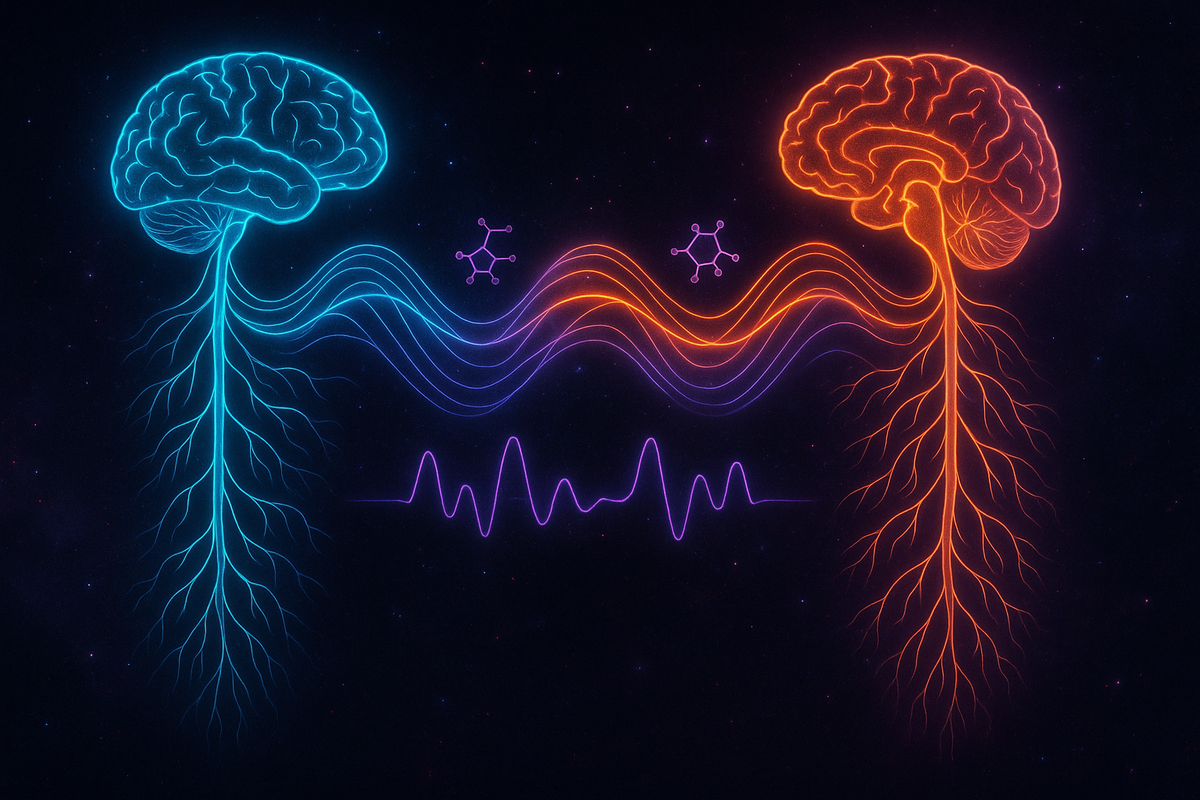
This external regulation isn't just behavioral. It's physiological. The caregiver's calm nervous system literally entrains the infant's nervous system. Synchronized heart rates. Coordinated stress hormones. Matched brainwave patterns. Two systems, oscillating together, one pulling the other toward equilibrium.
The infant learns to be calm by borrowing calm from someone else.
And here's the key: the patterns of that borrowing get internalized. If the caregiver is reliably available, the infant develops internal models that expect help. If the caregiver is inconsistent, the infant develops hypervigilance. If the caregiver is frightening, the infant develops contradictory models—need and dread, simultaneously.
These internal working models become the templates for all future relationships. Not because they're "beliefs" that can be reasoned away, but because they're wired into the nervous system's baseline predictions about safety, connection, and threat.
The Polyvagal Lens
Stephen Porges' polyvagal theory adds a crucial layer to this picture.
The vagus nerve—the tenth cranial nerve, running from brainstem to gut—has two branches with different evolutionary histories and different functions:
The dorsal vagal complex is ancient, shared with reptiles. It mediates the freeze response—shutdown, immobilization, dissociation. When threat is overwhelming and escape is impossible, dorsal vagal activation conserves resources by slowing everything down.
The ventral vagal complex evolved with mammals. It mediates social engagement—the ability to connect, communicate, and co-regulate with others. It controls the muscles of the face and voice, the systems that signal safety and invite connection.
Between them is the sympathetic nervous system, which drives fight-or-flight—mobilization in response to threat.
Porges argues these systems operate hierarchically. When ventral vagal is dominant, we feel safe enough to connect. When threat is detected, sympathetic takes over, preparing for action. When action seems futile, dorsal vagal kicks in, producing shutdown.
Secure attachment means the ventral vagal system works. The infant can engage with the caregiver, signal distress, receive soothing, and return to calm. The social engagement system does its job.
Insecure attachment means the ventral vagal system is compromised. The infant learns that connection doesn't reliably bring safety. They rely instead on sympathetic arousal (anxious attachment's vigilance) or dorsal vagal shutdown (avoidant attachment's distance).
The attachment patterns aren't just psychology. They're nervous system states that became habitual.
Entrainment and Co-Regulation
Here's where it gets precise.
When two nervous systems interact—parent and child, partners, therapist and client—their physiological rhythms influence each other. Heart rate variability, respiratory sinus arrhythmia, skin conductance, even neural oscillations: these tend to synchronize when people are in connected, attentive interaction.
This is entrainment. Like pendulum clocks on the same wall gradually synchronizing, or musicians in a band locking into a shared tempo, nervous systems in proximity coordinate their rhythms.
Secure attachment is good entrainment. The caregiver's regulated state pulls the infant toward regulation. The infant's distress is met, metabolized, returned as calm. Over time, the infant internalizes this: "distress leads to soothing leads to calm." The pattern becomes expectation.
Insecure attachment is disrupted entrainment. The caregiver can't regulate the infant—because they're dysregulated themselves, inconsistent, absent, or frightening. The infant's distress isn't metabolized. It cycles, intensifies, or gets suppressed. The pattern that gets internalized is: "distress leads to more distress" (anxious) or "distress is dangerous, don't show it" (avoidant).
You learn to regulate by being regulated. If that never happened reliably, you have to learn it later—through relationships, therapy, or deliberate practice.
The Predictive Processing Connection
Contemporary neuroscience adds another dimension: the brain as prediction machine.
Your brain constantly generates predictions about what's going to happen next and uses incoming data to correct those predictions. Prediction error—the gap between expectation and reality—drives learning and action.
Attachment patterns are essentially priors—baseline predictions about relationships. If your early experience taught you that caregivers respond reliably, your prior is: "when I signal need, help comes." If experience taught you that caregivers are unpredictable, your prior is: "connection is uncertain, stay vigilant."
These priors shape what you perceive in relationships. Anxious attachment involves high precision on threat cues—your nervous system is tuned to detect any hint of abandonment, and you'll find evidence even when it's not there. Avoidant attachment involves suppressed precision on attachment-related signals—you literally don't notice needs, or you explain them away.
Changing attachment patterns means changing priors. And priors don't change through insight alone. They change through repeated experiences of prediction error—expecting one thing and encountering another, over and over, until the model updates.
This is why therapy takes time. Why "understanding" your pattern isn't the same as changing it. The nervous system's predictions are sticky. They're held in place by years of reinforcement. Updating them requires persistent, embodied, relational experience that contradicts the old expectations.
The Coherence Frame
Attachment is coherence at the relational level.
A securely attached dyad is a coherent system—two nervous systems that can synchronize, repair ruptures, and return to equilibrium. The interaction has a stable pattern that both parties can predict and trust.
Insecure attachment is coherence breakdown—systems that can't synchronize reliably, that generate unpredictable dynamics, that leave both parties in chronic uncertainty.
The AToM framework (M = C/T) applies directly: meaning in relationships comes from coherence over time. A secure relationship feels meaningful because it's stable, predictable, and integrated. An insecure relationship feels confusing because the signals don't cohere—you can't predict what will happen, so you can't make sense of it.
Attachment security is relational coherence. Attachment insecurity is relational entropy.
The series that follows will examine each attachment pattern through this lens: what the nervous system learned, what it predicts, how it maintains itself, and what it takes to change.
Begin with [What Is Attachment Theory?](/attachment-theory-explained/), the foundation for understanding how early bonds shape lifelong patterns.

Comments ()