Base Editing and Prime Editing: Beyond Cut and Paste
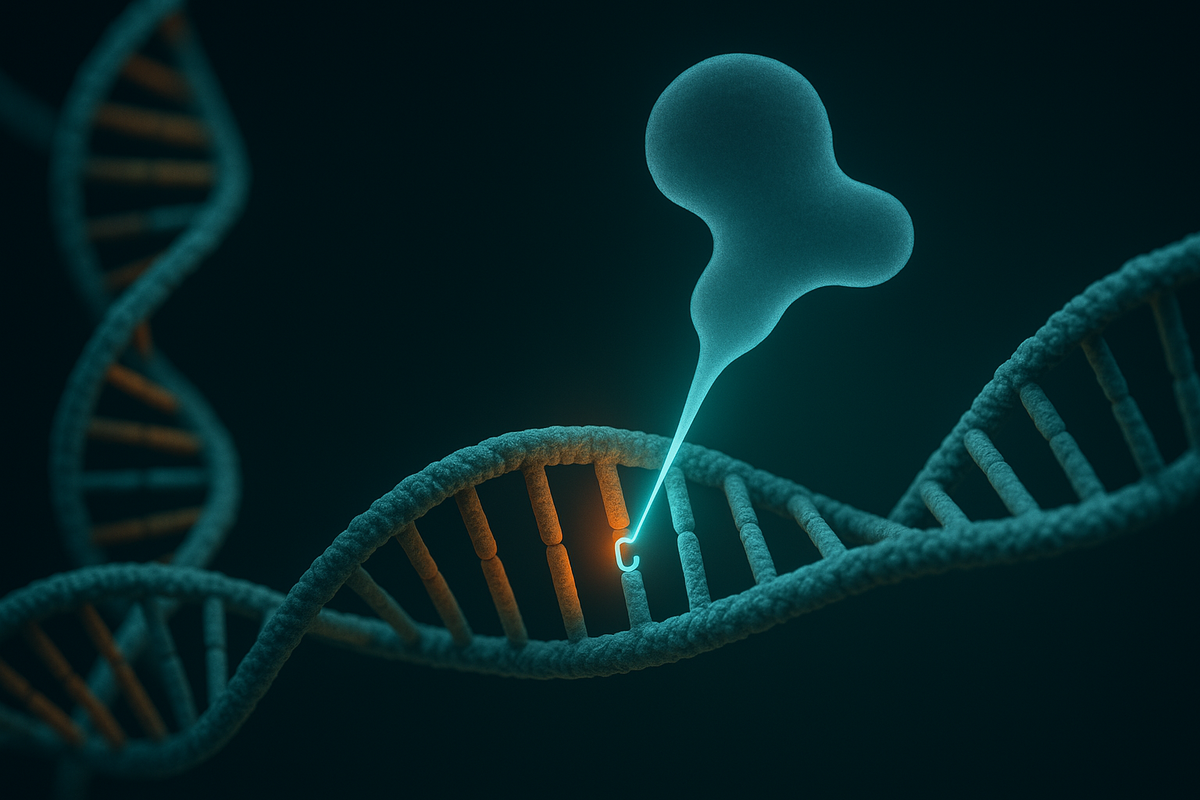
CRISPR cuts. Base editing and prime editing don't—they chemically rewrite individual DNA letters without breaking the double helix. David Liu's tools represent a quieter, more precise revolution in gene editing.
Base Editing and Prime Editing: Beyond Cut and Paste
Here's CRISPR's dirty secret: it works by breaking things. When Cas9 edits a gene, it doesn't delicately rewrite the code. It takes molecular scissors and snaps both strands of the DNA helix in half. Then it stands back and lets the cell's emergency repair systems scramble to fix the damage. Sometimes those repairs introduce the change you wanted. Sometimes they don't. And sometimes—more often than anyone likes to admit—they introduce random errors, deletions, or worse. Breaking DNA is violent at the molecular level. Cells treat double-strand breaks as five-alarm emergencies because they are. Left unrepaired, a double-strand break can kill the cell or turn it cancerous. The repair machinery that rushes in is fast, but it's sloppy. It's like fixing a typo in a manuscript by ripping the page in half and hoping the tape holds. David Liu looked at this and thought: there has to be a better way. Liu is a chemist at Harvard and the Broad Institute, and he's spent the last decade inventing tools that can rewrite DNA without ever breaking it. First came base editing—a way to chemically convert one DNA letter into another, like turning a C into a T with an eraser instead of scissors. Then came prime editing—a system that can make virtually any small change you want, inserting or deleting letters with surgical precision. If CRISPR gave us scissors, David Liu gave us a pencil. And then a word processor. The future of gene editing isn't cutting. It's rewriting.
Base Editing: Chemistry Instead of Scissors
The insight behind base editing is beautifully simple: instead of cutting DNA, what if you could chemically transform one base into another while it's still in the strand? Here's the trick. Liu took a broken version of Cas9—one that can find a target sequence but can't cut both strands—and fused it to a different kind of enzyme: a deaminase. Deaminases are proteins that can chemically modify DNA bases by removing an amino group. When you remove the amino group from cytosine (C), it becomes uracil. And here's the magic: cells read uracil as thymine (T). So on the next round of DNA replication, what was once a C becomes a T. One letter changed. No break required. The first base editor, published in 2016, could convert C to T (or more precisely, C·G base pairs to T·A base pairs). Liu's team called it BE1, and it was rough around the edges—efficient in some contexts, finicky in others. But the proof of concept was extraordinary: you could edit DNA without breaking it. Within a year, Liu's lab had developed adenine base editors (ABEs) that could convert A to G. This was harder—there's no natural enzyme that deaminates adenine in DNA—so Liu's team had to evolve one in the lab, running billions of variants through selection until they found one that worked. Between CBEs (cytosine base editors, C→T) and ABEs (adenine base editors, A→G), you can now correct about 60% of known disease-causing point mutations. Sixty percent of the "single typo" diseases—the ones caused by one wrong letter—became theoretically fixable without ever breaking DNA. The efficiency gains were staggering. Where HDR might give you 1-5% precise editing, base editors routinely achieve 50-80%. And because you're not making double-strand breaks, you avoid the messy insertions and deletions that NHEJ creates. Cleaner edits. Higher efficiency. Fewer side effects. Base editing isn't an incremental improvement over CRISPR. It's a different paradigm.
The Limits of Base Editing (And Why Liu Wasn't Done)
Base editing is powerful, but it has constraints. First: it can only make certain changes. CBEs do C→T. ABEs do A→G. These are called transition mutations—swapping one purine for another (A↔G) or one pyrimidine for another (C↔T). But what if you need a transversion—swapping a purine for a pyrimidine or vice versa? What if you need C→A or T→G? Base editing can't do that. Second: it can only change single letters. What if the disease is caused by a deletion—letters that are missing? Or an insertion—extra letters that shouldn't be there? Base editing has no answer. Third: the editing happens in a narrow window. Base editors work within a small region of the target site—typically positions 4-8 in the guide sequence. If your mutation doesn't fall in that window relative to an available target site, you can't reach it. These aren't minor limitations. Some of the most common genetic diseases fall outside base editing's reach:
- Cystic fibrosis: Most commonly caused by a three-nucleotide deletion (ΔF508). Base editing can't insert missing letters.
- Huntington's disease: Caused by expanded CAG repeats—too many copies of a three-letter sequence. Base editing can't delete the extras.
- Sickle cell disease: Caused by an A→T change—a transversion. Base editing can only do transitions.
For these diseases, you'd still need to cut. Or you'd need something better than base editing. In 2019, Liu delivered something better.
Prime Editing: Find and Replace for DNA
Prime editing is the closest thing to a true word processor for the genome. It can make any point mutation—transitions and transversions. It can insert small sequences. It can delete small sequences. And it does all of this without making double-strand breaks. The engineering is ingenious. A prime editor has three components: 1. A Cas9 nickase. This is Cas9 with one of its cutting domains disabled. Instead of breaking both DNA strands, it only nicks one strand—a single-strand break. Much less dangerous. The cell barely notices. 2. A reverse transcriptase. This is an enzyme (borrowed from retroviruses) that can build DNA from an RNA template. It's how HIV copies itself into your genome. Liu turned it into a writing tool. 3. A prime editing guide RNA (pegRNA). This is the clever part. A normal guide RNA just tells Cas9 where to go. A pegRNA does that and carries a template for the edit you want to make. It's the address and the new text, all in one molecule. Here's how it works: The nickase cuts one strand of the DNA. The pegRNA binds to the cut end and the reverse transcriptase copies the template sequence directly into the DNA. The result is a "flap" containing your edited sequence. The cell's normal repair machinery trims the flap and incorporates the edit. No double-strand break. No repair lottery. You write the change you want, and the cell installs it. Prime editing can theoretically correct about 89% of known pathogenic mutations. Not 60% like base editing. Eighty-nine percent. Almost every single-gene disease that's caused by a small mutation becomes, in principle, fixable. The efficiency is lower than base editing—typically 10-50% versus base editing's 50-80%—but the versatility is unmatched. Prime editing can do things no other technology can do.
The Race to the Clinic
Both technologies are sprinting toward patients. Verve Therapeutics (co-founded by Liu) is using base editing to treat heart disease. Their lead program permanently disables a gene called PCSK9 in the liver, which controls cholesterol levels. Disable PCSK9, and LDL cholesterol drops—permanently. In early trials, a single injection reduced LDL by 55%. One shot. Lifetime protection against heart attacks. They're in Phase 2 trials now. Beam Therapeutics (also Liu-founded) is developing base editing treatments for sickle cell disease, using a different strategy than the approved CRISPR therapy. Instead of disabling BCL11A to reactivate fetal hemoglobin, Beam's approach aims to directly convert the sickle mutation to a benign variant. Same disease, different edit, potentially simpler path. Prime Medicine is bringing prime editing to diseases that neither CRISPR nor base editing can touch. They're targeting chronic granulomatous disease, certain forms of liver disease, and conditions caused by small deletions and insertions. The clinical timelines are longer—prime editing is newer—but the potential is vast. The competition between these approaches isn't winner-take-all. Different diseases need different tools. A mature genetic medicine toolkit will have CRISPR for knocking genes out, base editing for fixing point mutations efficiently, and prime editing for everything else. Each tool has its sweet spot. The question isn't which technology wins. It's which diseases can we now reach.
What Precision Means
The evolution from CRISPR to base editing to prime editing follows a clear arc: from blunt force to surgical precision. CRISPR says: "I'll break the DNA and let the cell figure it out." Base editing says: "I'll chemically change this one letter without breaking anything." Prime editing says: "I'll write whatever sequence you want, exactly where you want it." This matters because biology isn't forgiving. Your genome isn't a rough draft you can scribble on. It's a three-billion-letter operating system that's been running continuously since the first cell divided. A single wrong letter can cause a fatal disease. A random insertion can trigger cancer. The first generation of gene editing asked: Can we change the genome at all? The second generation asks: Can we change exactly what we intend, and nothing else? David Liu likes to compare the tools to text editing. CRISPR is scissors—useful for cutting things out, but destructive. Base editors are like pencils—you can change individual letters, but only certain ones. Prime editors are like word processors—full search-and-replace functionality, insert, delete, whatever you need. But even that undersells it. What Liu built is closer to autocorrect for the genome. Find the typo. Fix it. Don't tear up the page. The source code of life isn't just editable anymore. It's rewritable.
Further Reading
- Komor, A.C. et al. (2016). "Programmable editing of a target base in genomic DNA without double-stranded DNA cleavage." Nature. (The original base editing paper)
- Gaudelli, N.M. et al. (2017). "Programmable base editing of A•T to G•C in genomic DNA without DNA cleavage." Nature. (Adenine base editors)
- Anzalone, A.V. et al. (2019). "Search-and-replace genome editing without double-strand breaks or donor DNA." Nature. (The prime editing paper)
- Liu, D.R. (2019). "Can We Cure Genetic Diseases by Rewriting DNA?" TED Talk.
This is Part 2 of the CRISPR Revolution series. Previous: "CRISPR: The Gene Editing Revolution." Next: "The CRISPR Babies Scandal"—what happens when someone edits human embryos before the world is ready.


Comments ()