Beyond Little Green Men: The Scientific Search for Alien Technology
Scientists searching for extraterrestrial intelligence have moved beyond radio signals. Technosignature science now looks for any non-natural anomaly in astronomical data—waste heat, megastructures, atmospheric chemistry.
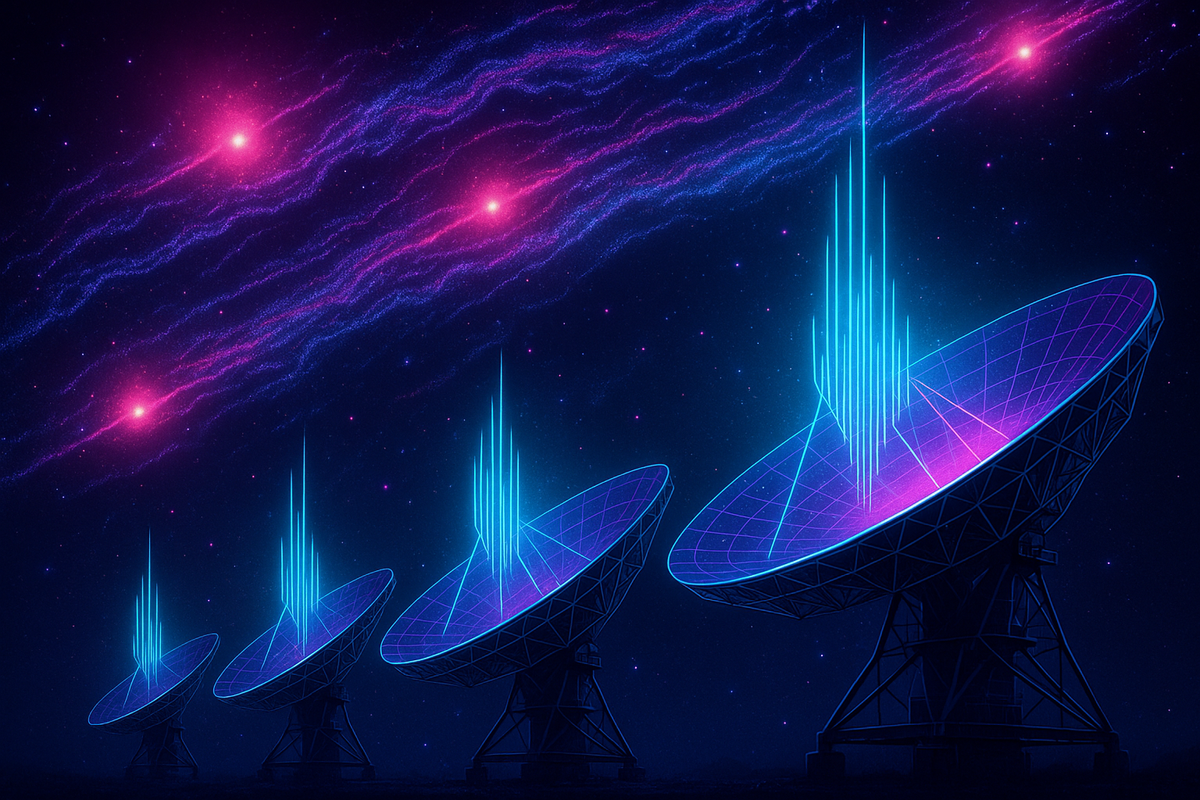
Beyond Little Green Men: The Scientific Search for Alien Technology
Series: Technosignatures | Part: 1 of 9
In 1960, Frank Drake pointed a radio telescope at two nearby stars and listened. For three months, he heard nothing but cosmic static. The project, dubbed Ozma after the queen of Oz, was the first systematic attempt to detect alien intelligence. It failed spectacularly. It also launched a scientific revolution that most people still don't know exists.
Today, the search for extraterrestrial intelligence isn't conducted by wild-eyed enthusiasts scanning the skies for flying saucers. It's performed by astrophysicists, information theorists, and data scientists using some of the most sophisticated detection algorithms ever developed. They're not looking for aliens. They're looking for technosignatures—patterns in astronomical data that can't be explained by natural processes alone.
This is the first article in a series about what might be the most ambitious scientific program in human history: the systematic search for evidence of technology beyond Earth. Not through speculation or wishful thinking, but through rigorous statistical methods applied to massive datasets collected by the world's most advanced telescopes.
The question isn't "Are aliens real?" It's "What would alien technology actually look like in our data, and how would we recognize it?"
From Contact to Detection: The New SETI
The popular imagination treats the search for extraterrestrial intelligence as a single dramatic moment—the scene from Contact where Jodie Foster hears the signal, the universal "hello" transmitted across the void. In reality, modern SETI (Search for Extraterrestrial Intelligence) looks more like an extended exercise in anomaly detection at cosmic scale.
The shift happened gradually. Early SETI focused on narrow-band radio signals—the kind that don't occur naturally and would indicate deliberate transmission. The assumption was straightforward: if aliens wanted to communicate, they'd broadcast on frequencies that cut through cosmic noise. The famous "Wow! signal" detected in 1977 fit this profile perfectly—a 72-second burst at 1420 MHz that has never repeated and remains unexplained. But one unexplained signal in nearly five decades doesn't make for a robust research program.
Modern technosignature science expanded the search space dramatically. Instead of waiting for aliens to intentionally contact us, researchers now look for incidental signatures—the electromagnetic byproducts of advanced technology that might leak into space whether anyone intends it or not. Industrial pollution in exoplanet atmospheres. Laser emissions from megascale engineering projects. Infrared excess from Dyson swarms harvesting stellar energy. Transit patterns that don't match known orbital mechanics.
The conceptual leap is profound. We're no longer asking "Are they trying to talk to us?" We're asking "Would their existence create detectable patterns in the data we're already collecting?"
This reframing transformed SETI from a speculative pursuit into a genuine science with falsifiable hypotheses and statistical methods. It's not about belief. It's about what the evidence permits.
The Statistical Foundations: Why Natural vs. Non-Natural Matters
At its core, technosignature detection rests on a deceptively simple question: Is this pattern more consistent with natural astrophysical processes or with the presence of technology?
This isn't a binary judgment. It's a Bayesian inference problem—comparing competing hypotheses and updating our credence based on the data. Every astronomical observation starts with a null hypothesis: the phenomenon can be explained by known physics operating under known conditions. Technosignature research asks whether that null hypothesis is sufficient, or whether the inclusion of technological explanations provides a better fit to the data.
Consider the now-famous case of Tabby's Star (KIC 8462852). Between 2009 and 2013, the Kepler Space Telescope observed this star dimming irregularly by up to 22%—far more than any known exoplanet transit should produce, and in patterns that defied conventional explanation. The natural hypotheses—cometary debris, protoplanetary disks, instrumental artifacts—all struggled to account for the full range of observations.
One hypothesis that did fit was a megastructure: an artificial construct orbiting the star and periodically blocking its light. A "Dyson swarm" of solar panels, perhaps, or a network of habitats. The proposal wasn't that this was alien technology, but that alien technology was a hypothesis worth investigating because it predicted the observed light curves better than the alternatives.
This distinction is critical. Technosignature science doesn't jump to alien explanations. It systematically explores whether technological hypotheses are statistically competitive with natural ones when both are held to the same evidentiary standards.
The scientific method demands we pursue the hypothesis that best explains the data. When natural explanations fail or require increasingly elaborate assumptions, technological explanations become scientifically necessary to explore—not because we want to find aliens, but because excluding technological hypotheses would be methodologically irresponsible.
Tabby's Star, as it turned out, is now best explained by circumstellar dust clouds with unusual optical properties. But the episode demonstrated something profound: the community treated the technological hypothesis seriously, subjected it to rigorous testing, and discarded it when the evidence failed to support it. This is how science should work.
The Taxonomy of Technosignatures: What We're Actually Looking For
Technosignatures come in multiple categories, each with distinct detection methods and evidentiary standards. Understanding this taxonomy is essential to grasping how modern technosignature science operates.
1. Electromagnetic Technosignatures
These are the classic SETI targets: radio transmissions, laser pulses, and other electromagnetic signals that don't match natural emission spectra.
Radio SETI searches for narrow-band signals—emissions concentrated at specific frequencies rather than spread across the electromagnetic spectrum. Natural astrophysical processes produce broadband radiation; intentional communication requires narrow-band transmission. Projects like Breakthrough Listen analyze billions of radio channels simultaneously, looking for signals that persist at specific frequencies and show Doppler drift consistent with transmission from a rotating planet.
Optical SETI looks for pulsed laser emissions that would appear as brief, intense flashes against the stellar background. A sufficiently advanced civilization could use directed laser beams for interstellar communication or energy transmission, creating detectable signatures in optical and near-infrared wavelengths.
The challenge with electromagnetic technosignatures is the inverse square law—signal strength drops with the square of distance, making detection increasingly difficult as we search farther from Earth. A transmission powerful enough to reach us from thousands of light-years away would require truly monumental energy expenditure. This doesn't make detection impossible, but it constrains the volume of space we can effectively search.
2. Atmospheric Technosignatures
As exoplanet characterization improves, we can now analyze the atmospheric composition of distant worlds by studying how starlight filters through their atmospheres during transits. This opens the possibility of detecting atmospheric technosignatures—chemical signatures that indicate industrial activity.
Chlorofluorocarbons (CFCs), for instance, don't occur naturally in planetary atmospheres. Their presence would be strong evidence of industrial chemistry. Other candidates include nitrogen dioxide at concentrations inconsistent with biological processes, or atmospheric compositions held deliberately out of thermodynamic equilibrium to suit the needs of an advanced civilization.
The advantage of atmospheric technosignatures is that they don't require intentional transmission. A civilization's industrial waste products could be detectable across interstellar distances even if they never built a single radio telescope. The disadvantage is that characterizing exoplanet atmospheres remains extraordinarily difficult with current technology, though next-generation instruments like the James Webb Space Telescope and future extremely large telescopes will dramatically improve our capabilities.
3. Megastructure Technosignatures
The most speculative—yet potentially most detectable—category involves massive engineering projects that would alter the observable properties of stellar systems.
Dyson spheres or Dyson swarms—networks of solar collectors surrounding a star—would absorb visible light and re-emit it as infrared radiation, creating an anomalous infrared excess. Searches for such signatures scan infrared sky surveys looking for objects with stellar masses but infrared-heavy emission spectra.
Transit anomalies caused by artificial structures in orbit could produce light curves inconsistent with natural bodies. Regular geometric patterns, non-Keplerian orbits, or coordinated behaviors across multiple objects would all constitute strong evidence of technological origin.
Stellar engineering signatures might include stars with unusually low metallicity (suggesting advanced civilizations harvesting heavy elements), or binary star systems with mass transfer rates inconsistent with natural evolution.
The key insight is that truly advanced civilizations operating at Kardashev Type II scales (harnessing the full energy output of their star) would necessarily create large-scale signatures detectable across vast distances. They wouldn't need to signal intentionally—their mere existence would alter the observable universe in measurable ways.
4. Artifacts and Probes
Finally, there's the possibility of detecting physical artifacts within our own solar system or nearby stellar neighborhoods. Self-replicating probes, interstellar debris, or even abandoned megastructures left behind by long-dead civilizations could exist in our cosmic backyard.
The recent public interest in unidentified aerial phenomena (UAPs) has renewed scientific discussion about local detection strategies, though the evidentiary bar for claiming artificial origin remains extraordinarily high. More prosaic searches involve surveying asteroids and moons for geometric anomalies or unusual spectral signatures, and analyzing archived sky survey data for fast-moving objects that might represent interstellar probes.
The Drake Equation Revisited: From Speculation to Constraint
In 1961, Frank Drake formulated an equation intended to structure discussions about the prevalence of communicating civilizations in our galaxy:
N = R × f_p × n_e × f_l × f_i × f_c × L*
Where:
- N = number of civilizations capable of communicating
- R* = rate of star formation
- f_p = fraction of stars with planets
- n_e = number of planets per star system in habitable zones
- f_l = fraction where life develops
- f_i = fraction where intelligent life emerges
- f_c = fraction that develop detectable technology
- L = length of time civilizations remain detectable
The equation was never meant to produce precise estimates—most of the terms remain deeply uncertain. Its value lies in decomposing the question "Are we alone?" into tractable components that can be constrained by observation.
Modern technosignature science has made remarkable progress on the early terms. We now know that f_p approaches 1—nearly every star has planets. Kepler and TESS data constrain n_e far better than Drake could have imagined; roughly 20-50% of Sun-like stars have Earth-sized planets in habitable zones.
The later terms—f_l, f_i, f_c—remain profoundly uncertain. We have exactly one example of a technological civilization (ours), making generalization impossible. But this is precisely why detection matters more than speculation. A single confirmed technosignature would transform those uncertain terms into empirical constraints.
The most contentious term is L—how long civilizations remain detectable. This intersects with the Fermi Paradox: if civilizations are common and some have existed for millions of years longer than us, where is everybody? The apparent absence of obvious alien signals suggests either civilizations are rare, technological phases are brief, or advanced civilizations don't produce the kinds of signatures we're searching for.
Each possibility has profound implications. If L is short because civilizations typically self-destruct, we're witnessing a Great Filter that most technological species fail to survive. If L is long but detectable signatures are absent, perhaps advanced civilizations deliberately avoid detection or transition to modes of existence we haven't imagined.
Technosignature science can't answer these questions with theory alone. Only detection—or increasingly stringent non-detection—can constrain the possibilities.
The Coherence Connection: Why Detection Is an Information Problem
From the perspective of AToM (A Theory of Meaning), technosignature detection is fundamentally about recognizing coherence at scales and in forms we don't naturally encounter.
Coherent systems—systems that maintain integrated, structured behavior over time—leave distinctive signatures in the data they generate. A planetary atmosphere in thermodynamic equilibrium looks different from one held deliberately out of equilibrium by industrial activity. Random stellar variability produces different light curves than periodic transit signatures from artificial structures. Broadband electromagnetic noise differs from narrow-band transmissions encoding information.
The mathematical core is this: technology is applied coherence. It's matter and energy organized to maintain specific patterns and achieve specific ends. Those patterns necessarily differ from the patterns produced by unguided physical processes operating under entropic pressures.
Detection, then, isn't about looking for "intelligence" in some abstract sense. It's about identifying coherence profiles that can't be explained by known astrophysical processes alone. This reframing grounds technosignature science in information theory and statistical inference rather than speculative astrobiology.
When we search for technosignatures, we're asking: Does this dataset contain organized information inconsistent with the null hypothesis of natural astrophysical processes? This is a question with a determinate answer, even if actually finding that answer requires analyzing petabytes of observational data with bleeding-edge algorithms.
The challenge is that coherence can masquerade as randomness and vice versa. Cryptographic signals intentionally designed to appear as noise would be invisible to conventional detection methods. Conversely, natural chaotic processes can generate transient patterns that superficially resemble structure. Distinguishing genuine non-natural coherence from noise and from natural-but-complex processes is the central technical challenge of the field.
This is where machine learning becomes essential. Modern technosignature searches increasingly rely on neural networks trained to recognize subtle anomalies in massive datasets—patterns human observers might miss, or patterns too high-dimensional for traditional statistical methods. The question is whether these algorithms can reliably distinguish technological signatures from astrophysical edge cases we haven't yet characterized.
The Ethics and Implications of Detection
If technosignature science succeeds—if we detect unambiguous evidence of extraterrestrial technology—the implications cascade through every domain of human thought.
Scientifically, a confirmed detection would be the most significant discovery in history. It would prove that abiogenesis and technological development aren't singular flukes but repeatable outcomes of physical law. It would provide a second datapoint for the evolution of intelligence, allowing us to begin generalizing about the conditions and trajectories of technological civilizations.
Philosophically, detection would resolve the question of humanity's cosmic uniqueness definitively. We'd know with certainty that we're not alone, and that the universe is—at least in some places and at some times—populated by minds and technologies other than our own. The psychological and cultural impact would be profound and unpredictable.
Practically, the consequences depend entirely on the nature of the detection. A radio signal from 10,000 light-years away tells us aliens existed 10,000 years ago, but provides no opportunity for interaction. An infrared signature from a Dyson swarm orbiting a nearby star suggests a vastly more advanced civilization whose current disposition toward us remains unknown. A self-replicating probe in our own solar system would raise immediate questions about contact protocols and potential risks.
Ethically, detection raises questions we've barely begun to address. Should humanity respond to a detected signal? If so, who decides the content of that response? What if detection reveals civilizations at wildly different developmental stages—would we have obligations to less advanced civilizations, or vulnerability to more advanced ones?
The METI debate (Messaging Extraterrestrial Intelligence) highlights these tensions. Some researchers argue we should actively transmit signals announcing our presence; others warn that revealing ourselves to unknown civilizations could be catastrophically dangerous. The absence of consensus reflects the genuinely unknowable nature of the risks and benefits.
What's clear is that technosignature detection isn't a purely academic exercise. It's a research program with potentially civilization-altering consequences, conducted by a small community of scientists making decisions that could affect the entire species. This raises profound questions about governance, transparency, and whether humanity is ready to engage with the implications of its own curiosity.
The Search Ahead: What This Series Will Cover
Technosignature science sits at the intersection of astrophysics, information theory, statistics, and philosophy. It asks some of the deepest questions accessible to empirical investigation: Are we alone? How common is intelligence? What is the ultimate fate of technological civilizations?
This series will explore the cutting edge of these questions, article by article:
-
Radio SETI and machine learning: How neural networks are transforming the search for electromagnetic signals, and what the latest Breakthrough Listen results reveal about the radio sky.
-
Atmospheric biosignatures vs. technosignatures: How next-generation telescopes will analyze exoplanet atmospheres, and what chemical signatures would constitute smoking-gun evidence of technology.
-
The Dyson swarm hypothesis: Whether megastructures are plausible, how we'd detect them, and what the absence of obvious infrared excess tells us about galactic-scale engineering.
-
Oumuamua and the interstellar object debate: What the first confirmed interstellar visitor to our solar system revealed about the challenge of distinguishing natural from artificial artifacts.
-
The zoo hypothesis and the Great Silence: Why the Fermi Paradox might be resolved by civilizations deliberately hiding, and what that implies about our own trajectory.
-
The intelligence-detection problem: Whether we could reliably recognize alien intelligence even if it doesn't resemble ours, and what non-anthropocentric search strategies might look like.
-
Ethics of contact and METI: The governance challenges of deciding whether and how humanity should signal its presence to the cosmos.
-
Technosignatures in archival data: How researchers are mining decades of astronomical observations for anomalies that might have been overlooked.
-
The Bayesian case for continued search: What non-detection tells us, and how to update our priors as search volumes expand without positive results.
-
Synthesis: Coherence, intelligence, and the structure of the search: How technosignature science connects to deeper questions about what intelligence is, how it manifests, and why coherence theory provides a unifying framework.
Each article will blend rigorous scientific detail with the broader implications of what we're actually doing when we search for alien technology. This isn't science fiction. It's science—strange, ambitious, and profoundly consequential.
Why This Matters Now
We are living through the first era in human history when technosignature detection is not just plausible, but inevitable given sufficient time and resources. The exponential growth in observational astronomy—driven by space telescopes, wide-field surveys, and machine learning—means we're generating more data about the universe every year than in all previous history combined.
If technosignatures exist in that data, we will find them. The question is when, not if.
This series is an attempt to prepare for that possibility—to understand what we're actually looking for, what detection would mean, and how the search itself reveals fundamental truths about coherence, intelligence, and the structure of the cosmos.
The search for alien technology isn't a fringe pursuit conducted by eccentrics. It's a serious scientific program asking the most profound question available to empirical investigation: Is the universe populated by minds other than our own?
We're about to find out.
This is Part 1 of the Technosignatures series, exploring the scientific search for extraterrestrial technology through rigorous detection methods, statistical inference, and coherence theory.
Next: "Radio SETI and Machine Learning: How Neural Networks Are Transforming the Search for Electromagnetic Signals"
Further Reading
- Wright, J.T., et al. (2014). "The G Infrared Search for Extraterrestrial Civilizations with Large Energy Supplies. I. Background and Justification." The Astrophysical Journal, 792(1), 26.
- Tarter, J. (2001). "The Search for Extraterrestrial Intelligence (SETI)." Annual Review of Astronomy and Astrophysics, 39, 511-548.
- Lingam, M., & Loeb, A. (2021). Life in the Cosmos: From Biosignatures to Technosignatures. Harvard University Press.
- Sheikh, S.Z., et al. (2021). "Characterizing Atmospheric Technosignatures." Nature Astronomy, 5, 1148-1155.
- Breakthrough Listen. (2023). "Breakthrough Listen Search for Intelligent Life: Public Data Archive." Berkeley SETI Research Center.
- Haqq-Misra, J., et al. (2022). "Searching for Technosignatures in Exoplanetary Systems with Current and Future Missions." Acta Astronautica, 198, 194-207.
Comments ()