Beyond Shannon: How Assembly Theory Differs from Information Theory
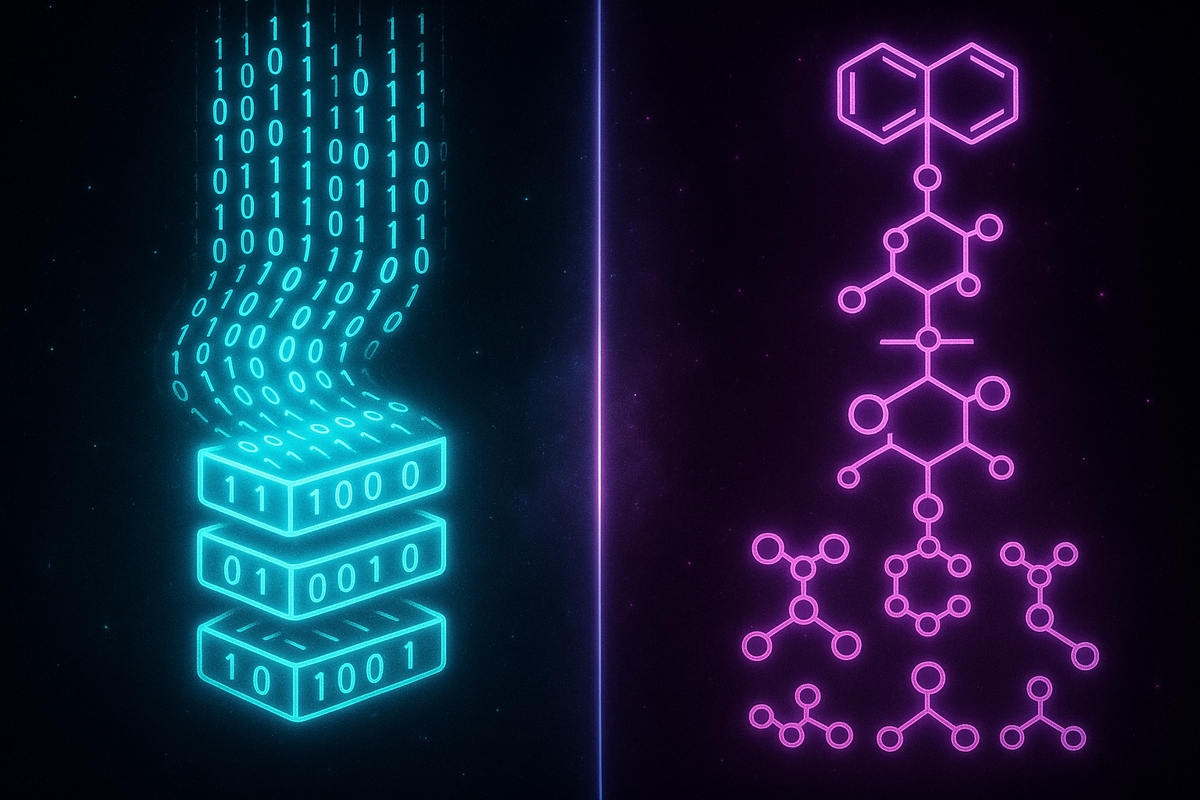
Shannon information measures how surprising a message is. Assembly theory measures how many steps it takes to build a molecule from scratch. That distinction — history vs. probability — is what makes assembly theory a candidate theory of life.
Beyond Shannon: How Assembly Theory Differs from Information Theory
Series: Assembly Theory | Part: 4 of 9
Claude Shannon's 1948 paper "A Mathematical Theory of Communication" gave us information theory—a way to measure surprise, redundancy, and the amount of data needed to transmit a message. It became foundational to computer science, telecommunications, and eventually to theories of cognition and consciousness. Shannon entropy tells you how much information is in a message by measuring how unpredictable it is.
But there's something Shannon information can't capture: how hard something was to build.
Assembly theory, developed by Lee Cronin and Sara Walker, measures something fundamentally different. It doesn't ask "How surprising is this pattern?" It asks "What's the minimum number of construction steps this object required?" That shift—from pattern to process, from surprise to history—reveals a distinction with profound implications for how we understand complexity, life, and meaning.
This isn't a replacement for Shannon. It's a complement. And understanding the difference illuminates why both matter—and why neither alone is sufficient.
What Shannon Measures: Pattern Without History
Shannon entropy quantifies the information content of a message by measuring its unpredictability. A perfectly random string has maximum Shannon entropy because every next symbol is maximally surprising. A repeated pattern (AAAAAAA...) has minimal Shannon entropy because once you know the rule, the rest is predictable.
This makes Shannon entropy excellent for compression. If I can encode your message more efficiently because it has internal redundancy, that's because its Shannon entropy is lower than it appears. Zip files exploit this. So does MP3 compression. Shannon gave us the mathematics of efficient communication.
But consider two molecules with identical Shannon entropy—one produced by random chemistry, the other by biological selection. Shannon information treats them as equivalent. Both have the same statistical properties, the same degree of surprise, the same compressibility.
Yet one emerged from billions of years of evolution, the other from minutes of thermal fluctuation. History disappears in Shannon's framework. Pattern is everything. Process is invisible.
This isn't a flaw. Shannon never claimed to measure history. His framework was designed to optimize transmission, not to detect the difference between life and non-life, between design and randomness, between constructed and accidental complexity.
But that limitation matters when you're trying to understand what makes life special—or when you're trying to detect it on other worlds.
What Assembly Measures: Construction Depth
Assembly theory asks a different question: What's the shortest path to construct this object from elementary parts?
The assembly index of a molecule is the minimum number of joining operations needed to build it, assuming you can reuse any intermediate structure you've already made. This isn't a measure of how surprising the molecule is. It's a measure of how much assembly history it required.
A simple molecule might assemble in one or two steps. A complex biological molecule—say, a protein with hundreds of amino acids folded into a specific functional shape—requires many steps. Not just many atoms, but many sequential construction operations.
Critically, high assembly requires something beyond random chemistry: selection. If you're going to make something with an assembly index above ~15 (Cronin and Walker's empirical threshold), you need mechanisms to stabilize intermediates, copy successful structures, and build on previous results. You need memory. You need iteration.
Random processes alone don't scale to high assembly. They produce low-assembly objects or they produce noise. Life produces high-assembly objects because it has mechanisms—replication, heredity, natural selection—that allow cumulative construction over time.
This is why assembly index might detect biosignatures. High assembly is a marker of selection acting over time, preserving and building on intermediate complexity. Shannon information doesn't give you this. You can have high Shannon entropy in pure noise. You cannot have high assembly in pure noise.
The Key Difference: Compressibility vs. Constructability
Here's the clearest way to see the distinction:
Shannon entropy measures compressibility. It tells you how short a description you can write of a pattern, given its statistical properties. Maximum entropy means no compression is possible—every bit is necessary.
Assembly index measures constructability. It tells you the shortest construction path to build the object, assuming you can reuse intermediates. Low assembly means few steps. High assembly means many steps, implying selection.
Consider a random string of 1000 characters with maximum Shannon entropy. It can't be compressed—you need all 1000 characters to transmit it. But its assembly index is low. Each character could have appeared independently; there's no construction depth, no reuse of structure, no cumulative history.
Now consider a carefully designed recursive structure—say, a fractal or a folded protein. Its Shannon entropy might be lower than the random string (because there's pattern, hence compressibility). But its assembly index is higher because constructing that precise structure requires many sequential steps, building from simpler components through intermediate forms.
Shannon focuses on redundancy. Assembly focuses on ancestry.
This distinction has implications:
- Shannon treats all randomness as equivalent. Assembly distinguishes between low-assembly noise and the absence of high-assembly structure.
- Shannon is indifferent to physical realizability. Assembly cares about the actual steps required to construct something in physical space-time.
- Shannon doesn't require causality. Assembly is inherently causal—it measures construction history.
They're measuring different things. Neither is "better." But they complement each other in ways that matter.
Why History Matters: The Case of Biosignatures
Imagine you're analyzing molecular samples from an exoplanet. You detect a set of complex organic molecules. How do you know if they came from life or from abiotic chemistry?
Shannon information alone won't tell you. A complex molecule can have high Shannon entropy just by being structurally irregular—lots of unpredictable variation. But that doesn't distinguish biological from non-biological origin. A random polymer could be just as "surprising" statistically as a functional protein. Shannon's framework is indifferent to the distinction.
Assembly index gives you something Shannon doesn't: a measure of cumulative construction. If you find molecules with assembly indices above the threshold where random processes alone can't explain them—where the probability of assembling such a structure without selection becomes vanishingly small—you have evidence of life-like processes.
Cronin and Walker tested this experimentally. They analyzed samples from biology (E. coli extracts, yeast, beer) and non-biological chemistry (crude oil, lab reagents). Biological samples showed a distinctive distribution: many molecules with assembly indices above 15. Abiotic samples did not. The threshold held across contexts.
What makes this powerful is that it's not a statistical argument about likelihood given current conditions. It's a causal argument about the construction process itself. High-assembly molecules require mechanisms that preserve intermediate steps, copy successful structures, and build iteratively on previous results. They require memory encoded in the physical structure of the system—whether that's DNA sequences, template molecules, or cellular machinery.
This is what random chemistry lacks. Random processes can generate complex-looking outputs, but they don't sustain the causal chains required for high assembly. Each molecule is independent, the result of thermal fluctuation or chemical equilibration, not cumulative construction.
This isn't about information content in Shannon's sense. It's about construction history. Life builds molecules that require many steps, where each step depends on previous steps being preserved and reused. Random chemistry doesn't do this at scale.
History becomes a detectable signature.
Shannon information can't capture this because it abstracts away from time. It treats a message as a static distribution of symbols. Assembly index, by contrast, is inherently temporal. It measures depth in causal space—how many generative steps preceded this structure.
This matters for biosignature detection, but it also matters conceptually. It suggests that complexity isn't just about surprise or entropy. It's about the depth of construction that produced the structure. Some things are complex because they're random. Others are complex because they're built.
Assembly theory helps you tell the difference.
Where They Converge: Algorithmic Information Theory
There's a middle ground worth noting: Kolmogorov complexity (also called algorithmic information theory). This measures the length of the shortest program that can generate a given string. It's closer to assembly than Shannon entropy because it's about generation, not just statistical pattern.
A random string has high Kolmogorov complexity—you can't write a shorter program than the string itself. A patterned string (like "ABABAB..." repeated) has low Kolmogorov complexity—the program print("AB" * 500) is much shorter than the output.
Kolmogorov complexity shares assembly theory's focus on construction. Both ask: What's the shortest path to generate this? But there are critical differences:
-
Kolmogorov is about computation. Assembly is about physical construction. The former abstracts away from space-time; the latter is grounded in it.
-
Kolmogorov allows arbitrary programs. Assembly restricts you to operations available in the physical environment—joining, copying, folding. This constraint matters.
-
Kolmogorov is uncomputable. You can't algorithmically determine the Kolmogorov complexity of an arbitrary string (it's undecidable). Assembly index is computable—you can measure it experimentally via mass spectrometry.
So while Kolmogorov complexity bridges the gap conceptually, assembly theory remains distinct. It's not trying to be a theory of computation. It's trying to be a theory of physical complexity—complexity as it manifests in molecules, organisms, and potentially other causal structures.
This grounding in physicality is what makes assembly index practically useful for detecting life. You don't need to solve the halting problem. You need to count construction steps in chemical space.
From Molecules to Meaning: Can Assembly Scale?
Here's where it gets speculative—but productively so. If assembly index measures the construction depth of molecules, can the same principle apply to other domains? Can we talk about the assembly index of ideas, languages, cultures?
Consider a meme—an idea that spreads through culture. Some memes are simple, requiring minimal conceptual prerequisites. Others are complex, building on layers of prior understanding. To grasp quantum mechanics, you need classical mechanics, calculus, and a baseline understanding of probability. These are construction dependencies—each concept assembles from earlier concepts.
Could we measure the assembly index of cultural artifacts?
In principle, yes—though the details get thorny. You'd need to define what counts as an "elementary operation" in conceptual space. Is it a basic cognitive primitive? A fundamental metaphor? A lexical unit? The framework becomes less rigorous as you move away from physical construction.
But the intuition remains compelling. Some meanings are shallow—easily acquired, minimally dependent on prior context. Others are deep—requiring extensive conceptual scaffolding, iterated refinement, cumulative cultural transmission. The latter have high "assembly" in a metaphorical but perhaps formalizable sense.
This connects to AToM's claim that meaning is a kind of coherence. In assembly terms: meaning has depth when it integrates many layers of construction, when it coheres across multiple scales of assembly. A shallow idea is low-assembly—it doesn't build on much. A profound idea is high-assembly—it crystallizes centuries of thought, connecting disparate domains into a structure that couldn't have been assembled in one step.
This isn't proven. It's a hypothesis worth testing. But it suggests that assembly theory's core insight—construction depth matters—applies beyond chemistry.
Synthesis: Why Both Frameworks Matter
Shannon information and assembly theory aren't rivals. They're complementary lenses.
Shannon tells you about pattern. It measures redundancy, compressibility, the statistical structure of signals. This is essential for communication, computation, and understanding how efficiently information can be transmitted or stored.
Assembly tells you about process. It measures construction depth, the minimum causal steps required to build something. This is essential for understanding life, detecting biosignatures, and distinguishing between accidental and cumulative complexity.
Together, they give you a more complete picture:
- High Shannon entropy, low assembly: Pure noise—random, incompressible, but shallow.
- Low Shannon entropy, low assembly: Simple patterns—redundant, compressible, still shallow.
- High Shannon entropy, high assembly: Biologically relevant—complex, not compressible by simple rules, but requiring deep construction history.
- Low Shannon entropy, high assembly: Organized structures—patterned, potentially compressible, but with deep causal history.
Life tends toward the third and fourth quadrants. Random chemistry stays in the first two.
The difference is history. Shannon abstracts it away. Assembly puts it center stage.
In AToM terms, this maps onto the distinction between coherence (pattern that holds together) and time (the construction process that generates coherence). Shannon measures the former. Assembly measures the latter. M = C/T suggests you need both—a system's meaning emerges from coherence sustained over construction time.
Put differently: Shannon tells you about the geometry of information—its structure, redundancy, compressibility. Assembly tells you about the trajectory through which that structure came to be—the path through construction space, the depth of assembly history.
Both are necessary. A message might be coherent (low Shannon entropy, high pattern) but shallow (low assembly, easily constructed). Think of a simple repeated motif. Or it might be incoherent (high Shannon entropy, random) but also shallow (low assembly, no construction depth). This is pure noise.
The interesting quadrant is high coherence and high assembly—structures that are both patterned and deeply constructed. These are the signatures of life, culture, and meaning. They don't arise by accident. They require processes that preserve, iterate, and build over time.
Assembly theory reminds us that not all complexity is the same. Some patterns are shallow—the result of randomness or simple iteration. Others are deep—the result of selection, memory, and cumulative construction.
Shannon can't tell you which is which. Assembly can.
This is Part 4 of the Assembly Theory series, exploring how Lee Cronin's Assembly Theory illuminates the origins of complexity and life.
Previous: Why Life Chemistry Is Special: What Assembly Theory Reveals About Biological Molecules
Next: Selection as Constructor: Where Assembly Theory Meets Constructor Theory
Further Reading
- Sharma, A., Czégel, D., Lachmann, M., Kempes, C.P., Walker, S.I., & Cronin, L. (2023). "Assembly theory explains and quantifies selection and evolution." Nature, 622, 321–328.
- Shannon, C.E. (1948). "A Mathematical Theory of Communication." Bell System Technical Journal, 27(3), 379–423.
- Li, M., & Vitányi, P. (2008). An Introduction to Kolmogorov Complexity and Its Applications. Springer.
- Walker, S.I. (2017). "Origins of life: A problem for physics, a key issues review." Reports on Progress in Physics, 80(9), 092601.
Comments ()