The Bioelectric Future: A Synthesis
Bioelectricity predates the nervous system by hundreds of millions of years. Evolution kept it because it solves a hard problem: how do cells that can't see each other coordinate into a coherent body plan? The answer is elegant and still being decoded.
The Bioelectric Future: A Synthesis
Series: Bioelectric Code | Part: 7 of 7 Primary Tag: FRONTIER SCIENCE Keywords: bioelectricity, regenerative medicine, developmental biology, Michael Levin, biological computation, coherence
A New Layer of Biological Information
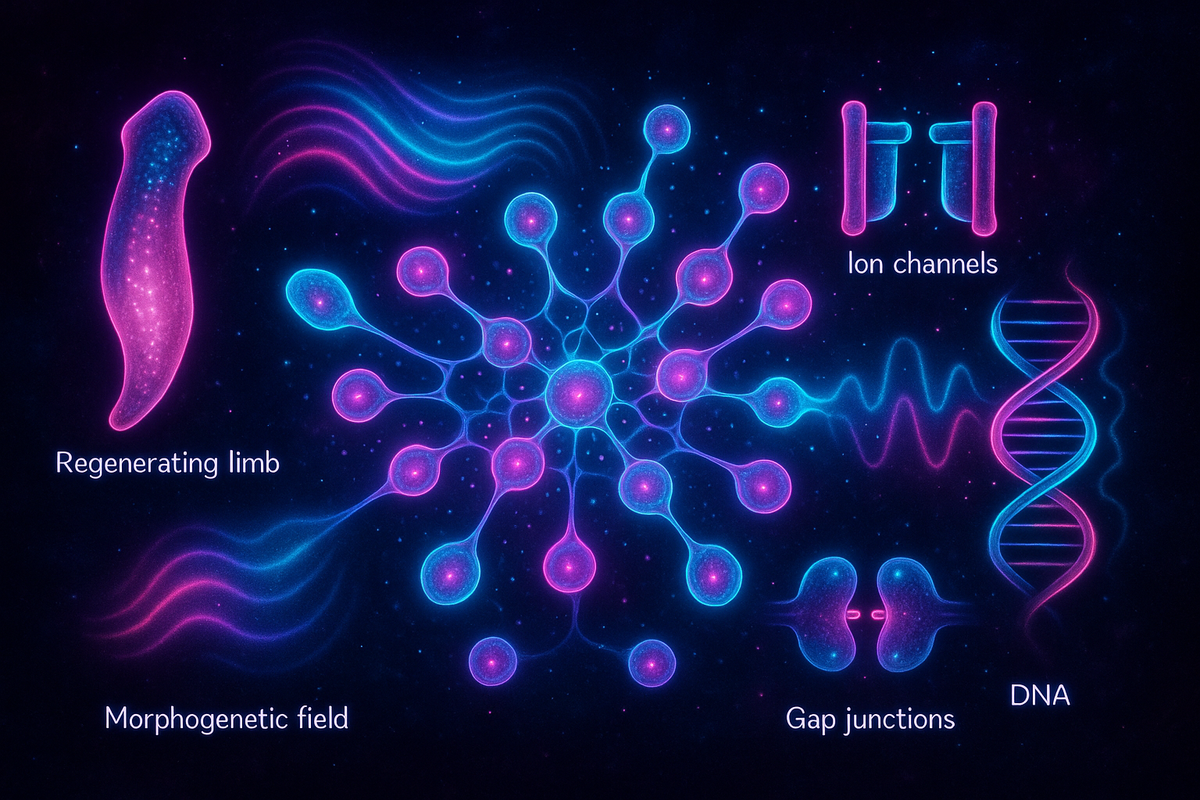
The central insight is simple but profound: there's more information in biology than DNA. The genomic revolution trained us to see DNA as "the code of life"—the instruction set, the blueprint, the master controller. Sequence the genome and you understand the organism. Edit the genes and you control the phenotype. This was always somewhat oversimplified, but it was productive. Genomics transformed medicine, agriculture, evolutionary biology. The successes were real. But it was also incomplete. The same genome produces every cell type in your body. The same DNA builds brain and bone. Sequence doesn't explain pattern. Bioelectricity provides part of the missing layer. The voltage patterns across tissues constitute information—positional information, coordination information, target morphology information. This information isn't written in DNA (though the machinery that creates it is genetically encoded). It's computed by cells in real-time, stored in ion gradients and gap junction networks, and transmitted through electrical coupling. It's a different kind of code. Not sequence (letters in a row), but state (voltage values in space). Not static (fixed once written), but dynamic (continuously maintained). Not located (in a specific molecule), but distributed (across cellular networks). The bioelectric code doesn't replace the genetic code. It complements it. Genes specify what's possible; bioelectric patterns specify what happens.
The Computational Metaphor
Michael Levin, whose laboratory has driven much of the bioelectric renaissance, uses computational language deliberately. Cells are computing systems. They take inputs (signals from neighbors, morphogens, mechanical forces, voltage gradients), process them (through signaling cascades, gene regulatory networks), and produce outputs (gene expression, secretion, division, movement). This is computation, even if it doesn't look like a silicon chip. The bioelectric network is a computational medium. Gap junctions connect cells into circuits. Voltage changes propagate through networks. The tissue computes its configuration. The target morphology is like a setpoint in a control system. The bioelectric pattern encodes what the tissue "should" look like. Deviations trigger corrective responses (regeneration, wound healing). The system maintains itself against perturbation. This computational view has practical implications: Reprogramming, not micromanagement. Instead of controlling each cell individually, you can reprogram the bioelectric setpoint and let the cells figure out the rest. Tell the system "make a leg here" by establishing the right voltage pattern, and the cells execute the program. Top-down causation. In a computational system, the pattern-level organization causally affects the component behavior. The bioelectric field influences cells; cells influence the field. They're coupled levels of a unified system. Information as intervention target. If bioelectricity is information, then therapies can target information—correcting the message rather than replacing the parts.
Evolutionary Perspective
Bioelectricity is ancient. Ion gradients across membranes predate multicellularity. The basic electrical properties of cells evolved billions of years ago. What changed with multicellularity was the network. Gap junctions appeared, connecting cells electrically. Suddenly, bioelectric states could be shared across cell groups. Coordination at tissue scale became possible. This may have been key to the evolution of complex body plans. The Cambrian explosion—the rapid diversification of animal forms starting ~540 million years ago—required new mechanisms for creating and maintaining complex shapes. Bioelectric signaling may have provided a substrate for morphological innovation. The toolkit is conserved. The same ion channels, the same connexins, the same voltage-sensitive signaling pathways appear across animals. What varies is how they're deployed—which channels where, which patterns when. This conservation makes bioelectric research broadly applicable. What we learn in planaria informs what's possible in humans. The underlying mechanisms are shared.
Clinical Horizons
Where is bioelectric medicine heading? Regenerative medicine. The dream is triggering mammalian regeneration—regrowing lost limbs, organs, tissues. Humans have the genes for regeneration; we regenerate some tissues (liver, skin). The barrier is regulatory, not genetic. Bioelectric manipulation might release that potential. Current status: early. Encouraging results in wound healing and nerve regeneration. Limb regrowth is far off but no longer inconceivable. Cancer treatment. If depolarization and gap junction loss contribute to malignancy, bioelectric intervention might complement conventional therapies. Ion channel drugs are in clinical trials. Gap junction modulators are in development. Current status: translational. Moving from laboratory to clinic. Not yet standard of care. Birth defect prevention/correction. If bioelectric patterns guide development, manipulating those patterns might prevent or correct developmental abnormalities. This is harder because it requires intervention during pregnancy, with all associated safety concerns. Current status: basic research. Proof of concept in animal models. Human applications distant. Wound healing. Electrical stimulation has been used clinically for wounds for decades. The bioelectric framework provides mechanistic understanding and targets for improvement. Current status: clinical use exists but is not optimized. Better-targeted approaches emerging. Neural repair. Brain and spinal cord injuries involve both neural damage and bioelectric disruption. Restoring normal bioelectric environments might enhance neural repair processes. Current status: active research. Some promising results in spinal cord injury models.
The Coherence Synthesis
Throughout this series, we've used "coherence" as a lens. Let's make that explicit. A coherent system is one whose parts maintain stable, functional relationships through dynamic interaction. Coherence isn't rigid—it's maintained despite perturbation, restored after disruption, adaptive to changing conditions. A coherent system self-organizes toward functional states. Bioelectric coherence in normal tissue:
- Cells maintain appropriate membrane voltages
- Gap junctions create electrical coupling across tissue regions
- Voltage patterns encode appropriate positional information
- Perturbations (wounds, damage) trigger coordinated responses
- The system maintains and repairs itself
Bioelectric incoherence in pathology:
- Cells are depolarized (wrong voltage)
- Gap junctions are lost (isolation)
- Positional information is corrupted (pattern breakdown)
- Coordination fails (uncontrolled growth, mispatterning)
- The system loses self-maintenance capacity
Cancer is bioelectric incoherence. Birth defects are bioelectric incoherence. Failed regeneration is bioelectric incoherence. Health is maintained coherence. Development is coherence establishment. Regeneration is coherence restoration. This isn't just metaphor. It's measurable. The voltage patterns, the gap junction networks, the coordination dynamics—these can be quantified, mapped, manipulated. Coherence is a scientific concept, not just a poetic one.
What Bioelectricity Doesn't Explain
The bioelectric framework is powerful but not complete: Biochemistry still matters. Bioelectricity works through ion channels, and ion channels are proteins encoded by genes. The bioelectric level supervenes on the molecular level. You can't understand one without the other. Mechanics matter. Cells experience forces—tension, compression, shear. Mechanotransduction affects gene expression, cell behavior, tissue organization. Bioelectricity interacts with but doesn't replace mechanics. Not everything is bioelectric. Some patterning is purely chemical (morphogen gradients without voltage involvement). Some is purely mechanical. Bioelectricity is one layer, not the only layer. Specifics are often unknown. The framework is established; the details are often missing. What exact voltage pattern specifies "grow a leg"? We don't know yet. The principles are clear; the parameters are not. Translation is hard. Moving from model organisms (planaria, frogs) to humans involves huge complexity gaps. What works in a flatworm may not work in a mammal. The bioelectric revolution expands biology. It doesn't simplify it.
The Philosophical Coda
What does bioelectricity suggest about life and mind? The body computes. Not just the brain—the whole body. Every tissue maintains state, processes information, coordinates with neighbors. Cognition isn't confined to neurons; it's a spectrum that extends throughout biological systems. Michael Levin calls this "basal cognition"—intelligence at the cellular level. Information is physical. The bioelectric code is literally made of voltage—differences in ion concentration across membranes. Information isn't abstract; it's embodied in the physical state of the system. To change the information, you change the voltage. Causation is circular. Genes encode ion channels. Ion channels create voltage. Voltage affects gene expression. It's a loop, not a line. The genome doesn't "control" the organism; the organism is a self-maintaining pattern in which genes and bioelectricity and everything else participate. The self is distributed. If your cells maintain voltage patterns that encode what your body should look like, and those patterns can be rewritten, and the rewriting changes what your cells become—then what you are is a dynamic pattern, not a fixed thing. You are the process of maintaining yourself. This connects to ancient philosophical questions about identity, change, and what it means to be a self. The bioelectric framework doesn't answer those questions, but it provides new ways to think about them.
The Frontier
We're in the early days of the bioelectric revolution. The tools are improving—better voltage-sensing proteins, better optogenetic control of ion channels, better computational models of bioelectric networks. The community is growing—more labs, more funding, more publications. The clinical applications are approaching—ion channel drugs in trials, regeneration research advancing. In twenty years, we may look back at the current moment the way we now look at the early days of genomics. The basic insights are in place; the applications are emerging; the transformation of medicine is beginning. Your cells are batteries. Your tissues are circuits. Your body is computing itself into existence, every moment, through the bioelectric code. That code is now legible. And increasingly, writeable.
Further Reading
- Levin, M. (2021). "Bioelectric signaling: Reprogrammable circuits underlying embryogenesis, regeneration, and cancer." Cell.
- Levin, M. (2019). "The Computational Boundary of a 'Self': Developmental Bioelectricity Drives Multicellularity and Scale-Free Cognition." Frontiers in Psychology.
- Durant, F. et al. (2019). "The role of early bioelectric signals in the regeneration of planarian anterior/posterior polarity." Biophysical Journal.
- McLaughlin, K.A. & Bhavsar, M.B. (2023). "Bioelectricity in regenerative medicine: Current and future directions." Stem Cell Research & Therapy.
This concludes the Bioelectric Code series. For more Frontier Science explorations, visit the Series Hub.


Comments ()