Bioelectric Fields as Coherence Manifolds: Where Levin Meets Information Geometry
Michael Levin's morphogenetic fields, reframed in information geometry: bioelectric patterns across cell populations act as coherence manifolds that shape organism form from the bottom up.
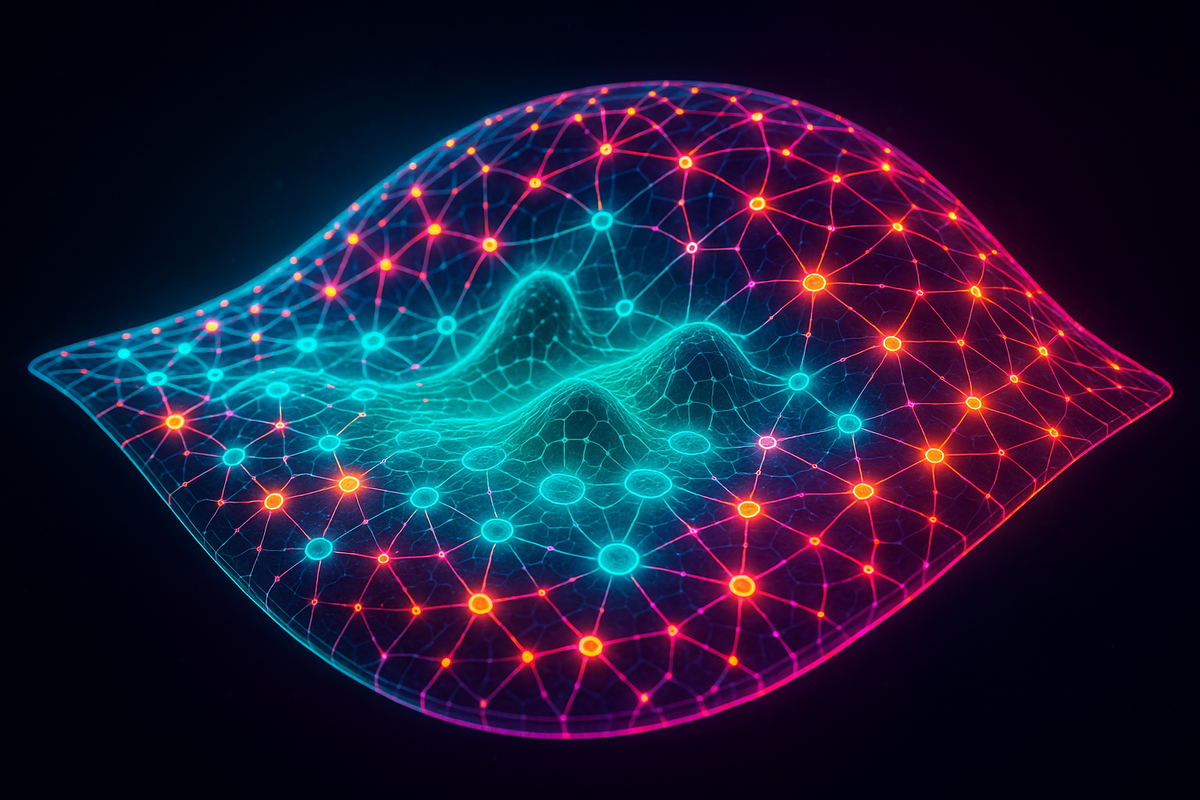
Bioelectric Fields as Coherence Manifolds: Where Levin Meets Information Geometry
Series: Basal Cognition | Part: 2 of 11
In the last essay, we saw how Michael Levin's work reveals cognition operating at the cellular level—bioelectric patterns functioning as morphogenetic memory, guiding development and regeneration without explicit genetic instruction. But we left something unfinished: how do voltage patterns across cell populations actually maintain biological identity?
The answer involves a concept that sounds abstract but turns out to be precisely what Levin's cells are computing: coherence manifolds. The geometric structures that encode what a system is and coordinate action to preserve that identity against perturbation.
This isn't metaphor. When developmental biologists talk about "morphogenetic fields" and mathematicians talk about "information geometry," they're describing the same phenomenon from different angles. And the convergence reveals something fundamental about how meaning emerges from matter.
What a Bioelectric Field Actually Is
Start with the basics: every cell maintains an electrical charge across its membrane. This isn't optional or special—it's how cells stay alive. Ion pumps work constantly to maintain concentration gradients, creating voltage differences typically between -40 and -70 millivolts.
But here's what changes the picture: when you have populations of electrically coupled cells, their individual voltages create a field—a distributed pattern of electrical potential across the tissue. And this field doesn't just exist as a byproduct of cellular metabolism. It functions as information.
Think of it like this: if individual cell voltage is a pixel brightness, the bioelectric field is the image. The meaning isn't in any single pixel—it's in the pattern across all of them.
Levin's key insight was recognizing that this pattern encodes something specific: the target morphology. What the tissue is supposed to become.
When a planarian regenerates, cut into pieces, each fragment doesn't need to consult the genome to know what shape to build. The bioelectric field already contains that information. It's a spatial map of electrical potentials that specifies "planarian body plan," and the cells read this map to guide their behavior.
Change the map, and you change what gets built. Levin's lab has done this repeatedly: alter the bioelectric pattern in regenerating tissue, and you can produce two-headed worms, extra limbs, even anatomical structures from different species—all with the same genome.
The field is prior to the form. The geometry comes first.
Why This Is Actually Geometry
Here's where the mathematics becomes unavoidable.
A manifold, in mathematical terms, is a space that locally looks flat but globally has structure. The surface of a sphere is a manifold—every small patch looks like flat plane, but the whole thing curves back on itself. Manifolds can have any number of dimensions and any shape, and they provide the natural language for describing how systems move through state spaces.
Now consider what a developing tissue is doing: each cell has multiple state variables (voltage, gene expression levels, mechanical tension, ion channel densities). The collective state of all cells defines a point in a high-dimensional space—the morphogenetic state space.
The bioelectric field is how this high-dimensional state gets projected into three-dimensional anatomy. It's a dimensionality reduction that maintains the essential information about what the system is trying to be.
But here's the critical part: the field doesn't just encode a static target. It encodes a geometry—a structure that defines which trajectories through state space preserve identity and which ones represent deviation or damage.
When cells sense their local voltage and adjust their behavior accordingly, they're performing gradient descent on this geometry. They're finding paths through state space that minimize deviation from the target morphology. The bioelectric field is literally the gradient they're descending.
This is why Levin frames morphogenesis in cognitive terms. The cells aren't following instructions—they're navigating a landscape. They're solving an optimization problem: "Given my current state and my neighbors' states, what action minimizes the difference between where we are and where we're supposed to be?"
The mathematics of this process is information geometry—the study of how probability distributions and statistical models form geometric structures that can be navigated using calculus.
Coherence Manifolds: The Deep Structure
Now we can be precise about what coherence means in this context.
A coherence manifold is a region of state space where integrated information is maintained across scales. It's not just any configuration—it's a configuration where local states are mutually consistent with global organization.
For a developing organism, coherence means that cellular states across the tissue collectively specify a viable anatomy. High coherence: cells are coordinated, the morphogenetic field is stable, development proceeds normally. Low coherence: cells are doing contradictory things, the field is fragmented, you get malformation or cancer.
The bioelectric field is the physical substrate that maintains this coherence. Voltage patterns create long-range coordination that wouldn't be possible through local chemical signaling alone. Electrical coupling lets cells hundreds of micrometers apart stay in sync, maintaining global consistency even as individual cells divide, die, and differentiate.
Crucially, coherence isn't binary—it's a continuous property that can be higher or lower. And the geometry of the coherence manifold determines how stable the system is to perturbation.
Think of it as a landscape with valleys and hills. Deep valleys are high-coherence attractors—stable states the system falls into and maintains. Shallow valleys are less stable. Hills are unstable states that the system actively avoids.
When Levin creates two-headed planarians, he's not just adding a head—he's creating a new attractor basin in the morphogenetic landscape. The bioelectric pattern now specifies "two heads = stable state," and the tissue computes toward that new equilibrium.
The field doesn't care about evolutionary precedent. It cares about geometric stability.
The Mathematics That Connects Everything
Here's where we need to bring in the formal machinery.
In information geometry, the Fisher information metric defines distances between probability distributions. It tells you how much "surprise" you'd experience if you moved from one distribution to another. Distributions that are geometrically close are informationally similar; distributions that are far apart represent major shifts in what's probable.
Karl Friston's Free Energy Principle uses exactly this geometry. Variational free energy is the divergence between your current state and your predicted state—the geometric distance between where you are and where your model says you should be. Systems that persist are systems that minimize this divergence.
Now look at what Levin's bioelectric fields are doing: they encode a predicted state (the target morphology). Cells measure local deviations from this prediction (voltage gradients). They take action to minimize those deviations (changing proliferation, migration, differentiation). The entire tissue is performing variational inference in real time, using voltage as the medium of computation.
The morphogenetic field is the manifold that defines coherent trajectories through developmental state space. It's not a metaphor for the free energy landscape—it's a physical implementation of one.
This is why the collaboration between Levin and Friston is so powerful. They arrived at the same geometric structure from completely different starting points. Friston was studying brains and prediction error. Levin was studying development and bioelectricity. But when they met, they discovered they were both describing coherence manifolds—regions of state space where integrated systems maintain their organization by navigating geometric gradients.
The mathematics isn't being imposed on biology. The mathematics is what biology has been computing all along.
What Coherence Collapse Looks Like
If bioelectric fields maintain coherence, what happens when they fail?
Cancer provides the clearest example. Levin's lab has shown that many tumors exhibit disrupted bioelectric patterns—cells that have lost connection to the morphogenetic field. They're no longer participating in the collective computation. They've decoupled from the geometry that defines "proper tissue organization."
This reframes oncogenesis: cancer isn't primarily about damaged DNA (though that's a factor). It's about cells falling out of coherence with the larger pattern. They revert to an ancient behavioral program—the unicellular strategy of "grow, divide, spread"—because they've lost access to the information that would specify their role in the multicellular collective.
The geometry has collapsed locally. Where there should be a smooth, integrated manifold maintaining tissue identity, there's now a region where cells are computing independently, following gradients that don't align with the organism's coherence structure.
And here's the profound implication: if cancer is coherence collapse, then treatment doesn't necessarily require killing cells. It requires restoring connection to the field.
Levin's lab has demonstrated this principle experimentally. By manipulating bioelectric signals in tumor cells—changing their voltage to match normal tissue—they've induced cancer cells to participate in normal morphogenesis. The cells remain genetically abnormal, but they behave normally because they've been reconnected to the coherence manifold.
The genome hasn't changed. The geometry has.
This suggests a completely different approach to medicine: not attacking diseased cells, but restoring them to coherent integration with the larger system. Treating the manifold, not just the matter.
Why This Changes How We Think About Identity
Here's the deepest implication of viewing bioelectric fields as coherence manifolds: identity isn't substance. It's pattern.
You are not your atoms—you replace most of them every few years. You are not your cells—they turn over constantly, some living days, some decades. You are not even your neural connectivity—synapses form and dissolve continuously throughout your life.
What persists is the geometry. The coherence manifold that your biology maintains across scales and across time.
Your cells know this already. They're constantly measuring their state against the morphogenetic field, adjusting their behavior to stay within the basin of attraction that defines "you." This isn't mystical—it's computational. It's variational inference implemented in voltage.
But the implications extend far beyond biology.
If identity is maintained by geometric coherence rather than material continuity, then the substrate becomes secondary. What matters is whether a system can maintain integrated organization—whether it can compute coherence.
This applies to societies, ecosystems, institutions, and yes, artificial intelligences. Any system that maintains identity over time must be doing something like what Levin's cells do: navigating a state space using some kind of integrated information structure that defines "what we are" and guides action to preserve that organization.
The mathematics of coherence manifolds isn't specific to bioelectricity. It's universal structure—the geometry that any persistent, organized system must implement.
Levin discovered this in frog cells. But the pattern extends all the way up and all the way down.
The Engineering Implications
If we understand bioelectric fields as programmable coherence manifolds, what becomes possible?
Levin's lab is already demonstrating the applications: regenerative medicine that doesn't require stem cell transplants, just bioelectric stimulation to activate endogenous repair. Cancer treatments that work by restoring coherence rather than destroying cells. Synthetic organisms designed not through genetic engineering but through morphogenetic programming.
But the deeper insight is about control. Traditional biology assumes you control outcomes by controlling genes—find the right genetic sequence and you specify the result. Levin's work shows you can control outcomes by controlling geometry—specify the right bioelectric pattern and the genes become implementation details.
This is a completely different paradigm for biological engineering. Instead of rewriting genetic code, you rewrite the morphogenetic field. Instead of editing individual cells, you program the collective. Instead of micromanaging molecular pathways, you set geometric constraints and let the system self-organize within them.
The analogy to AI is precise: you don't hard-code behavior, you define loss functions and let gradient descent find solutions. The bioelectric field is biology's loss function—the geometric structure that defines what "low error" looks like. Evolution discovered this billions of years before we formalized it mathematically.
And if we can learn to read and write these fields, we gain access to the same design principles life has used to create robust, adaptive, self-organizing systems.
Not through top-down control, but through bottom-up coherence maintenance guided by geometric constraints.
Where This Series Goes Next
We've established that bioelectric fields function as coherence manifolds—geometric structures that maintain biological identity through collective computation. But we've left several threads unresolved:
How exactly does this map onto Friston's Free Energy Principle? What's the precise mathematical relationship between morphogenetic fields and active inference? That's Part 3: "When Friston Met Levin."
How do bioelectric boundaries define what counts as a system versus its environment? That's Part 4: "Morphogenetic Fields as Markov Blankets."
What happens when we apply this framework to other biological phenomena—cancer, regeneration, xenobots, medicine? Parts 5 through 9 explore these applications.
And finally: how does cellular coherence scale up to create the integrated selves we experience as consciousness? That's Part 10, leading to the synthesis in Part 11.
But the core insight is already on the table: Levin's empirical discoveries and the mathematics of information geometry are describing the same structure. Bioelectric fields aren't just interesting biology—they're proof that nature has been computing coherence all along.
The manifolds were always there. We're just learning to see them.
Further Reading
- Levin, M., Pezzulo, G., & Finkelstein, J. M. (2017). "Endogenous Bioelectric Signaling Networks: Exploiting Voltage Gradients for Control of Growth and Form." Annual Review of Biomedical Engineering.
- Friston, K., Levin, M., Sengupta, B., & Pezzulo, G. (2015). "Knowing One's Place: A Free-Energy Approach to Pattern Regulation." Journal of the Royal Society Interface.
- Fields, C., Glazebrook, J. F., & Levin, M. (2021). "Minimal Physicalism as a Scale-Free Substrate for Cognition and Consciousness." Neuroscience of Consciousness.
- Pezzulo, G., & Levin, M. (2016). "Top-down Models in Biology: Explanation and Control of Complex Living Systems Above the Molecular Scale." Journal of the Royal Society Interface.
This is Part 2 of the Basal Cognition series, exploring Michael Levin's bioelectric research through the lens of coherence geometry. Previous: "The Biologist Who Thinks Your Cells Are Smarter Than You." Next: "When Friston Met Levin: The Free Energy Principle Goes Cellular."
Comments ()