Black Holes: Where Spacetime Breaks
Black holes aren't just exotic objects — they're places where our best theories stop working. The singularity isn't just a dense point in space; it's a crack in the mathematical structure of reality.
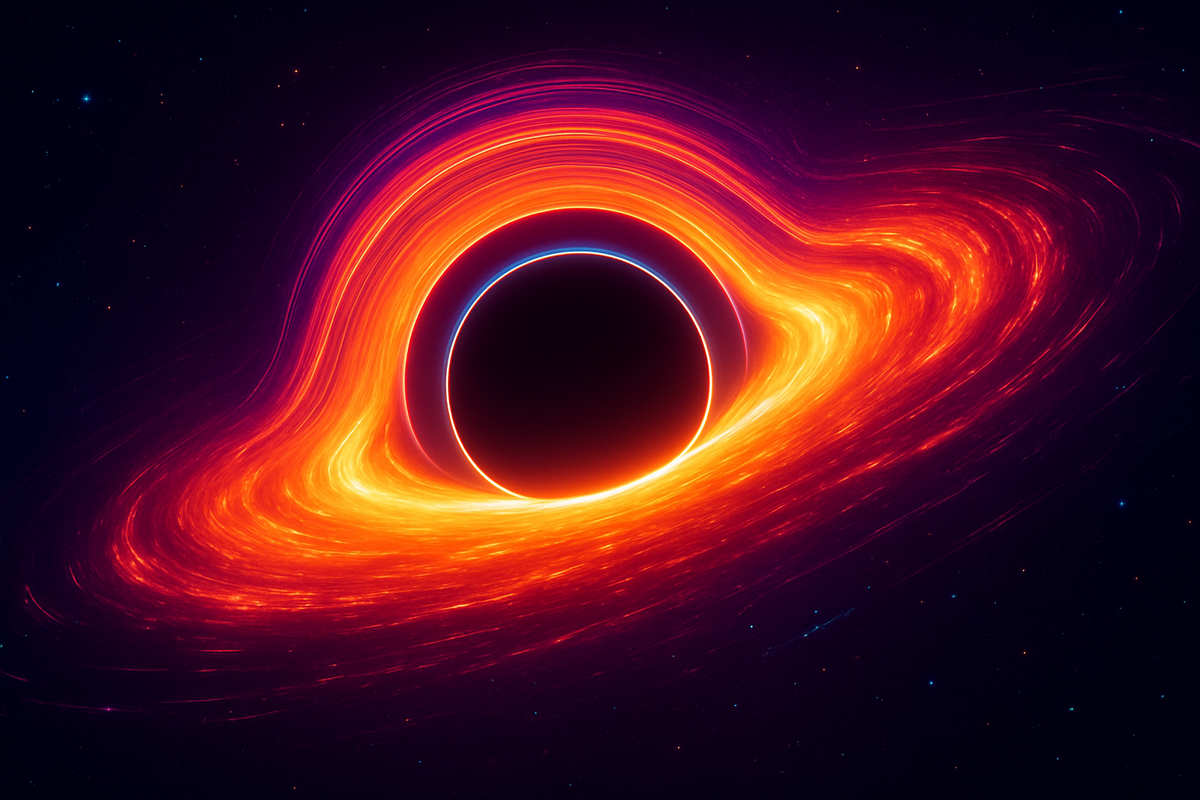
Black Holes: Where Spacetime Breaks
Series: Spacetime Physics | Part: 3 of 9 Primary Tag: FRONTIER SCIENCE Keywords: black holes, event horizon, singularity, Schwarzschild, Penrose, Hawking radiation
Within months of Einstein publishing general relativity in 1915, Karl Schwarzschild—a German physicist serving on the Russian front in World War I—sent Einstein a letter with an exact solution to the field equations.
The solution described spacetime around a spherical mass. It was elegant, useful for calculating orbits and light bending. But it had a disturbing feature: at a specific radius, something strange happened. And at the center, something impossible.
Schwarzschild's solution contained a singularity—a point where the math gives infinity, where physics as we understand it breaks down. And it contained an event horizon—a surface beyond which nothing, not even light, can escape.
Einstein didn't like it. He spent years trying to prove such objects couldn't actually form. He was wrong. The universe is full of them.
The Schwarzschild Radius
The Schwarzschild radius defines the event horizon: the point of no return.
R = 2GM/c²
For any mass M, there's a radius R such that if the mass is compressed within that radius, an event horizon forms. For Earth, that radius is about 9 millimeters. For the Sun, about 3 kilometers. For a 10-solar-mass star, about 30 kilometers.
Stars don't naturally compress to these sizes. But after certain stars exhaust their nuclear fuel, gravity wins. The core collapses. If the star is massive enough, nothing can stop the collapse—not electron degeneracy pressure (which creates white dwarfs), not neutron degeneracy pressure (which creates neutron stars). The collapse continues past all physical barriers, past the Schwarzschild radius, forming a black hole.
This was proven theoretically in the 1960s by Roger Penrose and Stephen Hawking. Their singularity theorems showed that under quite general conditions, gravitational collapse inevitably produces singularities. Black holes aren't exotic exceptions; they're predicted outcomes of stellar evolution for massive stars.
The Event Horizon
The event horizon isn't a physical surface. It's a boundary in spacetime—the surface where the escape velocity equals the speed of light.
Outside the horizon, you can still escape if you accelerate hard enough. At the horizon, even light moving directly outward stays stationary. Inside, all paths lead inward. The future points toward the singularity the way time normally points toward tomorrow.
This is crucial: the event horizon isn't a place where physics gets weird and then returns to normal. It's a one-way membrane. Cross it, and you cannot return to the outside universe. Ever. Not because something blocks you—because the geometry of spacetime no longer contains paths that lead outward.
An observer falling in wouldn't notice crossing the horizon. There's no local marker, no sign saying "point of no return." Spacetime looks normal locally. It's only globally—in terms of where paths can lead—that the horror becomes apparent.
Time At The Horizon
From an outside observer's perspective, time does something strange at the event horizon.
Watch someone fall toward a black hole. As they approach the horizon, you see them slow down. Their light shifts red—gravitational redshift. They seem to freeze as they reach the horizon, getting dimmer and redder, asymptotically approaching but never quite crossing.
From your perspective outside, they never cross. The image of them hovering at the horizon persists forever (though becoming so redshifted as to be undetectable).
From their perspective, nothing unusual happens. They cross the horizon at normal speed, barely noticing. Then they fall toward the singularity, reaching it in finite time—seconds for a stellar-mass black hole, hours for a supermassive one.
Both perspectives are correct. This is general relativity: time is relative, and dramatically so near extreme gravity.
The Singularity
At the center—or more precisely, at the end of all paths inside the horizon—lies the singularity.
The math says: infinite density, infinite curvature, zero volume. All the mass of the black hole compressed to a dimensionless point.
This is physics saying "I don't know." Infinities in physics usually mean the theory has broken down, that something beyond our current understanding is happening.
General relativity predicts its own failure at singularities. Quantum effects must become important at such extreme conditions, but we don't have a theory of quantum gravity to tell us what actually happens. The singularity isn't a description of physical reality—it's a placeholder for our ignorance.
What's really at the center of a black hole? No one knows. Probably not a literal point of infinite density. Probably something that requires quantum gravity to describe. The singularity is where general relativity waves a white flag.
Spaghettification
Fall into a stellar-mass black hole and you get spaghettified.
The tidal forces—the difference in gravitational pull between your head and feet, or between the sides of your body—become enormous. You're stretched along the direction toward the singularity and compressed perpendicular to it. The stretching increases without bound as you approach the center.
For a stellar-mass black hole (a few solar masses), this happens outside the event horizon. You'd be torn apart before you crossed.
For a supermassive black hole (millions to billions of solar masses), the event horizon is much larger, and the tidal forces at the horizon are much gentler. You could cross the horizon of a supermassive black hole intact—you'd only be spaghettified later, on your way to the singularity.
This is counterintuitive: larger black holes are safer to fall into, at least initially.
No-Hair Theorem
Black holes are surprisingly simple.
A black hole is completely characterized by just three parameters: mass, spin (angular momentum), and electric charge. That's it. Every other property of the matter that formed it—composition, shape, history—is lost. Two black holes with the same mass, spin, and charge are identical.
This is the no-hair theorem (or more properly, a collection of related theorems). Black holes have "no hair"—no distinguishing features beyond these three numbers.
The theorem has an unsettling implication: information seems to be destroyed. If you throw a book into a black hole, all the information in the book is lost. The black hole's mass increases by the book's mass, but nothing else changes. The content of the book—every word, every idea—vanishes from the universe.
This creates a problem when combined with quantum mechanics, which requires information to be conserved. The "information paradox" has vexed physicists for decades. We'll touch on it again when we discuss quantum gravity.
Observational Evidence
Black holes have gone from theoretical curiosity to observed reality.
Stellar-mass black holes are detected in binary systems. When a black hole orbits with a regular star, it can strip matter from its companion. This matter spirals inward, heats up, and emits X-rays. We've detected many such X-ray binaries, with the compact object's mass too high to be a neutron star.
Supermassive black holes exist at the centers of most galaxies. The Milky Way's central black hole, Sagittarius A*, has a mass of about 4 million solar masses. We've tracked stars orbiting it, confirming an enormous mass in a tiny region.
Direct imaging became possible in 2019. The Event Horizon Telescope—a global network of radio telescopes acting as one Earth-sized instrument—imaged the black hole at the center of galaxy M87. The image shows the event horizon silhouette against the glowing accretion disk: 6.5 billion solar masses of concentrated spacetime curvature.
Gravitational waves from black hole mergers were first detected in 2015. When two black holes spiral together and merge, they release enormous energy as gravitational waves—ripples in spacetime. LIGO detected these ripples from 1.3 billion light-years away. We now regularly detect black hole mergers.
Hawking Radiation
In 1974, Stephen Hawking showed that black holes aren't completely black.
Quantum effects near the event horizon cause black holes to emit radiation—now called Hawking radiation. The mechanism involves virtual particle pairs near the horizon, where one particle falls in and the other escapes. The escaping radiation carries energy away, and the black hole slowly shrinks.
For stellar-mass black holes, Hawking radiation is negligible—the temperature is far below the cosmic microwave background, so black holes absorb more than they emit. But in principle, isolated black holes will eventually evaporate completely.
This evaporation worsens the information paradox. The Hawking radiation appears to be thermal—random, carrying no information about what fell into the black hole. If the black hole eventually evaporates completely, the information seems lost forever.
Whether information is truly destroyed or somehow encoded in subtle correlations in the radiation is one of the deepest open questions in theoretical physics.
What Black Holes Teach
Black holes reveal the extremes of Einstein's theory. They're where general relativity makes its strangest predictions—and where it ultimately fails.
They show that spacetime is dynamic: it can curve so severely that regions become causally disconnected from the rest of the universe.
They show that our concepts of space and time are provisional: inside the horizon, the radial direction becomes timelike, the singularity becomes a moment in the future rather than a place in space.
They show that general relativity needs quantum completion: the singularity isn't physics, it's a cry for help.
And they're real. Not thought experiments, not mathematical curiosities—observed objects, millions of them in our galaxy alone, billions throughout the universe. The universe contains places where spacetime breaks.
Further Reading
- Penrose, R. (2010). Cycles of Time. Bodley Head. - Thorne, K. (1994). Black Holes and Time Warps. W.W. Norton. - Hawking, S. (1988). A Brief History of Time. Bantam. - Event Horizon Telescope Collaboration (2019). First M87 results papers in Astrophysical Journal Letters.
This is Part 3 of the Spacetime Physics series. Next: "Wormholes: Tunnels Through Spacetime."

Comments ()