Black Mirror and Feedback Loops: Tech as Trap
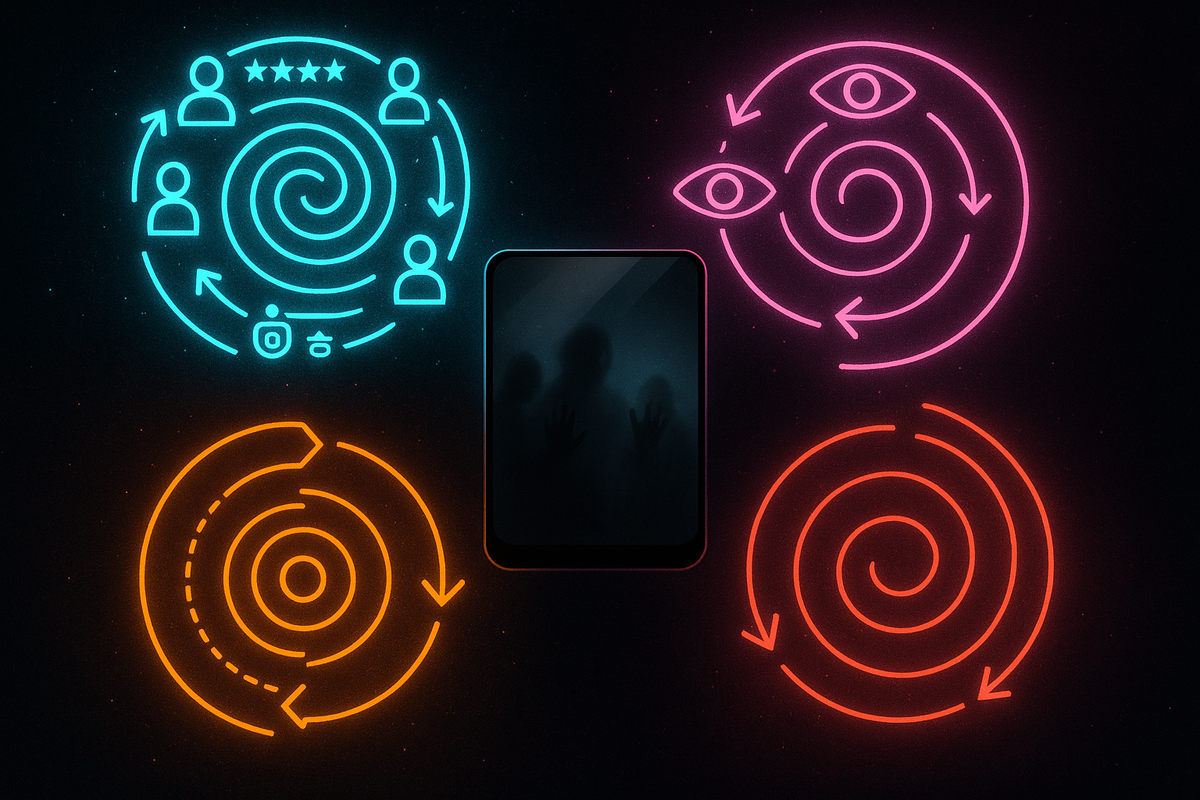
Black Mirror's horror isn't the technology — it's the feedback loops. Algorithms optimizing for engagement, social scoring systems, total surveillance: the show works because the traps are already latent in the systems we're building.
Black Mirror and Feedback Loops: Tech as Trap
In 2011, Charlie Brooker launched Black Mirror—an anthology series about technology's dark side.
The title is literal: a black mirror is what screens become when they're off. The series explores what happens when the screens are on—when technology creates feedback loops that trap users in dynamics they can't escape.
Unlike older tech-dystopia fiction, Black Mirror rarely features evil corporations or malevolent AI. The technology mostly works as intended. The horror comes from what happens when it works—when systems designed to give us what we want give us what we want so effectively that we can't stop wanting it.
This is systems-thinking fiction. Not "technology as tool" but "technology as environment." Not individual choices but emergent dynamics. The trap isn't a villain—it's a feedback loop.
The Feedback Loop as Plot
A feedback loop is a process where output becomes input.
Positive feedback amplifies: you watch a video, the algorithm shows you more like it, you watch more, the algorithm narrows further, you watch more, until you're deep in a content rabbit hole you never intended to enter.
Negative feedback stabilizes: a thermostat measures temperature, turns on heat when cold, turns off heat when warm, maintaining equilibrium.
Black Mirror episodes are almost all positive feedback loops—systems that amplify until they break something.
"Nosedive" (S3E1): Social rating. You rate every interaction; your rating affects opportunities. This creates a feedback loop: low ratings lead to desperation, desperation leads to awkwardness, awkwardness leads to lower ratings. Or: high ratings lead to privilege, privilege leads to sycophants, sycophants lead to higher ratings until you're so dependent on the ratings that any fluctuation is catastrophic.
"The Entire History of You" (S1E3): Memory recording. You can replay any moment of your life. This creates a feedback loop: you review a suspicious conversation, find something that could be suspicious, review it again, become more paranoid, find more suspicious details, until you've destroyed your relationship with your own memories.
"Be Right Back" (S2E1): Digital recreation of the dead. You interact with an AI trained on your dead partner's messages. This creates a feedback loop: the AI says what you want to hear (it's trained on what you responded to), you want more, it gives more, you become more dependent, until you can't function without a simulation that isn't really your partner.
Technology as Environment
Older science fiction treated technology as tools—objects you pick up and use.
Black Mirror treats technology as environment—an ambient condition that shapes behavior without explicit choice.
You don't choose to optimize for social ratings. The system surrounds you, and everyone around you is optimizing, and the default path leads to optimization. The choice is not "use this tool or not" but "exist in this environment or not."
This is closer to how technology actually operates. You didn't choose to carry a smartphone; you adapted to a world where everyone has one and everything assumes you do. The technology created the environment; you live in the environment.
When technology is environment, individual choices are constrained by systemic pressures. You can delete Instagram, but your friends are on Instagram, and events are organized on Instagram, and you're now socially legible only if you're on Instagram. The feedback loop holds you even when you'd prefer to exit.
The Trap Mechanism
Black Mirror episodes follow a pattern:
1. Technology offers something genuinely valuable (connection, memory, reputation, survival) 2. The technology creates a feedback dynamic (more use → more dependency) 3. The dynamic intensifies until something breaks (relationships, sanity, society) 4. The protagonist realizes they're trapped—the exit has closed
This is the structure of addiction, of abusive relationships, of systemic capture. The trap isn't set all at once. It tightens incrementally. Each step is small, reasonable, reversible in principle. But the aggregate path leads somewhere you would never have chosen if you'd seen it from the start.
The horror is recognizing the trap only after it's closed.
"White Bear" and Spectacle Loops
"White Bear" (S2E2) is one of the most disturbing episodes.
A woman wakes with no memory. People film her but don't help. Masked figures hunt her. She runs, screams, doesn't understand.
Then the twist: she's a criminal whose punishment is to be hunted daily while spectators watch and film. Her memory is wiped each night. She wakes, terrified, in the same scenario. Forever.
The feedback loop here is spectacle. The crowds watch because watching is entertaining. The watching is enabled by her torment. Her torment is justified by her crime. The crime justifies endless punishment. The endless punishment entertains.
Everyone involved has a reason. No one individual is responsible for the horror. The system produces the horror emergently—through the interaction of justified individual decisions.
The Social Credit Episode
"Nosedive" (S3E1) depicts a world where social rating determines everything.
Your rating—aggregated from every interaction—controls your access to housing, flights, jobs, social circles. A 4.2 gets you a certain life; a 3.5 gets you a worse one; below 2.0, you're essentially an outcast.
The protagonist Lacie obsesses over raising her rating to 4.5 (needed for an apartment discount). Her obsession leads to inauthenticity. Inauthenticity reads as off-putting. Off-putting earns lower ratings. Lower ratings increase desperation...
The episode isn't about evil technology. The rating system works exactly as designed. It's meant to incentivize nice behavior. And it does—everyone is nice. But the niceness is performed, the performance is detectable, and the detection creates new strategies of performance. The system produces a society of anxious performers, none of whom can exit.
Systems Thinking as Genre
Black Mirror represents a specific paradigm: systems thinking as horror.
Traditional horror has monsters—identifiable threats that can be fought or fled.
Black Mirror horror has dynamics—emergent processes that can't be fought because there's no one to fight, can't be fled because the system is everywhere.
This is the horror of the 21st century. Climate change is a dynamic. Economic inequality is a dynamic. Attention capture is a dynamic. You can't punch a dynamic. You can't shoot a feedback loop. You can only recognize that you're inside one and that the exits are fewer than you thought.
The Cautionary Taxonomy
Black Mirror episodes can be categorized by which loop they explore:
Attention loops: "Fifteen Million Merits" (entertainment → engagement → more entertainment), "USS Callister" (game immersion → isolation → more immersion)
Reputation loops: "Nosedive" (rating → behavior → rating), "Hated in the Nation" (virality → attention → more virality)
Memory loops: "The Entire History of You" (review → paranoia → more review), "Crocodile" (guilt → concealment → more guilt)
Relationship loops: "Be Right Back" (simulation → attachment → more simulation), "Hang the DJ" (dating algorithm → dependence → more algorithmic dating)
Punishment loops: "White Bear" (spectacle → punishment → more spectacle), "Black Museum" (suffering → entertainment → more suffering)
Each loop has the same structure: a reasonable starting point amplified until it becomes trap.
The Exit Problem
Black Mirror episodes rarely show exits.
The characters discover they're trapped. Sometimes they break temporarily—Lacie screams the truth at the wedding and gets arrested, finally free of the rating game. But even this is ambiguous. Is she free or just in a different, worse trap?
The lack of exits is the point. These systems are designed without exits—or with exits so costly that they're not really exits.
How do you exit social media when your social network is there? How do you exit the reputation economy when your livelihood depends on it? How do you exit the surveillance state when it's everywhere?
The feedback loops are inescapable not because they're physically inescapable but because the cost of escape exceeds what most people can bear. The trap is soft but total.
What Black Mirror Says About Now
Black Mirror is the fiction of social media, surveillance capitalism, and algorithmic governance.
It's not about future technology—most episodes use tech that exists now or is clearly imminent. It's about extrapolating current dynamics to make visible what's already happening.
The social rating system exists in China. Reputation scoring exists in hiring algorithms. Memory recording exists in lifelogging apps. Digital resurrection exists in chatbots trained on the dead.
Black Mirror doesn't predict. It reveals. It shows us feedback loops we're already in by making them slightly more extreme, slightly more visible, slightly more obviously horrible.
The mirror is black because it shows us ourselves in unflattering light. Not technology-as-villain but technology-as-amplifier—making us more of what we already are, faster than we can adjust.
The Paradigm
Black Mirror reflects the systems-thinking paradigm:
- Behavior is shaped by environment, not just individual choice - Environments are constructed by feedback dynamics - Feedback dynamics can produce outcomes no one intended - Once you're inside a dynamic, exit is costly and rare - The horror is not malice but emergence
This is different from determinism (which emphasizes initial conditions), chaos (which emphasizes sensitivity), or multiverse (which emphasizes optionality). It's the paradigm of systemic capture—the recognition that systems can trap you not through force but through shaping the space of available options.
Paul couldn't escape the attractor. Neo could hack the code. MCU heroes had infinite branches. Black Mirror characters are in a different situation: the system is their world, and leaving the system means leaving their world.
This is perhaps the most contemporary paradigm—the recognition that our technologies have become our environments, and our environments have feedback loops that tighten without anyone pulling the strings.
Further Reading
- Brooker, C. (creator) (2011–present). Black Mirror. Channel 4, Netflix. - Zuboff, S. (2019). The Age of Surveillance Capitalism. PublicAffairs. - O'Neil, C. (2016). Weapons of Math Destruction. Crown.
This is Part 8 of the Science Fiction Mirror series. Next: "[Synthesis: What Our Fiction Says About Our Science](/fiction-science-synthesis/)."
Comments ()