Bottlenecks Aren't Metaphors: The Literal Geometry of Feeling Trapped
When all paths funnel through a narrow passage, that's not metaphor—it's topology. Explore how trauma and developmental gaps create bottlenecks in belief manifolds with real consequences.
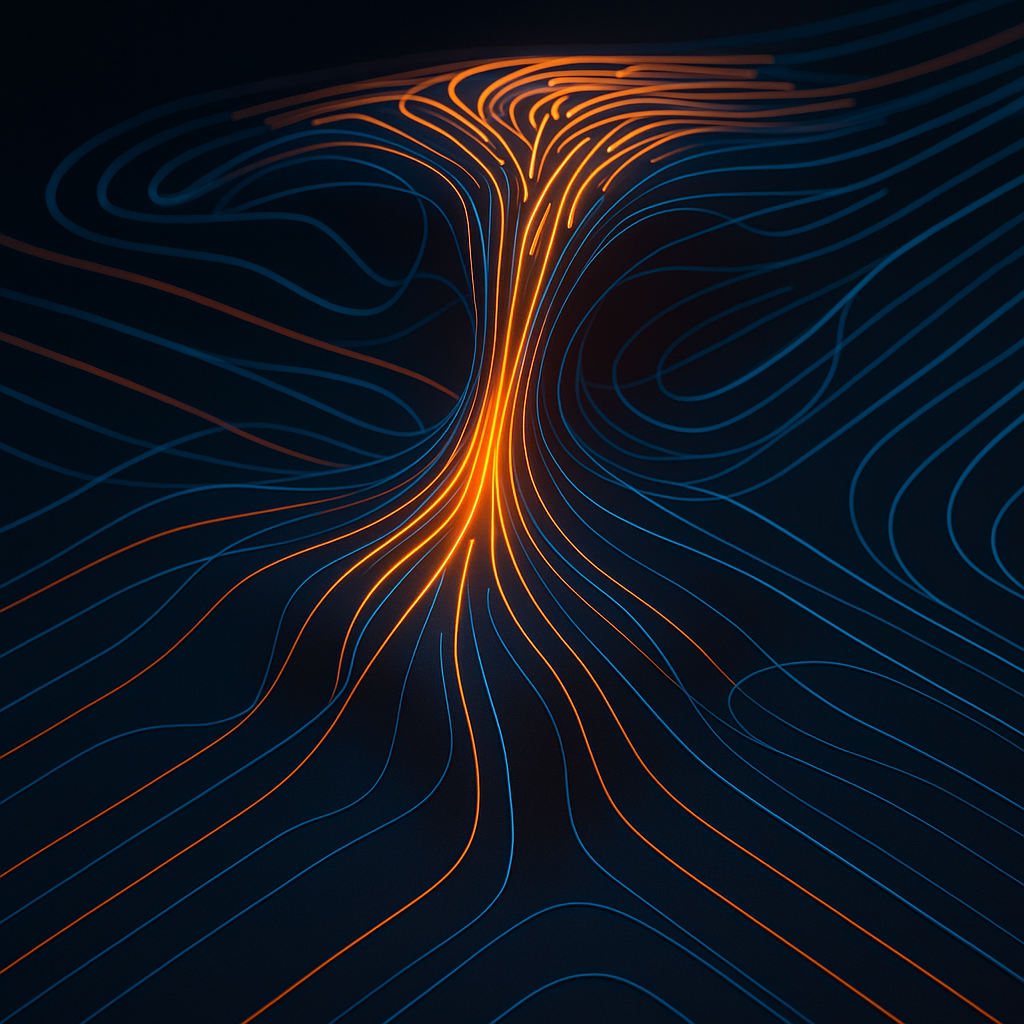
Bottlenecks Aren't Metaphors: The Literal Geometry of Feeling Trapped
Formative Note
This essay represents early thinking by Ryan Collison that contributed to the development of A Theory of Meaning (AToM). The canonical statement of AToM is defined here.
There's a feeling you recognize.
The sense that no matter where you're trying to go, you have to pass through that thing first. The conversation you've been avoiding for months. The decision you can't seem to make. The memory that sits in the path of every attempt to move forward. The person whose presence—or absence—blocks the way.
You want to get to the other side. A new job, a healed relationship, a different sense of yourself. You can imagine being there. Sometimes you can almost see it. But the path to there passes through something you can't face. And so you stay here.
This isn't weakness of will. It isn't avoidance in some moral sense that could be fixed by trying harder. It isn't a choice in the ordinary meaning of the word.
It's topology.
The manifold has a bottleneck—a narrow passage through which all paths to certain regions must pass. Until you traverse the constriction, you can't reach what lies beyond. And if you can't traverse it, you're stuck. Not because you're deficient but because the geometry is what it is.
Understanding bottlenecks as literal geometric features—not metaphors, not figures of speech, but actual structural properties of belief manifolds—changes how you think about stuckness, about avoidance, and about what change actually requires.
The Geometry of Narrow Passages
Picture a landscape. Two broad valleys separated by a mountain range. You're in the western valley; you want to reach the eastern one. Each valley is pleasant, navigable, full of options. But between them? A single narrow pass cuts through the mountains. There might be many paths through your valley. Many paths through the other. But to get from one to the other, every route must go through that pass.
This is a topological bottleneck. The local geometry in either valley doesn't determine whether you can reach the other. What matters is the global topology—the structure of connection between regions. And the structure says: through the pass, or not at all.
Now translate this to belief space.
Your belief manifold—the space of possible belief states you might occupy—has regions. Some regions are states of confidence, capability, secure attachment. Other regions are states of anxiety, avoidance, fragmentation. You currently occupy one region. You want to reach another.
But the manifold's topology may dictate that all paths between these regions pass through a single narrow zone. A zone where dimensions compress—fewer options, less flexibility, tighter constraints. A zone where curvature spikes—small movements produce large destabilization. A zone where hysteresis lurks—changes made there may be permanent.
This is the bottleneck. Not a metaphor for difficulty but a literal structural feature. The constriction exists in the geometry. All paths through it, or no paths through at all.
What Creates Bottlenecks
Bottlenecks don't appear arbitrarily. They form through specific processes, each leaving characteristic geometric signatures.
Trauma creates bottlenecks.
The traumatic experience warps the manifold. It creates a region of high curvature, collapsed dimensionality, often with hysteretic deformation that persists long after the trauma ends. This region doesn't disappear; it becomes a permanent feature of the manifold's geography.
And often, this wounded region lies directly in the path between where you are and where you want to be. Want to form secure attachment? The path passes through the region where attachment was originally damaged. Want to feel confident in your body? The path passes through where the body was violated. Want to trust again? The path passes through betrayal.
The trauma has to be traversed to reach the other side. But traversing means crossing exactly the terrain the whole system has organized around avoiding.
This is why trauma recovery is so difficult despite sincere desire for change. It's not that people don't want to heal. They do. But healing requires transiting a bottleneck that their system has spent years building protective structures around.
Developmental gaps create bottlenecks.
Something that should have been learned wasn't. A capacity that should have developed didn't. Maybe secure attachment in infancy. Maybe emotional regulation in childhood. Maybe identity formation in adolescence. The development didn't happen, and now there's a gap in the manifold—not a damaged region, but an absent one.
Now every path to adult functioning passes through the gap. You can't reach secure adult relationship without the capacity for trust that should have developed in childhood. You can't reach emotional maturity without the regulation skills that should have been learned. The missing development is the bottleneck.
This differs from trauma bottlenecks. Trauma bottlenecks are regions you can't face. Developmental bottlenecks are capacities you don't have. Both constrain where you can go, but they constrain differently and require different approaches.
Unresolved decisions create bottlenecks.
You've been avoiding a choice. Should you stay or leave? Should you commit or keep options open? Should you speak or stay silent? The decision sits at a juncture where multiple future paths converge into the present. All of them pass through the decision point.
Until you decide, you can't proceed down any path. Not because proceeding is hard, but because proceeding is undefined. The future branching structure of the manifold hasn't been determined. The bottleneck is the point of bifurcation—the moment where potential becomes actual.
Some people live for years at decision bottlenecks. Not in paralysis exactly—life continues—but in a holding pattern. All paths that require the decision remain inaccessible. The manifold is shaped by the unresolved choice.
Relational patterns create bottlenecks.
A dynamic with a specific person—parent, partner, former friend, formative enemy—creates a lasting deformation in your relational manifold. Maybe they're no longer in your life. Maybe they're dead. But the pattern they established remains.
Want to have the relationship life you want? The path passes through resolving, processing, or somehow traversing the pattern with them. They're not present, but their geometric signature is. And that signature is a bottleneck.
This explains why people can work hard on themselves, achieve genuine growth, and still keep encountering the same relational patterns. The pattern isn't in their character or their choices. It's in the topology of their relational manifold. Until the bottleneck is addressed at that level, the pattern persists.
Structural positions create bottlenecks.
In organizations, decisions that should flow through multiple channels all funnel through one person, one committee, one approval process. The bottleneck isn't psychological; it's architectural. The system is designed to constrict at that point.
Some organizational bottlenecks are deliberate. Quality control requires a checkpoint. Strategic alignment requires executive approval. The constriction serves a function.
Others are accidental or vestigial. A reporting structure that made sense years ago now just slows things down. A key person who's become a gatekeeper without anyone deciding they should be. These bottlenecks persist through organizational inertia.
Cultural taboos create bottlenecks.
Topics that can't be discussed. Options that can't be considered. History that can't be acknowledged. Futures that can't be imagined. The forbidden creates constrictions in the cultural manifold—all paths toward certain collective futures pass through conversations the culture won't have.
These are collective bottlenecks. They constrain not just individuals but entire populations. A culture can be collectively stuck because its topology has collective constrictions.
The Phenomenology of Bottlenecks
Bottlenecks have characteristic felt qualities. Recognizing these qualities helps identify where the topology is constricted.
The approach.
As you move toward a bottleneck, the space narrows. Options reduce. The path becomes more constrained. There's a growing sense of channelization—of being funneled toward something.
Often there's rising resistance. The system detects the approaching constriction and generates avoidance signals. Anxiety, distraction, fatigue, sudden competing priorities—anything to turn back before entering the narrow zone.
This isn't neurosis. It's rational response to geometry. The system knows, at some level, that the bottleneck is ahead. The resistance is information.
The threshold.
At the bottleneck's entrance, dimensionality compresses. What was a range of options becomes a single path. The comfortable flexibility of the broader manifold gives way to constraint.
There's often a moment of choice—proceed or retreat. Many people reach this threshold repeatedly. They approach, feel the compression beginning, and turn back. This isn't failure; it's boundary detection. But repeated turning-back without eventual transit keeps the person stuck.
The transit.
Within the bottleneck, everything intensifies. Curvature is typically high—every small movement produces large effects. Dimensionality is minimal—there's only one way through. Hysteresis looms—what happens here may be permanent.
Transit is metabolically expensive. Resources deplete quickly. Time perception often distorts. The transit that takes hours can feel like years; the transit that takes months can feel like it's taking forever and simultaneously can't possibly be survived.
Support matters enormously here. Another person—therapist, friend, partner—can provide scaffolding that makes the passage survivable. Alone, the same passage might be impossible. The geometry hasn't changed, but the resources for navigating it have.
The emergence.
Exiting the bottleneck, the manifold opens. Dimensionality expands. Options return. There's space again.
But emergence isn't just relief. There's often disorientation. The new region isn't the old region. The paths available here aren't the paths that were available before. Something has changed, and the change is still settling.
And sometimes there's grief. The transit cost something. The high curvature left marks. The constriction demanded sacrifice. You're through, but you're not quite the same person who entered.
Bottleneck Strategies
Systems develop strategies for dealing with bottlenecks. Each strategy has contexts where it's appropriate and contexts where it's not.
Circumnavigation is trying to find a path around the bottleneck. Maybe there's another route—a way to reach the destination without transiting the constriction.
Sometimes circumnavigation works. Sometimes there genuinely is another way. If you find it, you've solved the problem.
But often the topology doesn't support circumnavigation. There is no other route. The bottleneck is the only connection between the regions. In these cases, circumnavigation becomes an energy sink—resources spent searching for a path that doesn't exist.
How do you know the difference? Partly through exploration. Partly through guidance from others who know the topology. Partly through eventual acceptance that if there were another way, you would have found it by now.
Staying put means accepting that transit isn't going to happen and building a life in the current region.
This can be wisdom. Some bottlenecks genuinely can't be crossed—not now, maybe not ever. The resources aren't available. The curvature is too severe. The cost of transit would exceed the value of what lies beyond.
In these cases, staying put isn't failure. It's accurate assessment. The goal shifts from reaching the other region to living well where you are.
But staying put can also be rationalization. The bottleneck could be crossed, but it's easier to tell yourself it can't be. The line between realistic assessment and rationalized avoidance isn't always clear.
Titration means approaching the bottleneck in measured increments. Getting closer. Building tolerance. Expanding capacity. Eventually entering, bit by bit.
This is the logic of exposure therapy. You don't force yourself through the phobia all at once; you approach gradually, building capacity at each stage. The geometry hasn't changed, but your ability to navigate it has.
Titration works well for bottlenecks where the main obstacle is the system's own reactivity. If the curvature spike at the bottleneck can be reduced through repeated partial exposure, titration eventually enables transit.
It works less well for bottlenecks that don't soften with exposure—where the curvature is intrinsic to the topology, not just reactive to your approach.
Resource building means accumulating capacity before attempting transit. Energy, support, skills, stable base—whatever will be depleted during transit, you build up beforehand.
This is often the missing step. People attempt bottleneck transit depleted and fail, then conclude the bottleneck is impassable. It might have been passable with adequate resources.
What resources? Depends on the bottleneck. Relational support for relational bottlenecks. Somatic capacity for embodied bottlenecks. Cognitive skills for intellectual bottlenecks. Financial security for material bottlenecks. The resource must match the demand.
Supported transit means going through together. Another person—therapist, partner, friend, guide—accompanies you.
The bottleneck geometry doesn't change. The passage is still narrow. But the passage is no longer solo. The other person provides real-time support: co-regulation when curvature spikes, holding when dimensions collapse, witness when hysteresis threatens.
Many bottlenecks that are impassable alone become passable with support. Not because the supported transit is easy—it's still hard—but because the other person adds capacity that the system lacks on its own.
Topological intervention means changing the bottleneck itself. Not navigating it as is, but restructuring the manifold so the constriction widens or disappears.
This is the most ambitious strategy and the rarest to succeed. Topology is resistant to change. But it's not impossible. Sometimes deep therapeutic work doesn't just enable transit through a bottleneck but actually restructures the manifold so the bottleneck no longer exists.
When this happens, it's not just that one transit has been achieved. The topology itself has been repaired. The region that was only accessible through the narrow passage is now accessible more broadly. The constraint is gone, not merely overcome.
Therapeutic Implications
Much of what effective therapy does is bottleneck work. Different modalities approach it differently, but the underlying geometry is consistent.
Identifying bottlenecks is often the first task. What's the constriction? What region is the person trying to reach, and what stands in the way? Sometimes the bottleneck is obvious—the trauma, the decision, the relationship—and presents immediately. Sometimes it takes months of exploration before the actual constriction becomes clear.
Mapping the approach means understanding the topology around the bottleneck. How does the manifold narrow as you approach? What are the early signs of constriction? What triggers the system's avoidance responses? Detailed mapping enables more effective navigation.
Assessing traversability means asking honestly whether this bottleneck can be crossed with available resources. Not whether it "should" be crossable, but whether it actually is. Some bottlenecks require more than the person currently has. The answer might be "build resources first" or "find support" or "not now" rather than "proceed immediately."
Curvature reduction targets the spike. Can the bottleneck be made less steep before transit? Can some processing happen before the full traverse? This is titration's logic—softening the geometry through gradual approach.
Resource provision ensures the person isn't attempting transit depleted. Building energy, establishing support systems, developing skills—this is preparation that makes the difference between failed and successful transit.
Supported transit happens when the therapist accompanies the person through the bottleneck. Not walking the path for them—they can't; it's the person's manifold—but walking alongside. Providing real-time regulation, stabilization, witness. Being the presence that makes the passage survivable.
Post-transit integration holds space for arrival. The other side isn't just relief; it's new territory. The person needs time to orient, to make sense of the transit, to stabilize in the new region before moving on. Rushing past this phase undermines the gains.
Different modalities emphasize different aspects. Exposure therapy focuses on titrated approach and curvature reduction. EMDR creates rapid, supported transit. Somatic therapies work with embodied bottlenecks. Psychodynamic work maps the topology carefully. IFS identifies parts stuck at various bottleneck thresholds. Each approach is a different geometry toolkit, but the underlying terrain is consistent.
Organizational and Cultural Bottlenecks
Organizations experience bottlenecks at collective scale. The principles are the same; the manifestation differs.
Decision bottlenecks occur when all paths forward require a decision that the organization can't make. The CEO who can't choose between strategies. The board that won't commit. The committee that keeps meeting without resolving. Until the decision happens, the organization is stuck.
Process bottlenecks occur when work flows channel through a single point. Everything needs that one approval. All information passes through that one person. All projects require that one resource. The process architecture creates the constriction.
Knowledge bottlenecks occur when critical information exists in one place—one person's head, one team's documents, one system that no one else can access. The organization can't proceed because what it needs to know is trapped.
Cultural bottlenecks occur when collective futures require conversations the culture won't have. The topic that's off-limits. The truth that can't be spoken. The history that can't be acknowledged. Cultural taboo creates collective constriction.
Organizational bottleneck work parallels individual bottleneck work. Identify the constriction. Assess traversability. Build necessary resources. Enable supported transit. But the "system" being treated is the organization itself, and the interventions require organizational rather than individual tools.
The Other Side
What's it like when you cross a bottleneck?
There's relief. Often profound relief. The constriction was intense. The transit was costly. And now it's over. The space has opened. The manifold has expanded. You can breathe.
But relief isn't the whole story.
There's disorientation. You're in new territory now. The old valley is behind you. The patterns that worked there may not work here. You've achieved a transit that opens possibilities, but the possibilities are still unknown.
There's sometimes grief. The crossing cost something. You're not the same person who entered. Some version of you didn't survive the passage. What remains is through—but it's not unchanged.
There's sometimes disappointment. The other side isn't what you imagined. You thought reaching it would feel different. You thought arrival would be more dramatic. Instead it's just... here. The work of living continues.
And there's often discovery. Things that weren't possible before are possible now. Moves you couldn't make are available. The region you've reached has its own geography, its own paths, its own possibilities. The bottleneck crossing didn't just move you; it opened.
Bottleneck transit is transformation. Not just relocation from here to there, but the kind of passage that changes who's passing. The geometry requires it. Narrow places demand compression. Something has to give. What emerges on the other side carries what survived the squeeze.
This is why bottlenecks matter so much in the architecture of life. They're the transitions that shape identity. The constrictions through which people become who they become. Not the easy paths through open terrain, but the hard passages through narrow places that leave marks and make differences.
The geometry of bottlenecks is the geometry of transformation itself.
Comments ()