The Brain's Impossible Efficiency: 20 Watts
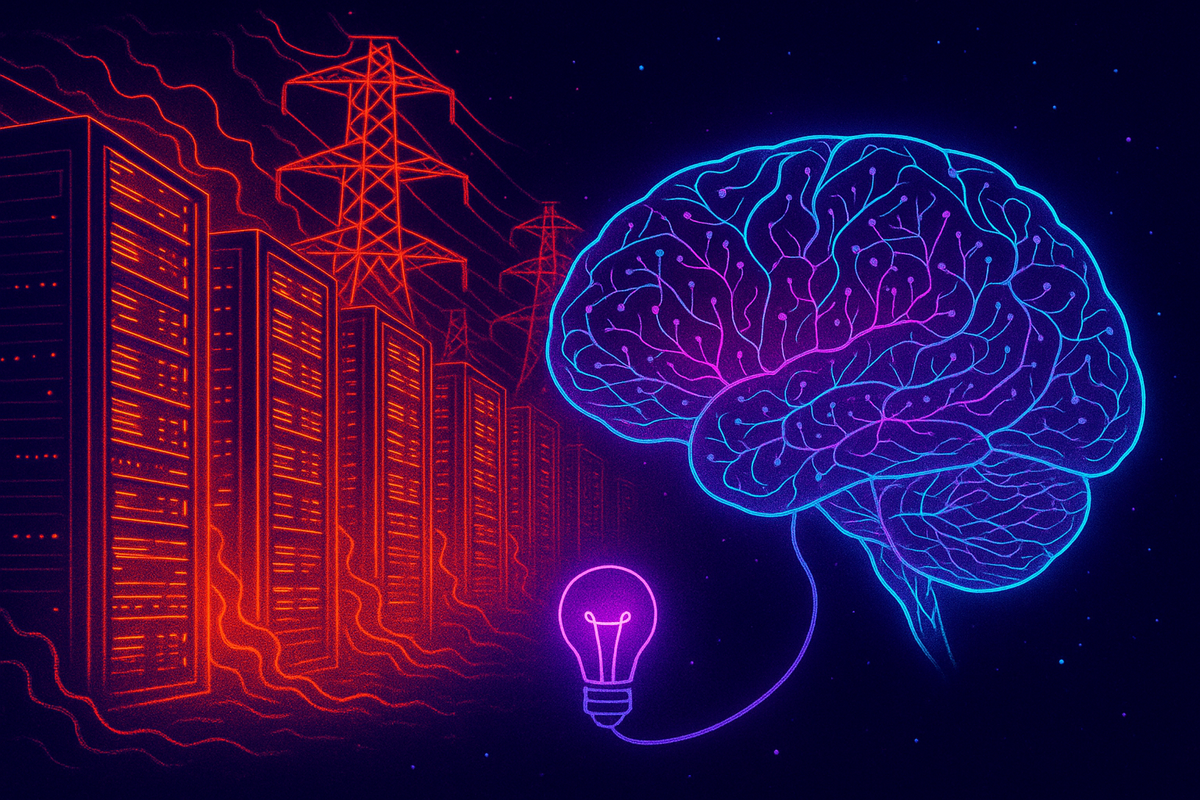
GPT-4 needs a small power plant. Your brain needs a dim lightbulb. The human brain's 20-watt efficiency isn't just impressive — it's still the most embarrassing gap in AI.
The Brain's Impossible Efficiency: 20 Watts
Here's a number that should make every computer scientist uncomfortable: 20 watts.
That's the power consumption of an adult human brain. A typical incandescent light bulb uses more. A laptop uses three to four times as much. A gaming PC uses ten times as much. A single rack of AI servers uses a thousand times as much.
And yet the brain does something that those servers struggle to match: general intelligence. The ability to recognize faces, understand language, navigate social situations, learn new skills, generate creative ideas, and do all of this simultaneously, seamlessly, while also keeping you breathing and your heart beating.
Twenty watts. Eighty-six billion neurons. Computational miracles.
How? That's not a rhetorical question. Understanding how the brain achieves its efficiency isn't just neuroscience curiosity—it might be the key to breaking through the compute ceiling that's strangling AI development.
The Numbers That Don't Add Up
Let's do some back-of-envelope comparisons to appreciate how weird this is.
The brain contains roughly 86 billion neurons, connected by an estimated 100 trillion synapses. Each synapse can be thought of as a kind of adjustable weight, similar to parameters in a neural network. So the brain has, very roughly, 100 trillion "parameters."
GPT-4 is rumored to have around 1.8 trillion parameters. Let's say 2 trillion for round numbers. The brain has 50 times more.
Training GPT-4 consumed approximately 50 gigawatt-hours of electricity. Running it at scale costs millions of dollars per day in energy.
The brain runs on the equivalent of about 175 kilowatt-hours per year—the energy in a few gallons of gasoline, delivered via sandwiches and coffee. It never stops running. It doesn't need to be retrained from scratch when learning something new.
The brain is at least a million times more energy-efficient than current AI hardware for comparable tasks. Some estimates put it closer to ten million times.
This isn't a difference of degree. It's a difference that suggests something fundamentally different is happening.
Where the Watts Go
To understand biological efficiency, we need to understand where energy gets spent.
In silicon, the dominant cost is moving information. Electrons flow through wires, encountering resistance, generating heat. Memory access—fetching data from RAM to processor—is far more expensive than computation itself. Modern chips spend most of their energy shuffling bits around, not processing them.
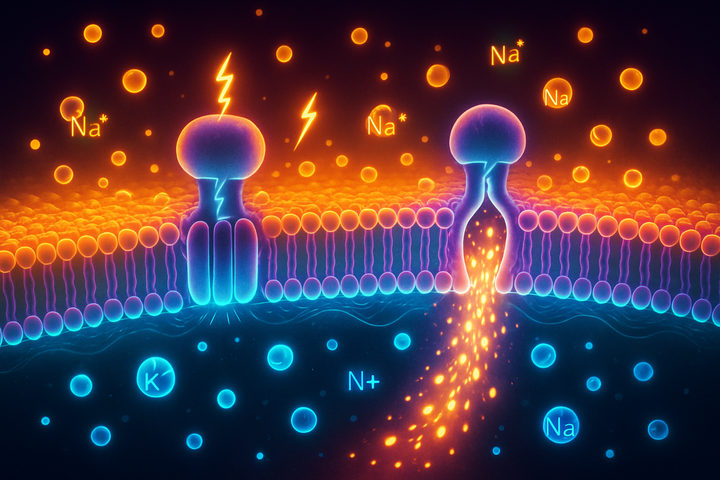
In the brain, the physics is different. Neurons communicate through electrochemical signals. A neuron "fires" when it generates an action potential—a wave of electrical change that travels down its axon to the synapses connecting it to other neurons.
Action potentials are expensive in biological terms. Each spike requires ions to be pumped across membranes, fighting chemical gradients. This costs ATP—the molecular energy currency of cells. By some estimates, the brain's signaling accounts for about 80% of its energy consumption.
But here's the key insight: neurons don't fire very often.
The average neuron fires between 1 and 10 times per second. Some neurons are mostly silent. Only a tiny fraction of neurons are active at any given moment—perhaps 1-2% of the brain is "on" at once.
This is radically different from silicon, where every transistor switches billions of times per second, and large fractions of the chip are active simultaneously. The brain achieves its computational feats through sparse, event-driven processing. Most of the brain is quiet most of the time.
Sparsity: The Brain's Secret Weapon
Silicon computing is dense. Every clock cycle, massive parallel operations occur across millions of transistors. This is how we achieve the raw computational throughput that makes modern AI possible.
Biological computing is sparse. Instead of all components operating all the time, only the relevant ones activate. The rest are silent, consuming minimal energy.
This isn't a bug—it's how neural computation actually works. Cognitive scientists call it sparse coding: representing information using a small number of active neurons from a large population. A visual scene doesn't activate all visual neurons; it activates a specific, minimal subset that represents that particular scene.
Sparsity is enormously energy-efficient. If only 1% of your neurons fire at any moment, you're saving 99% of the energy you'd spend if all of them were active. The brain's "clock speed" is slow—neurons are sluggish compared to transistors—but it compensates by running massively parallel sparse computations.
There's evidence that the brain actively maintains sparsity as an optimization target. Inhibitory neurons suppress activity, preventing runaway excitation. Neural circuits seem tuned to represent information with the minimum number of active cells required.
When sparsity fails—when too many neurons fire simultaneously—the result is epileptic seizure. Seizures are what happens when the brain loses its efficiency optimization and every neuron starts firing at once. It's metabolically catastrophic and computationally useless.
Local Processing: Compute Where the Data Lives
Another key to biological efficiency: the brain minimizes data movement by processing information locally.
In conventional computers, there's a strict separation between memory and processing. Data lives in RAM; computation happens in the CPU or GPU. Every operation requires shuttling data back and forth across buses. This is the "von Neumann bottleneck"—the architectural constraint that makes memory access the dominant energy cost.
In the brain, memory and processing are the same thing. Synapses are both storage (their strengths encode learned information) and computation (they transform incoming signals based on those strengths). There's no separation between where information lives and where information is processed.
This architecture is called "compute-in-memory" or "processing-in-memory," and it's one of the hottest areas in computer architecture research. Neuromorphic chips—silicon designed to mimic neural architecture—attempt to replicate this co-location of storage and processing.
When you don't have to move data, you don't pay the energy cost of moving data. The brain's intimate coupling of memory and computation eliminates the most expensive part of conventional computing.
Analog vs. Digital: The Fuzzy Advantage
Conventional computers are digital: information exists as discrete states, 0 or 1, with nothing in between. This requires precise voltage levels and careful timing. Any noise or variation is an error to be corrected.
Biological neurons are analog-ish. They use graded potentials, continuous chemical concentrations, stochastic release of neurotransmitters. There's noise at every level. From an engineering perspective, the brain is appallingly imprecise.
And yet this imprecision might be a feature.
Digital computation requires energy to maintain precision. Every additional bit of accuracy costs exponentially more energy to achieve reliably. The brain operates with "good enough" precision—just accurate enough for behavior to work, no more.
This is related to the predictive processing framework we've explored elsewhere in ideasthesia: the brain isn't trying to perfectly represent reality. It's trying to predict well enough to act effectively. Perfect accuracy isn't the goal; useful approximation is.
Low precision at low energy cost is often better than high precision at high energy cost. Evolution optimized for calories, not significant figures.
Modern AI is learning this lesson. Quantization—using fewer bits per parameter—dramatically reduces inference costs with minimal capability loss. Models trained in full 32-bit precision often run inference in 8-bit or even 4-bit precision. The brain has been doing this for millions of years.
Parallel, Asynchronous, Event-Driven
Put it together: the brain is a massively parallel, sparsely activated, locally computed, analog-tolerant, event-driven processor.
Massively parallel: Billions of neurons operating simultaneously, not sequentially.
Sparsely activated: Only small subsets active at any moment, minimizing total energy.
Locally computed: No separation between memory and processing, eliminating data movement costs.
Analog-tolerant: Imprecise computation at low energy rather than precise computation at high energy.
Event-driven: Neurons fire in response to specific events, not at fixed clock cycles.
This is radically different from von Neumann architecture, which is sequential, dense, separated, digital, and clock-driven. Silicon has gotten faster and more efficient over decades, but it's been optimizing within a fundamentally less efficient paradigm.
The brain isn't just doing the same thing better. It's doing something different.
What Evolution Knew
Why is the brain so efficient? Because inefficient brains didn't survive.
Calories were scarce throughout evolutionary history. An organism that could think better per calorie outcompeted organisms that couldn't. Over millions of years, natural selection ruthlessly optimized for metabolic efficiency.
The brain is expensive—it consumes about 20% of the body's energy despite being only 2% of its mass. Any neural tissue that didn't earn its caloric keep got pruned. What remains is the result of millions of years of metabolic optimization pressure.
This optimization occurred across multiple timescales. Evolutionary timescales selected for efficient neural architectures. Developmental timescales pruned unnecessary connections during childhood. And ongoing metabolic regulation suppresses unnecessary neural activity moment to moment.
The brain is efficient because inefficiency was death. Silicon has only had decades of engineering optimization, driven by market forces rather than survival pressure. It's not surprising that biology is ahead.
Consider the difference in optimization pressure. A chip that uses twice as much power might sell slightly worse; a brain that uses twice as much food might mean starvation. Evolution's selection pressure was existential. Market selection pressure is merely economic. The intensity of optimization reflects the stakes.
There's also the question of time. Nervous systems have been evolving for over 500 million years. Transistors have existed for about 75 years. Even accounting for the speed of intentional engineering versus blind evolution, biology has had an enormous head start in solving the efficiency problem.
The Gap and the Opportunity
Here's where it gets exciting for AI.
The brain demonstrates that intelligent information processing can occur at radically lower energy costs than current silicon achieves. Not theoretically—actually. Existence proof. You're doing it right now as you read these words.
This means the compute ceiling isn't a fundamental limit on intelligence. It's a limit on our current approach to implementing intelligence. The brain shows another approach is possible.
The challenge is translating biological principles into engineerable systems. This isn't straightforward. You can't just copy the brain—neurons are slow, noisy, and operate on chemical timescales that don't translate directly to electronics.
But you can learn from biological principles:
Sparsity. AI researchers are developing sparse attention mechanisms and mixture-of-experts architectures that activate only relevant model components for each input. This is the silicon version of the brain's selective activation.
Neuromorphic computing. Chips like Intel's Loihi attempt to implement spiking neural networks that communicate through discrete events rather than continuous signals. Event-driven processing promises major efficiency gains.
Analog computing. New chip designs perform computation using continuous voltages rather than digital bits, trading precision for efficiency.
In-memory computing. Architectures that perform calculations within memory arrays, eliminating the von Neumann bottleneck.
Each of these approaches draws inspiration from the brain's efficiency strategies. None yet matches biological performance, but the gap is closing.
The Benchmark We're Chasing
Twenty watts. That's the target.
Not because we need to match the brain exactly—we might find even more efficient approaches. But because the brain proves that intelligent processing at that power level is achievable. It's not a theoretical possibility; it's biological reality.
The AI industry is currently spending megawatts to achieve capabilities the brain achieves with milliwatts. That's not just expensive—it's a sign that we're doing something fundamentally inefficient. The brain is proof that better approaches exist.
Understanding how the brain achieves its efficiency isn't just intellectual curiosity. It's reverse-engineering a working solution to the compute ceiling. Evolution already solved this problem. We just need to figure out how.
The brain's efficiency also raises a deeper question: Is there something special about biological substrates, or can any physical system achieve similar efficiency with the right architecture? The next articles in this series explore both possibilities—using actual biological tissue for computation, and building silicon that mimics biological principles.
Either way, the brain sets the benchmark. Twenty watts of general intelligence, running continuously for decades, learning on the fly, generalizing to novel situations. That's not a theoretical limit. That's your head.
Further Reading
- Sterling, P., & Laughlin, S. (2015). Principles of Neural Design. MIT Press. - Niven, J. E., & Laughlin, S. B. (2008). "Energy limitation as a selective pressure on the evolution of sensory systems." Journal of Experimental Biology. - Lennie, P. (2003). "The cost of cortical computation." Current Biology.
This is Part 3 of the Intelligence of Energy series. Next: "[Organoid Intelligence: Wetware as Compute](/organoid-intelligence-compute/)."


Comments ()