The Line Between Brain and Machine Is Already Blurring
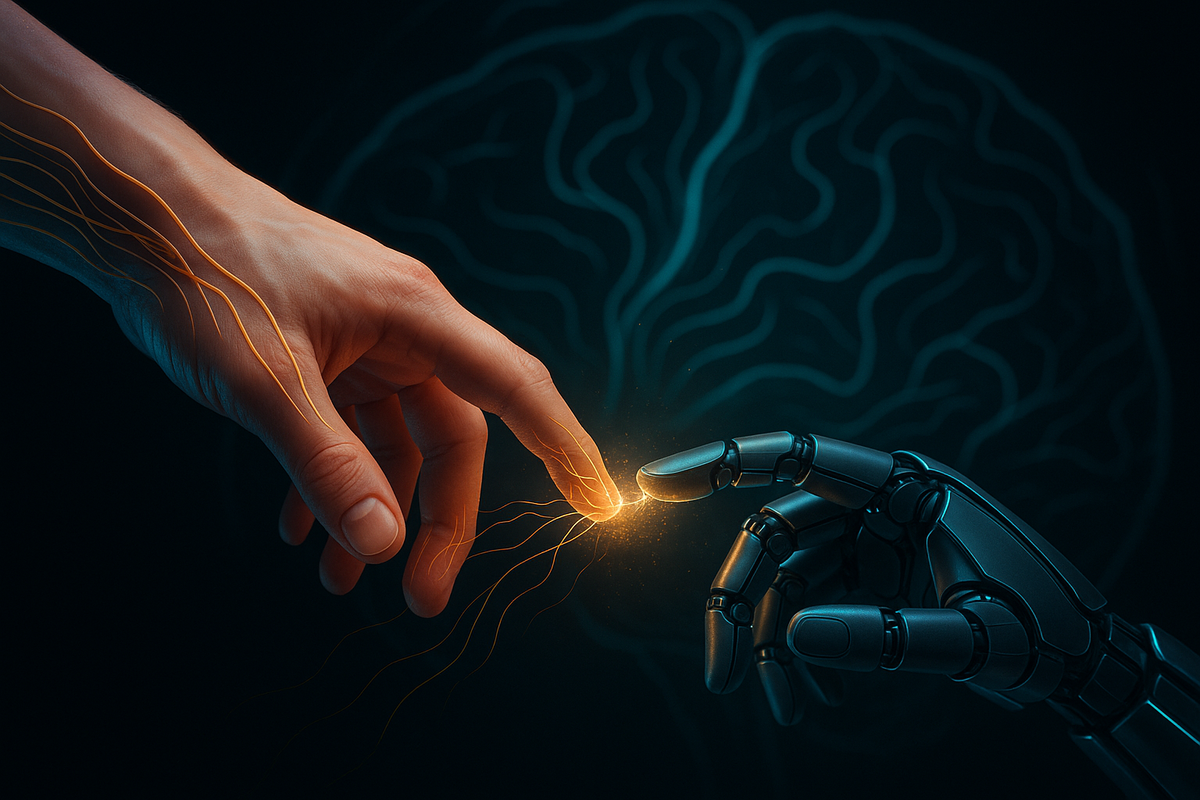
BMIs aren't a future technology — they're a present one with real patients and expanding capabilities. The gap between the neural signal and a useful command is closing, and that has implications for medicine, identity, and what we mean by agency.
The Line Between Brain and Machine Is Already Blurring
In 2012, a woman named Jan Scheuermann fed herself chocolate for the first time in nine years. Jan has spinocerebellar degeneration—a progressive disease that had taken away her ability to move anything below her neck. She couldn't scratch her nose, couldn't brush her teeth, couldn't pick up a fork. For nearly a decade, she'd needed someone else to do literally everything for her body. But researchers at the University of Pittsburgh had implanted two small arrays of electrodes in her motor cortex—the part of the brain that controls movement. These electrodes picked up the electrical signals that her brain still generated when she thought about moving her arm. A computer translated those signals into commands. And a robotic arm, sitting on a table beside her, moved in response. She reached for the chocolate. She brought it to her mouth. She bit down. "One small nibble for a woman," she said, grinning. "One giant bite for BCI." This happened twelve years ago. The technology has only gotten more capable since. And most people have no idea how far along it actually is.
What Counts as a Neural Interface?
Let's be clear about what we're talking about. A neural interface—also called a brain-computer interface (BCI) or brain-machine interface (BMI)—is any device that creates a direct communication pathway between the nervous system and an external device. It reads neural signals, or writes to neural tissue, or both. That definition covers a lot of ground. It includes: Cochlear implants. Over a million people worldwide have these devices, which convert sound into electrical signals delivered directly to the auditory nerve. The first implants were approved in the 1980s. This is neural interface technology that's been mature for decades. Deep brain stimulation. Over 200,000 people have electrodes implanted deep in their brains to treat Parkinson's disease, essential tremor, dystonia, and severe OCD. The electrodes deliver electrical pulses that modulate circuit activity. Again—not experimental. FDA-approved and widely used. Retinal implants. Devices like the Argus II (now discontinued, but successors are in development) provide rudimentary vision to people with certain forms of blindness by electrically stimulating the retina. Motor BCIs. This is the cutting edge—systems that read neural activity from the motor cortex and translate it into control signals for computers, robotic arms, or paralyzed limbs. Experimental, but with multiple human trials showing remarkable results. Bidirectional interfaces. The next frontier: devices that both read from and write to the brain, enabling closed-loop systems where sensory feedback flows back into neural tissue. The common thread is direct connection. Not keyboard and mouse. Not voice commands. The brain itself becomes the input device—or the output device—or both.
The Electrode Problem
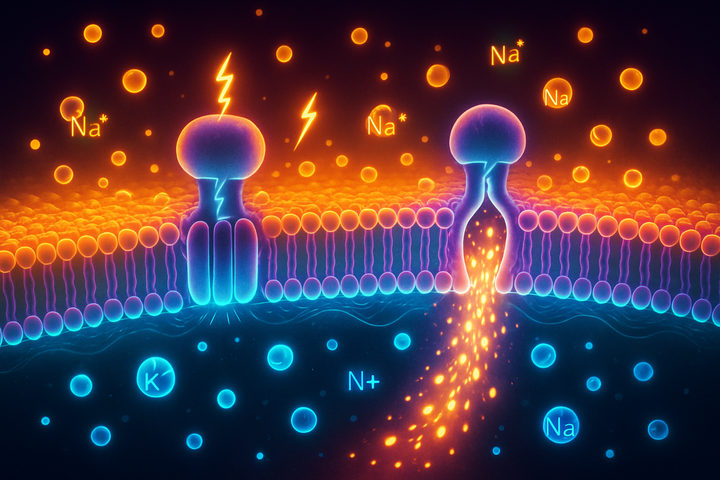
Here's the core technical challenge: how do you actually listen to neurons? Neurons communicate through electrical impulses. When a neuron "fires," there's a brief change in voltage that can, in principle, be detected by nearby electrodes. Get your electrode close enough to a neuron, and you can record its activity. Get electrodes close to many neurons, and you can start to decode what the brain is doing. The problem is "close enough." Neurons are microscopic. The best spatial resolution comes from electrodes that are practically touching them. But brain tissue is fragile. It doesn't like having foreign objects shoved into it. The immune system treats implanted electrodes as invaders and walls them off with scar tissue. Over time, the signal degrades. This is why the history of neural interfaces is largely a history of electrode engineering. The early motor BCIs used arrays with a few dozen electrodes—typically the "Utah array," a small silicon grid with 96 electrodes that look like tiny needles. These arrays gave researchers enough signal to decode basic movement intentions. But they degrade over months to years as the brain reacts to the implant. Neuralink's approach is different: 1,024 electrodes on incredibly thin, flexible threads, inserted by a custom robot to minimize tissue damage. The theory is that thinner, more flexible electrodes will cause less scarring and last longer. They're testing this theory right now, in human patients. Synchron takes a completely different approach: instead of penetrating the brain, their "stentrode" is delivered through blood vessels and lodges against the inside of a blood vessel wall near the motor cortex. Less invasive, but also less resolution—you're recording through the vessel wall, at a distance from the neurons. Each approach has tradeoffs. More invasive means more signal but more risk. Less invasive means easier surgery but cruder data. The field is still figuring out what the right balance is. The brain doesn't come with a USB port. We're improvising one.
What BCIs Can Actually Do (Right Now)
Let's ground this in current capabilities, as of this writing. Cursor control. Multiple systems have demonstrated reliable cursor control from neural signals. Paralyzed patients can navigate computer interfaces, type text (at speeds approaching 90 characters per minute in some studies), browse the web, and play video games. Noland Arbaugh, Neuralink's first public patient, is doing exactly this. Robotic arm control. Jan Scheuermann and others have controlled robotic arms with enough precision to feed themselves, grasp objects, and perform fine motor tasks. The movement isn't as fluid as natural motion, but it's far better than no movement at all. Speech decoding. This is newer and stunning. Researchers at Stanford and UCSF have demonstrated systems that decode attempted speech from neural activity in people who can no longer speak. Ann, a woman with ALS, now communicates through a computer avatar at about 80 words per minute—just by thinking about speaking. Mood and tremor modulation. Deep brain stimulation for Parkinson's is mature technology. Experimental applications for treatment-resistant depression show promise—electrodes that detect depression-associated brain states and deliver corrective stimulation. Hearing restoration. Cochlear implants are so successful that they've become routine. Most implanted children develop near-normal speech and language. What BCIs can't do yet: read thoughts directly, enable telepathy, upload consciousness, or create superhuman cognitive abilities. The current state of the art is more modest—translating specific, trained neural patterns into specific commands. It's learned vocabulary, not mind reading. But the trajectory is clear. Every year, the electrodes get better, the algorithms get smarter, and the capabilities expand.
The Real Patients
The people living with neural interfaces right now are mostly patients with severe disabilities—people for whom the risk of brain surgery is worth it because the alternative is such profound limitation. Nathan Copeland was the first person to feel sensation through a robotic arm controlled by a brain implant. His spinal cord was severed in a car accident at 18. Researchers at Pittsburgh implanted electrodes in his sensory cortex. Now, when sensors on the robotic arm detect touch, corresponding electrodes stimulate his brain, and he feels the touch on his phantom hand. Erik Sorto was paralyzed in a shooting. Researchers at Caltech implanted electrodes in his posterior parietal cortex—a region involved in movement planning rather than movement execution. He can now control a robotic arm to drink a beer himself. "I was surprised at how easy it was," he said. "I just think about moving my hand and it moves." Hanneke de Bruijne has ALS and is almost completely locked-in. A Dutch research team implanted electrodes that let her control a typing interface with her eyes and brain signals combined. She types messages to her family. Without the implant, she'd have no way to communicate at all. These are early adopters in the deepest sense. They're accepting significant surgical risk—general anesthesia, craniotomy, electrode implantation—because the potential benefit outweighs it. They're the test pilots of neural interfaces. And they're remarkably consistent in how they describe the experience: it feels natural. After some training, thinking about moving the cursor feels like moving the cursor. The brain is plastic enough to incorporate the interface into its body schema. The technology becomes transparent. It becomes part of you.
The Commercial Race
Neural interfaces are now a commercial race, not just an academic pursuit. Neuralink gets the most attention (Musk), but Synchron has been implanting patients longer with their less-invasive stentrode. Blackrock Neurotech makes the Utah arrays used in most academic research. Precision Neuroscience offers thin-film electrodes that sit on the brain surface. Behind all of these are decades of academic research—BrainGate at Brown and Stanford, the Pittsburgh groups, UCSF's speech decoding work, Caltech's motor intention research. We'll cover each major player in detail in the articles ahead.
The Road Ahead
The trajectory is clear, even if the timeline isn't. Near term: Motor BCIs become treatment options for paralyzed patients. Speech decoding matures. The current trials generate the data that determines which approaches work. Medium term: Bidirectional interfaces become standard—you control the prosthetic arm and feel through it. Deep brain stimulation expands beyond movement disorders. Long term (speculative): Memory enhancement. Skill downloading. Brain-to-brain communication. The fusion of human and artificial intelligence. None of the long-term possibilities are close. All of them are, in principle, allowed by the physics. The brain is an electrical organ. Once you can speak its language fluently, the possibilities are hard to bound. The brain is learning to talk to machines. The machines are learning to talk back.
What's Coming
This series will take you deep:
- Neuralink and Synchron—the competing approaches to getting electrodes into brains
- Motor prosthetics—how we decode movement intention
- Sensory feedback—the harder problem of writing information back
- Cochlear implants—the success story that proves the concept
- Mind uploading—the speculative frontier
The ethics—privacy, identity, access, autonomy—we'll address in the synthesis, after you've seen what the technology actually does and doesn't do. For now: a woman paralyzed for nine years feeds herself chocolate with a robot arm she controls with her thoughts. A man with ALS communicates through a system that decodes his intended speech. A child born deaf hears her mother's voice for the first time. This is what neural interfaces are for. The restoration of capacities that make life worth living. Let's start with the company that's made everyone pay attention. Next up: Neuralink.


Comments ()