The Caloric Brain: Why Thinking Costs Food
Intelligence is metabolically expensive and evolution doesn't pay for what it can't afford. Cooking unlocked caloric density that made the large human brain viable — and that energetic dependency shapes cognition in ways we're still measuring.
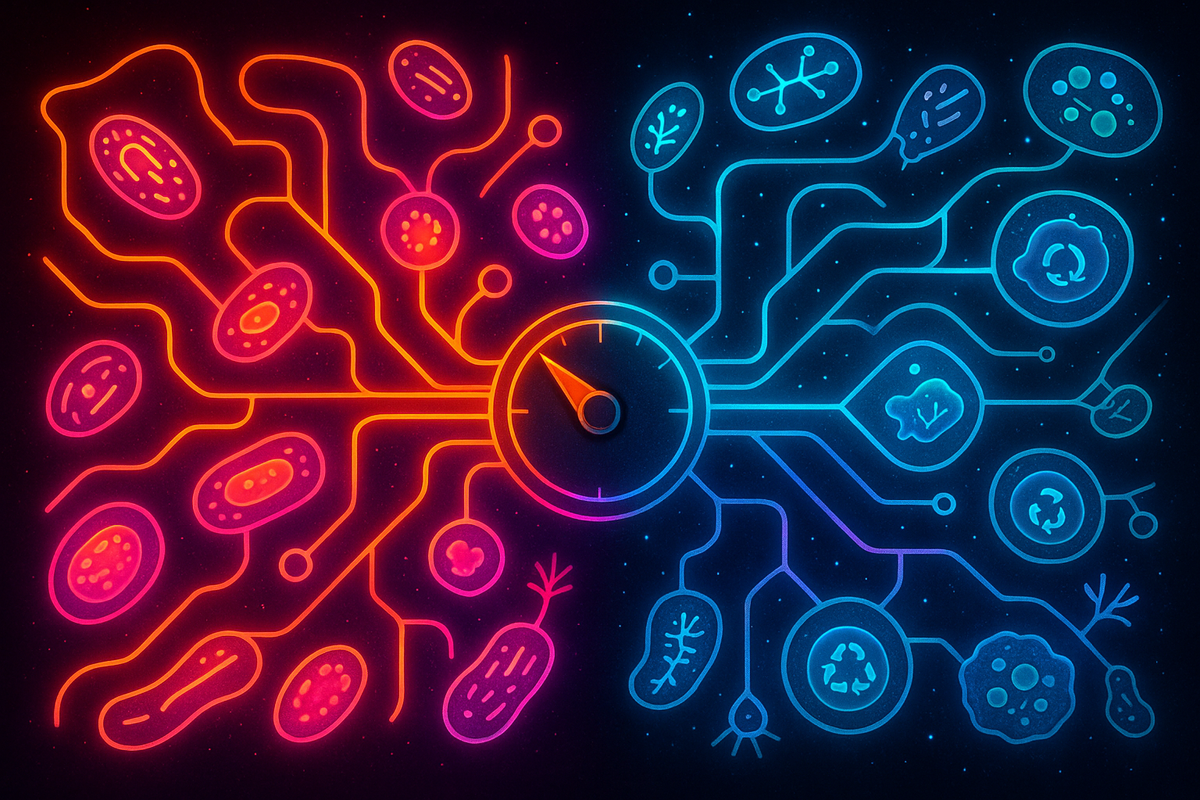
Why Eating Less Extends Life: The Science of Caloric Restriction
Series: Longevity Science | Part: 5 of 7 Primary Tag: FRONTIER SCIENCE Keywords: caloric restriction, intermittent fasting, mTOR, AMPK, sirtuins, longevity, metabolism
In 1935, a nutritionist at Cornell named Clive McCay reported something remarkable. Rats fed a diet with 30-40% fewer calories than normal lived significantly longer—up to 50% longer in some experiments. They didn't just live longer; they stayed healthier. Delayed cancer. Delayed kidney disease. Delayed cognitive decline. They aged slower by almost every measure.
This finding has been replicated in every organism tested: yeast, worms, flies, mice, dogs, and primates (including preliminary human data). Caloric restriction (CR) is the most robust longevity intervention in biology. Nothing else comes close to its consistency across species and studies.
And for 90 years, we've been asking: why?
The answer, it turns out, involves some of the most fundamental biology of how cells sense their environment and decide whether to grow or repair. Understanding caloric restriction is understanding the metabolic logic of aging.
The Basics: What Caloric Restriction Actually Is
Caloric restriction means reducing calorie intake below ad libitum (eat-as-much-as-you-want) levels while maintaining adequate nutrition. Typically, CR studies reduce calories by 20-40% while keeping protein, vitamins, and minerals at normal levels.
CR is not starvation. Starvation involves malnutrition and has harmful effects. CR provides all necessary nutrients; it just provides fewer total calories.
CR is not intermittent fasting (exactly). Intermittent fasting involves time-restricted eating windows but might not reduce total calories. CR reduces total calories regardless of timing. In practice, the two often overlap—it's hard to eat the same calories in a shorter window—but they're conceptually distinct. Some of their mechanisms overlap; others don't.
CR effects depend on degree and duration. Mild restriction (10-15% fewer calories) produces modest effects. More severe restriction (30-40%) produces stronger effects, up to a point. Too severe, and the benefits reverse—malnutrition causes harm.
The classic rodent finding: 30% CR started in young adulthood extends median lifespan by 30-50% and maximum lifespan by 20-30%. Healthspan benefits are even more dramatic.
Why Would Eating Less Extend Life?
The evolutionary logic isn't immediately obvious. If food is energy and energy is life, shouldn't more food mean more life?
The answer comes from evolutionary biology. Organisms evolved in environments of fluctuating food availability—feast and famine, not constant abundance. The famine response isn't just about survival during scarcity; it's about optimizing for reproduction when conditions improve.
When nutrients are scarce, two things make evolutionary sense:
1. Delay reproduction. Don't have offspring you can't feed. Wait for better times. 2. Invest in maintenance. Keep your body in good shape so you're still reproductively viable when food returns.
The opposite holds when nutrients are abundant:
1. Reproduce now. Conditions are good; don't waste them. 2. Invest less in maintenance. You'll have offspring to carry your genes; your individual body matters less.
This tradeoff—growth and reproduction vs. maintenance and longevity—is fundamental to evolutionary biology. Organisms can't maximize both simultaneously. Resources are finite. The metabolic programs that promote rapid growth and reproduction are, to some extent, antagonistic to the programs that promote longevity.
Caloric restriction tricks the body into "famine mode." It activates the maintenance and repair programs. It suppresses the growth and reproduction programs. And it turns out those maintenance programs are what extend lifespan.
The Nutrient-Sensing Pathways
Four interconnected signaling pathways mediate most of caloric restriction's effects:
1. Insulin/IGF-1 Signaling
Insulin is released in response to glucose. IGF-1 (insulin-like growth factor 1) is released in response to growth hormone and nutrients. Both promote cellular growth and proliferation. Both are suppressed by caloric restriction.
The first genetic longevity mutations discovered were in insulin/IGF-1 pathway genes. Worms with reduced insulin signaling live twice as long. Mice with growth hormone deficiency (which reduces IGF-1) live 40-60% longer. In humans, Laron dwarfs (with IGF-1 receptor mutations) have remarkably low rates of cancer and diabetes, though overall longevity effects are unclear.
Lower insulin/IGF-1 signaling = less growth signaling = more investment in maintenance.
2. mTOR (Mechanistic Target of Rapamycin)
mTOR is a master regulator of cell growth. When nutrients are abundant, mTOR is active—promoting protein synthesis, cell division, and growth while suppressing autophagy (cellular self-cleaning).
When nutrients are scarce, mTOR is inhibited. Protein synthesis slows. Autophagy activates, recycling damaged cellular components. The cell enters a maintenance-and-repair mode.
The drug rapamycin directly inhibits mTOR. It extends lifespan in every organism tested, including starting treatment in middle-aged mice. It's one of the most studied longevity drugs and likely mimics some of CR's effects through mTOR inhibition.
3. AMPK (AMP-Activated Protein Kinase)
AMPK is an energy sensor. When cellular energy is low (high AMP/ATP ratio), AMPK activates. It triggers catabolic pathways (breaking things down for energy) and inhibits anabolic pathways (building things that require energy).
AMPK activation promotes autophagy, mitochondrial biogenesis, and stress resistance. It's activated by exercise, fasting, and the drug metformin (which extends lifespan in some models and is being tested for longevity in humans).
4. Sirtuins
Sirtuins are a family of proteins (SIRT1-7 in mammals) that regulate metabolism, stress responses, and aging. They require NAD+ as a cofactor, which declines with age. Their activity links energy status to gene regulation.
Sirtuins are activated by fasting and caloric restriction. SIRT1 deacetylates PGC-1α, promoting mitochondrial function. SIRT3 protects mitochondria from oxidative stress. SIRT6 regulates DNA repair and metabolism.
David Sinclair has championed sirtuins as central to aging, arguing that sirtuin activation through NAD+ precursors or compounds like resveratrol might mimic CR's benefits. The evidence is mixed but sirtuin biology remains intensely studied.
How These Pathways Connect
The four pathways aren't independent. They're an integrated network:
- mTOR and AMPK are reciprocally inhibitory (high mTOR = low AMPK and vice versa) - Insulin/IGF-1 signaling activates mTOR - AMPK activates sirtuins through NAD+ effects - Sirtuins regulate many of the same downstream processes as AMPK
Caloric restriction doesn't just tweak one pathway—it shifts the entire metabolic network toward a "repair and maintain" configuration. This is why CR affects multiple hallmarks of aging simultaneously: enhanced autophagy (proteostasis), better mitochondrial function (mitochondrial health), reduced inflammation (intercellular communication), and improved stress resistance.
What Happens in the Body
The biochemistry is one level. The physiological effects are another:
Metabolic effects: Lower blood glucose, lower insulin, improved insulin sensitivity, lower triglycerides, lower cholesterol. Basically, the opposite of metabolic syndrome.
Inflammatory effects: Reduced inflammatory markers (C-reactive protein, IL-6, TNF-α). Less inflammaging.
Autophagy: Enhanced clearance of damaged proteins and organelles. Better proteostasis.
Stem cell function: Better maintained stem cell pools in many tissues.
Cancer resistance: Dramatically reduced cancer incidence in CR animals. The growth suppression that helps cells live longer also prevents cancer.
Cognitive function: Preserved memory and cognitive function in aged CR animals. Possible neuroplasticity benefits.
Cardiovascular function: Better heart function, lower blood pressure, less atherosclerosis.
These aren't separate effects—they're a coherent phenotype. CR animals age slower on virtually every physiological measure. They look younger. They act younger. They are, biologically, younger.
Does It Work in Humans?
The million-dollar question. The rodent data is spectacular. But humans aren't rodents.
Observational data: Populations with lower caloric intake (Okinawans before Westernization, Seventh-day Adventists) tend to be long-lived. But confounders abound—these populations differ in many ways beyond diet.
CALERIE trials: The Comprehensive Assessment of Long-term Effects of Reducing Intake of Energy (CALERIE) trial enrolled non-obese adults in 2-year 25% CR protocols. Results:
- Participants achieved ~12% CR on average (25% is hard) - Improved cardiovascular risk factors - Reduced markers of inflammation - Improved metabolic health - No negative effects on mood or quality of life
Two years isn't long enough to see mortality effects, and the degree of restriction was modest. But the biomarkers moved in the right directions.
Biosphere 2: The famous sealed ecosystem experiment in the 1990s accidentally created a CR population. For two years, eight people ate ~1800 calories/day (modest CR). Their metabolic changes mirrored rodent CR: lower blood pressure, cholesterol, glucose, and insulin.
Centenarian studies: Long-lived populations and centenarians often have metabolic profiles consistent with low-level lifetime CR—lower IGF-1, enhanced insulin sensitivity—though whether this is cause or effect is unclear.
The honest assessment: human CR probably works directionally, but we don't have proof of lifespan extension. The magnitude of effect is likely smaller than in rodents (percent lifespan extension tends to be smaller in longer-lived species). And sustained CR is brutally hard for most people to maintain.
Intermittent Fasting and Time-Restricted Eating
If continuous CR is hard, maybe the timing of eating matters as much as the amount.
Intermittent fasting (IF) involves alternating periods of eating and fasting: - 16:8 (16 hours fasting, 8-hour eating window) - 5:2 (five normal days, two very-low-calorie days) - Alternate-day fasting
Time-restricted eating (TRE) focuses on limiting eating to certain hours, often aligned with circadian rhythms (eating during daylight hours only).
The rationale: fasting periods activate autophagy, suppress mTOR, and trigger metabolic adaptations similar to CR, even if total calories are similar. The fasting signal matters, not just the reduced energy.
Animal data supports this. Mice fed the same calories but in a restricted time window are healthier than mice fed ad libitum. Fasting itself—independent of total calorie reduction—has benefits.
Human data is more mixed. IF and TRE improve metabolic health markers in many studies. Weight loss is common (because reducing eating windows tends to reduce calories, even without trying). But whether the specific timing matters beyond caloric effects is debated.
The practical advantages: IF is easier to adhere to than chronic CR for many people. Not eating is simpler than eating less. No calorie counting required.
CR Mimetics: The Drug Approach
If CR works through identifiable pathways, maybe drugs can activate those pathways without actual restriction.
Rapamycin: Directly inhibits mTOR. Extends lifespan in mice, even when started late in life. Currently the strongest CR mimetic candidate. Challenges: immunosuppression at clinical doses, though intermittent dosing may avoid this.
Metformin: Activates AMPK. Extends lifespan in some mouse studies, not all. Epidemiological data suggests diabetics on metformin may live longer than non-diabetic controls (!). The TAME trial (Targeting Aging with Metformin) is testing metformin for longevity in humans.
NAD+ precursors: NMN and NR (nicotinamide riboside) boost NAD+ levels, potentially activating sirtuins. Mixed results in animal models. Human trials ongoing.
Resveratrol and other sirtuin activators: Resveratrol (found in red wine) was initially hyped as a sirtuin activator. Reality proved more complicated—it may work through other mechanisms—and clinical results have been disappointing.
Spermidine: A polyamine found in aged cheese, mushrooms, and legumes. Induces autophagy. Extends lifespan in multiple model organisms. Human trials for cognitive and cardiovascular outcomes underway.
The dream: a pill that gives you the benefits of CR without the hunger. We're not there yet, but rapamycin and metformin are the closest approximations.
The Coherence Frame
From a coherence perspective, caloric restriction is the ultimate example of how metabolic signals influence system-level organization.
The body's default in abundance is growth—reproduction, replacement, expansion. This is coherent for evolutionary fitness in a feast-or-famine world. But continuous abundance—the modern environment—keeps the growth programs running past their adaptive window.
CR shifts the metabolic attractor toward maintenance, repair, and preservation. The system reorganizes around a different goal: persist rather than reproduce. And that reorganization happens at every level—molecular, cellular, tissue, organismal.
The longevity pathways aren't separate mechanisms bolted onto metabolism. They are metabolism, viewed through the lens of its developmental trajectory. Young, well-fed systems grow. Restricted systems maintain. And maintaining—keeping the pattern coherent—is what extends healthy function.
Practical Implications
If you're not going to spend your life hungry, what can you do with this information?
Avoid overnutrition: You don't need 30% CR to get benefits. Just don't chronically overeat. The modern default—constant snacking, large portions, caloric surplus—is the worst of all worlds.
Consider time-restricted eating: Even without caloric restriction, limiting eating to an 8-10 hour window may provide some fasting-signal benefits. It's also easier than constant restraint.
Exercise mimics some CR effects: Exercise activates AMPK, enhances autophagy, and improves metabolic health. It's not identical to CR, but it's complementary.
Watch the data on metformin and rapamycin: These drugs are being seriously studied for longevity. If trials succeed, they might become appropriate for healthy aging adults. For now, they're experimental.
Don't expect miracles from supplements: NMN, resveratrol, spermidine—these have plausible mechanisms but limited human evidence. They're not shortcuts around diet and exercise.
The unsexy truth: moderate eating, regular fasting periods, and exercise reproduce much of what CR achieves through more dramatic interventions. The metabolic signals aren't mysterious. They're the same signals our ancestors experienced through normal life. We've just engineered an environment that never sends them.
Further Reading
- Fontana, L. & Partridge, L. (2015). "Promoting health and longevity through diet: from model organisms to humans." Cell. - de Cabo, R. & Mattson, M.P. (2019). "Effects of Intermittent Fasting on Health, Aging, and Disease." New England Journal of Medicine. - Most, J. et al. (2017). "Calorie restriction in humans: An update." Ageing Research Reviews. - Longo, V.D. & Panda, S. (2016). "Fasting, Circadian Rhythms, and Time-Restricted Feeding in Healthy Lifespan." Cell Metabolism. - Kaeberlein, M. (2013). "mTOR Inhibition: From Aging to Autism and Beyond." Scientifica.
This is Part 5 of the Longevity Science series, exploring the biology of aging and interventions to extend healthspan. Next: "The Longevity Gold Rush."


Comments ()