Cancer as Coherence Collapse: What Tumors Reveal About Cellular Prediction
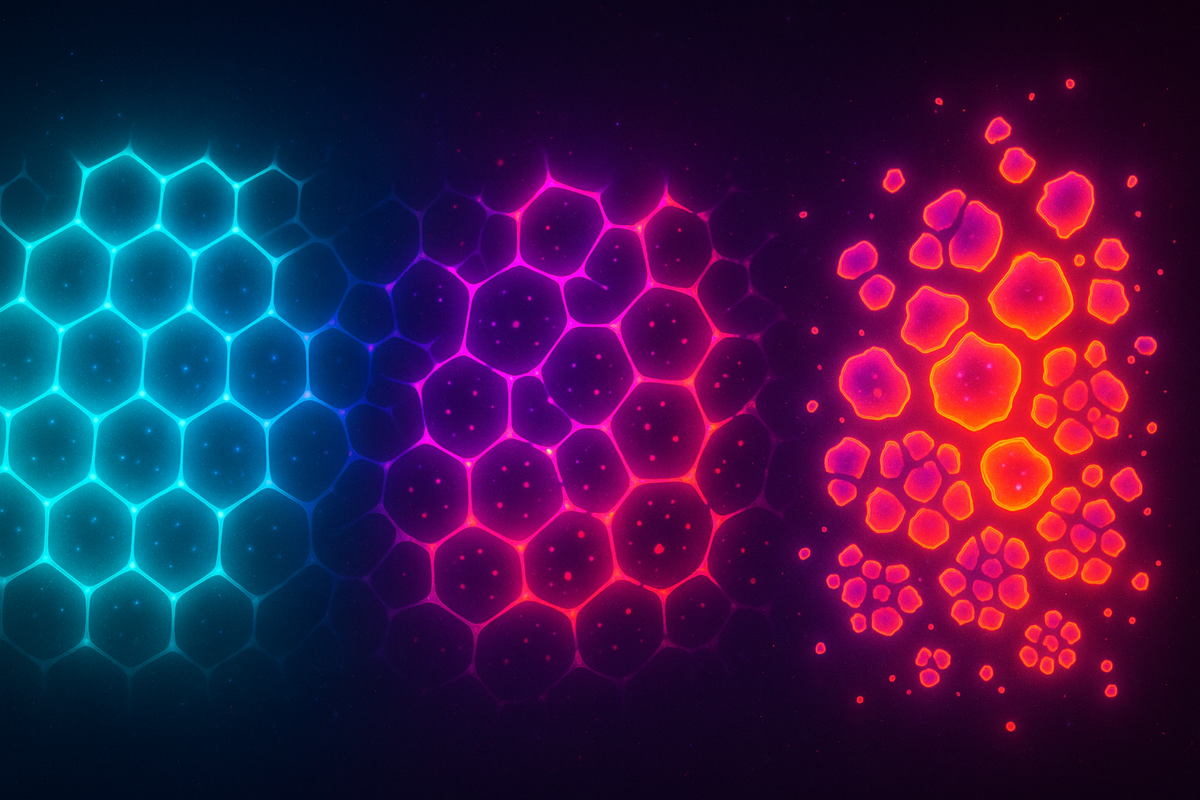
Standard oncology frames cancer as genetic damage — mutated cells ignoring the rules. Levin's bioelectric model: cancer is coherence collapse. Cells lose connection to the tissue's shared prediction model and revert to single-cell behavior, suggesting different therapeutic targets.
Cancer as Coherence Collapse: What Tumors Reveal About Cellular Prediction
Series: Basal Cognition | Part: 5 of 11
What if cancer isn't a genetic mistake that needs fixing, but a breakdown in collective intelligence? What if tumors aren't just rogue cells multiplying out of control, but communities that have lost their shared prediction model—their sense of what they're supposed to be?
This is Michael Levin's provocation, and it changes everything about how we might treat the disease that kills one in six people worldwide. If cancer is fundamentally a coherence collapse—a failure of cells to maintain their collective bioelectric conversation about form and function—then the therapeutic target shifts from DNA damage to communication restoration. From killing defectors to re-establishing the consensus that makes multicellular life possible.
The implications reach far beyond oncology. They suggest that cancer reveals something fundamental about how any complex system maintains its identity over time: through prediction, communication, and shared goals. When those mechanisms fail, you don't just get chaos. You get a different kind of order—one that serves parts rather than wholes.
The Standard Story and Its Cracks
The somatic mutation theory has dominated cancer research for decades. The narrative is clean: DNA damage accumulates through environmental insults or replication errors, mutations disable growth controls, and cells divide without restraint. Cancer is genetic corruption. Treatment is therefore targeted deletion—surgery to remove, radiation to destroy, chemotherapy to poison.
This model has produced real victories. We can sequence tumor genomes, identify driver mutations, develop targeted therapies against specific oncogenes. The pharmaceutical industry has built an empire on this foundation.
But the cracks are widening. Why do genetically identical cancer cells in the same tumor behave differently? Why can you transplant a tumor nucleus into a healthy egg and sometimes get normal development? Why do some cancers regress spontaneously without treatment? Why does the same genetic mutation produce cancer in one tissue context but not another?
The mutation-centric view struggles with these phenomena because it treats cancer as a cell-autonomous problem—as if individual cells make independent decisions to become malignant. But cells aren't hermetically sealed units. They're nodes in networks, participants in collective processes, components of larger computational architectures.
What if cancer isn't primarily about broken genes, but broken geometry?
Bioelectric Coherence: The Morphogenetic Field That Holds You Together
Before we can understand how that field collapses, we need to understand what it is. In earlier parts of this series, we explored how bioelectric fields function as coherence manifolds—spatial patterns of voltage gradients that encode anatomical information. These aren't metaphorical fields. They're measurable electrical potentials across cell membranes, created by ion channel activity and gap junction connectivity.
Here's what makes them remarkable: bioelectric states predict and regulate anatomy. Change the voltage pattern in a developing limb, and you can grow extra fingers. Hyperpolarize a region of a planarian flatworm, and you'll induce an ectopic head. The electrical state carries information about what should grow where, serving as a scaffold that guides gene expression.
This is what Levin calls the bioelectric code—a layer of information processing that sits above genetics but below gross anatomy. It's how cells collectively compute what they're supposed to become. Individual cells read their local voltage environment, compare it to their own electrical state, and adjust their behavior accordingly. The result is a self-maintaining pattern—a coherent prediction about form that cells work together to fulfill.
Think of it as a distributed prediction model. Each cell holds hypotheses about its role in the larger structure. Those hypotheses are constantly tested against bioelectric inputs from neighbors. When the predictions align—when cells agree on what they're building—you get coherent morphogenesis. When they diverge, you get developmental defects, regeneration failures, or something worse.
You get cancer.
When the Collective Model Breaks Down
Levin's reconceptualization treats cancer as bioelectric coherence collapse—a breakdown in the collective prediction that defines tissue identity. Cells haven't necessarily acquired malicious mutations. They've lost connection to the morphogenetic field that tells them what "normal" means.
Consider the experimental evidence. In multiple systems, researchers have shown that:
Bioelectric disruption induces tumor-like growth. Depolarize cells (make their membrane potential less negative), and they start behaving like cancer cells—proliferating inappropriately, ignoring growth signals, losing differentiation. This happens without introducing genetic mutations. The electrical change is sufficient.
Bioelectric normalization suppresses tumorigenesis. Force depolarized cells back into a hyperpolarized state, and tumor formation decreases—even in cells carrying oncogenic mutations. The electrical correction overrides the genetic damage. This shouldn't be possible if cancer is purely a DNA problem.
Gap junction communication matters. Cancer cells characteristically shut down gap junctions—the channels that allow electrical and chemical signals to pass between cells. This isn't just correlation. When you experimentally restore gap junction connectivity in cancer cells, their malignant behavior often normalizes. They're not hearing their neighbors anymore. Re-establish communication, and they remember who they are.
The tumor microenvironment controls phenotype. The same genetically transformed cell will behave differently depending on its bioelectric context. Place it in a region with normal bioelectric polarity, and it integrates. Place it in a disrupted region, and it proliferates. The cell's genotype doesn't change. Its context does—and that's sufficient to switch between dormancy and malignancy.
This looks exactly like what happens when you remove a node from a coherent network. The node doesn't become evil. It becomes confused. Without input signals that ground its predictions in collective reality, it defaults to local optimization—growth for growth's sake, unconstrained by information about the larger structure.
Cancer cells aren't defecting from the multicellular contract. They're acting like single-celled organisms because they've lost the signals that made them multicellular in the first place.
Prediction Error at the Cellular Scale
This maps cleanly onto the Free Energy Principle framework developed by Karl Friston. Under FEP, living systems persist by minimizing prediction error—the difference between expected and actual sensory inputs. You maintain your boundary (your Markov blanket, your identity as a thing-distinct-from-environment) by successfully predicting what happens next and acting to make those predictions come true.
For a single cell in a multicellular organism, the "environment" includes neighboring cells, extracellular matrix, and bioelectric fields. A healthy cell's generative model predicts: "I should receive growth inhibition signals when density is high. I should differentiate toward liver/skin/neuron phenotype based on positional cues. I should coordinate division timing with neighbors. I should apoptose if DNA damage exceeds repair capacity."
These predictions are encoded in gene regulatory networks, but they're parametrized by bioelectric state. Ion channel expression determines resting potential, which gates which genes activate, which determines cell behavior. The voltage pattern is the inference—the cell's best guess about what it should be doing given its place in the larger organism.
Now disrupt that bioelectric input. Gap junctions close. Voltage gradients flatten. Morphogen distributions become noisy. Suddenly the cell's predictions don't match reality. Surprise (free energy) accumulates.
From an active inference perspective, the cell has two options:
- Update beliefs to match unexpected inputs—differentiate differently, proliferate less, realign with neighbors
- Act to make predictions true—change behavior to reduce surprise in a different way
Option 1 requires accurate inference about what's actually happening. But if the bioelectric signals are degraded, inference becomes impossible. You can't compute the right answer from corrupted data. So the cell increasingly relies on option 2: act to minimize free energy by creating conditions that match prior predictions—the ancient, conserved predictions about growth and replication that predate multicellularity.
Cancer cells aren't broken thermostats. They're thermostats that have lost their temperature sensor. They're still minimizing free energy, still trying to maintain their Markov blanket. But without reliable input about collective goals, they fall back on autonomy—the prediction that survival means growth, that persistence means replication.
This is coherence collapse. The system fragments into local optimizers because the signals that synchronized global optimization have failed.
The Geometry of Malignancy
In AToM terms, cancer represents a curvature catastrophe at the tissue scale. Healthy tissue exists in a low-curvature region of state space—a stable attractor basin where cells coordinate to maintain form and function. The bioelectric field is the manifold structure that keeps trajectories integrable, that makes "liver" or "skin" or "heart muscle" a geometrically coherent state.
Oncogenesis is a transition to high curvature—a destabilization where trajectories no longer integrate to a shared anatomical goal. Instead of cells coordinating toward tissue-level coherence (maintaining liver-ness, skin-ness, heart-ness), you get local attractors: proliferation, dedifferentiation, invasion. These aren't arbitrary states. They're geometrically accessible once the constraints that held the system in the multicellular basin are removed.
Think of it topologically. A developing organism navigates a morphospace—a high-dimensional space where each dimension represents some aspect of form (cell count, tissue architecture, differentiation states, spatial patterns). Healthy development traces a specific trajectory through this space: zygote → blastula → gastrula → organized anatomy. The bioelectric field acts as a constraint surface, limiting which trajectories are possible.
Cancer is when regions of this space become locally accessible that should have been globally forbidden. Cells find pathways through morphospace that lead away from anatomical coherence—not because those pathways are inherently malignant, but because the field that enforced coherence has degraded. The geometry permits trajectories it shouldn't.
This explains several puzzling features of cancer:
Heterogeneity. Even clonal tumors diversify rapidly because they're exploring state space without coherence constraints. Many trajectories become available.
Context-dependence. The same mutation produces different outcomes in different bioelectric contexts because the geometry—the curvature structure that determines which attractors are accessible—varies by context.
Plasticity. Cancer cells can dedifferentiate, transdifferentiate, enter dormancy, or normalize phenotype because they're not locked into a fixed identity. They're navigating based on local gradients in a high-curvature space where many states are equally accessible.
Regression. Spontaneous tumor regression happens when the bioelectric field somehow re-establishes coherence—when the geometry stabilizes and cells find their way back to the multicellular attractor.
The geometric view suggests that malignancy is a navigational failure. Cells aren't doing the wrong thing on purpose. They're optimizing locally in the absence of global positional information. They're lost in morphospace, following gradients that don't lead home.
Implications for Treatment: Restoring Coherence Instead of Killing Defectors
If cancer is coherence collapse, then therapy should target coherence restoration—not just cell destruction. This isn't speculative philosophy. It's producing experimental results.
Bioelectric reprogramming. Multiple labs have shown that forcing cancer cells back into hyperpolarized states (the electrical signature of normal differentiated cells) can normalize their behavior. You're not fixing their mutations. You're restoring the bioelectric context that allows them to integrate into collective computation. The genetic damage remains, but phenotype shifts from malignant to benign because the prediction model has been repaired.
Gap junction restoration. Compounds that upregulate connexin expression (the proteins that form gap junctions) show anti-cancer effects across multiple tumor types. You're not poisoning proliferation. You're re-establishing the communication channels that allow cells to hear what their neighbors are predicting—and to update their own models accordingly.
Morphoceuticals. Levin's term for interventions that target anatomical information rather than genetic damage. This could mean using ion channel modulators to reshape bioelectric fields, or deploying external electric fields to impose coherence from outside, or using optogenetic tools to selectively activate voltage-gated pathways in tumor tissue.
The key shift is from adversarial to corrective intervention. The standard paradigm treats cancer cells as enemies to be eliminated. The coherence paradigm treats them as confused participants in a collective process—still trying to minimize free energy, still capable of responding to signals, but disconnected from the morphogenetic field that would tell them how to do it cooperatively.
Restoration is possible because the machinery for coherence—the ion channels, gap junctions, downstream signaling—is usually still present. It's misparametrized due to bioelectric disruption, but not destroyed. Get the electrical state right, and gene expression often follows. Get communication re-established, and cells can sometimes infer their proper role from neighbor inputs.
This doesn't mean throwing out chemotherapy or radiation. It means adding a layer—coherence scaffolding—that helps surviving cells reorganize into stable anatomical patterns rather than recurring tumors. It means thinking about cancer as a systems-level failure that requires systems-level repair.
What This Tells Us About Meaning
Cancer is terrifying because it represents the betrayal of self by self—your own cells turning against you. But the coherence framework reframes the horror. Malignancy isn't betrayal. It's disconnection. It's the breakdown of shared meaning at the most fundamental biological level.
Cells are meaning-making systems. They interpret signals, build models, act to fulfill predictions. In a healthy organism, those meanings align—cells share a prediction about form, coordinate to maintain it, communicate to update their models when conditions change. The multicellular organism is that shared meaning, instantiated in bioelectric geometry and maintained through collective inference.
Cancer is what happens when meaning fragments. When the signals that synchronized prediction degrade, cells fall back on older, simpler meanings: survive, replicate, expand. These aren't wrong meanings. They're local meanings, optimized for single-cell existence. They work for bacteria. They fail catastrophically for members of a 37-trillion-cell cooperative.
This is M = C/T made visceral. Meaning (coherent organismal identity) equals Coherence (bioelectric field integrity) over Tension (the thermodynamic and evolutionary pressures toward autonomy). When coherence collapses, meaning collapses. What remains is not meaningless—cancer cells are still minimizing free energy, still acting purposefully—but it's meaning at the wrong scale. Local optimization that destroys global function.
The therapeutic insight is that meaning can be reconstructed. Because cells retain the capacity to respond to bioelectric signals, restoring the coherence field can restore coordinated prediction. You don't need to make cancer cells "good." You need to help them rejoin the conversation—to receive inputs that let them update their models to align with multicellular goals.
And the philosophical insight is that this pattern—coherence collapse, fragmentation into local optimizers, potential for re-integration—shows up everywhere. In traumatized nervous systems where regions stop communicating. In failing organizations where departments optimize locally. In fragmenting societies where shared narratives dissolve.
Cancer teaches us that the boundary between cooperation and defection is not fixed. It's maintained—actively, continuously, through communication and prediction. When maintenance fails, the system doesn't necessarily die. It reorganizes. Sometimes into configurations we call malignant. Sometimes, if coherence can be restored, back into health.
The question isn't whether cells are good or bad. It's whether they can hear each other—and whether the field they're embedded in provides enough information to let them predict together.
The Hardest Questions
If cancer is coherence collapse, why doesn't it happen constantly? Why are we not all tumors?
The answer is that it almost does, constantly. Your immune system kills thousands of dysregulated cells daily. Apoptosis eliminates cells with excessive DNA damage. Contact inhibition stops proliferation when density thresholds are reached. Error correction mechanisms at every level work to maintain the bioelectric patterns that define anatomical coherence.
Cancer happens when these mechanisms fail simultaneously—when multiple layers of coherence maintenance break down and cells can't reconstruct the morphogenetic field from available information. It's a cascade failure. One gap junction network degrades. Voltage gradients flatten. Cells depolarize. Growth signals go unheard. More gap junctions close because depolarized cells downregulate connexins. The field collapses further. Positive feedback drives the system into the high-curvature region where malignant attractors dominate.
This cascade structure explains why cancer risk increases with age (more time for coherence mechanisms to fail), why inflammation promotes cancer (disrupts bioelectric patterns), why some mutations are "driver mutations" (they destabilize the bioelectric field in ways that trigger cascades).
But it also suggests resilience. Cascades can be interrupted. If you stabilize bioelectric coherence at any point in the sequence, downstream failures might not occur. This is why gap junction restoration works even in the presence of oncogenic mutations—you've broken the positive feedback loop that drives field collapse.
The second hard question: If this is true, why hasn't natural selection built more robust coherence mechanisms?
Because there's a tradeoff. Tight coherence constraints make the organism developmentally fragile—unable to adapt to injury, unable to regenerate, locked into rigid anatomical patterns. Loose coherence allows plasticity, regeneration, adaptation to damage. Organisms that regenerate well (salamanders, planaria) have highly dynamic bioelectric fields. They can rebuild lost structures because their morphogenetic information isn't rigidly fixed.
Mammals sacrificed regenerative capacity for other advantages—homeothermy, complex nervous systems, long lifespans. But the cost is cancer vulnerability. Our bioelectric fields are relatively static compared to regenerating species. We maintain coherence well enough for development and homeostasis, but we struggle to repair field disruptions. We can't rebuild a lost limb because our coherence mechanisms don't support that level of morphological flexibility. But that same rigidity makes us vulnerable when coherence does fail—we can't re-establish the field as easily as a flatworm.
Cancer is the price of our particular solution to the coherence-plasticity tradeoff. Other organisms solve it differently and get different pathologies.
From Cells to Societies
The final provocation: If cancer is what happens when cells lose collective coherence and revert to single-celled optimization, what does that tell us about other scales?
Consider trauma as neural coherence collapse—brain regions that should coordinate toward integrated processing instead fragment into local attractors (hypervigilance, dissociation, freeze). The mechanism isn't bioelectric field disruption (though autonomic dysregulation is certainly involved). But the structure is similar: parts optimizing locally because communication between parts has failed.
Consider organizational dysfunction as social coherence collapse—departments or teams that should coordinate toward institutional goals instead optimize for local metrics. Not because they're malicious. Because they've lost connection to signals that would align their predictions with collective function.
Consider cultural fragmentation as narrative coherence collapse—groups that should share predictions about meaning and value instead occupy incommensurable reality tunnels. Each group is minimizing free energy according to its local model. But without shared morphogenetic field (narrative, ritual, common reference points), the trajectories diverge.
In each case, the failure mode isn't chaos. It's ordered fragmentation. Local coherence without global coordination. Subsystems that work fine in isolation but destroy emergent function. This is what cancer teaches us. The cells in a tumor aren't disordered. They're highly organized—around the wrong goals.
And in each case, the therapeutic direction is similar. Not adversarial elimination of defectors, but coherence restoration. Re-establishing communication. Rebuilding shared fields. Providing scaffolding that lets parts rejoin the collective prediction.
This doesn't mean all problems reduce to coherence failures. But it suggests that a certain class of systemic pathology—the kind where components are functional but the whole is broken—might respond to coherence-based interventions rather than component replacement.
Cancer forces us to ask: What holds a system together? Not laws or commands, but shared prediction. Information that aligns local models toward collective goals. Communication that lets parts infer their role from context. Fields that constrain trajectories toward integrable states.
When those mechanisms work, you get multicellular organisms, coordinated nervous systems, functional institutions, coherent cultures. When they fail, you get malignancy at the corresponding scale.
The question is always the same: Can we restore the field before fragmentation becomes irreversible?
Further Reading
- Levin, M., & Martyniuk, C. J. (2018). "The bioelectric code: An ancient computational medium for dynamic control of growth and form." BioSystems, 164, 76-93.
- Chernet, B. T., & Levin, M. (2013). "Transmembrane voltage potential is an essential cellular parameter for the detection and control of tumor development in a Xenopus model." Disease Models & Mechanisms, 6(3), 595-607.
- Levin, M. (2021). "Bioelectric signaling: Reprogrammable circuits underlying embryogenesis, regeneration, and cancer." Cell, 184(8), 1971-1989.
- Sonnenschein, C., & Soto, A. M. (2013). "The aging of the 2000 and 2011 Hallmarks of Cancer reviews: A critique." Journal of Biosciences, 38, 651-663.
- Friston, K. (2019). "A free energy principle for a particular physics." arXiv preprint arXiv:1906.10184.
This is Part 5 of the Basal Cognition series, exploring how Michael Levin's work on cellular intelligence reshapes our understanding of life, mind, and meaning.
Previous: Morphogenetic Fields as Markov Blankets: The Statistical Boundaries of Development
Next: Xenobots and the Plasticity of Biological Coherence
Comments ()