CAR-T Therapy: Engineering Cancer Killers
Emily Whitehead was 6 years old and out of options when she became the first child treated with CAR-T therapy. Her engineered T cells eliminated her leukemia. The science behind that result is one of the most remarkable in modern medicine.
CAR-T Therapy: Engineering Cancer Killers
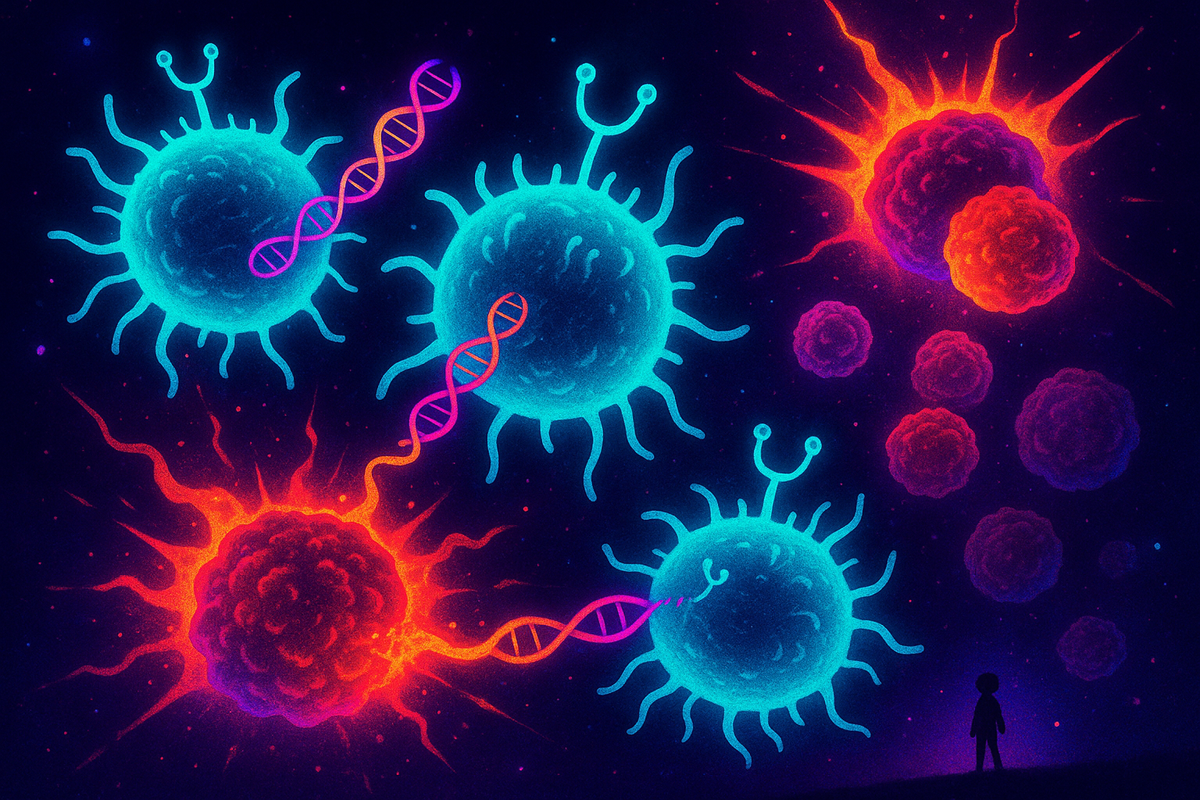
In 2012, a six-year-old girl named Emily Whitehead was dying of leukemia. She had relapsed twice after chemotherapy. There were no more standard options. Her doctors at the Children's Hospital of Philadelphia tried something that had never worked before: they extracted her T cells, genetically modified them to recognize her cancer, multiplied them in the lab, and infused them back into her body. Within days, she developed a violent immune reaction—a cytokine storm that nearly killed her. Her fever spiked to 106°F. She was put in a coma on a ventilator. Then the storm passed. And when she woke up, the cancer was gone. Emily Whitehead is still alive today, over a decade later. She was the first child cured by CAR-T therapy. She's now a teenager who visits other kids with cancer, a walking proof of concept for one of the most radical ideas in medicine: turning the immune system into a precision weapon against cancer.
How It's Made
The manufacturing process for CAR-T is unlike any other drug. It's individualized—made fresh for each patient from their own cells. 1. Leukapheresis: Blood is drawn from the patient and passed through a machine that separates out T cells. The rest of the blood is returned. 2. Genetic modification: The T cells are modified to express the CAR. This is usually done with a viral vector—a disabled virus that inserts the CAR gene into the T cell's DNA. 3. Expansion: The modified T cells are grown in the lab for 1-3 weeks, multiplying from millions to billions. 4. Quality control: The cells are tested for viability, potency, and safety. 5. Infusion: The patient receives chemotherapy to make room in the immune system, then the CAR-T cells are infused. This isn't mass production. It's bespoke manufacturing. Every dose is unique to one patient. This makes CAR-T expensive (around $400,000-$500,000 per treatment) and logistically complex. But for cancers that respond, the results can be dramatic.
The Breakthrough Cancers
CAR-T has been most successful against B cell malignancies—cancers of a type of white blood cell. These include:
- Acute lymphoblastic leukemia (ALL): The cancer Emily Whitehead had. CAR-T achieves complete remission in 70-90% of patients who have failed other treatments.
- Diffuse large B cell lymphoma (DLBCL): The most common aggressive lymphoma. CAR-T produces durable remissions in about 40% of patients with relapsed/refractory disease.
- Multiple myeloma: A blood cancer affecting plasma cells. Newer CAR-T products are showing strong responses.
What these cancers share is a good target: CD19 (for leukemia and lymphoma) or BCMA (for myeloma). These are proteins expressed on the surface of B cells and their cancerous counterparts. The CAR recognizes these proteins, and the T cells destroy any cell displaying them. The catch: CAR-T also destroys normal B cells expressing the same proteins. Patients lose their ability to make antibodies and need ongoing immunoglobulin replacement. This is considered an acceptable trade-off when the alternative is death from cancer.
The Toxicity Problem
CAR-T isn't gentle. When it works, it works violently. Cytokine release syndrome (CRS) is the main toxicity. When CAR-T cells encounter their target and activate, they release signaling molecules called cytokines. These cytokines recruit and activate other immune cells, which release more cytokines. The result can be a systemic inflammatory storm. Symptoms range from mild (fever, fatigue) to life-threatening (hypotension, hypoxia, organ failure). Emily Whitehead's cytokine storm nearly killed her. Fortunately, her doctors happened to have access to an IL-6 blocker called tocilizumab, originally developed for rheumatoid arthritis. It worked—CRS could be controlled. Tocilizumab is now standard supportive care for CAR-T. The discovery that CRS could be managed without losing anticancer efficacy was crucial to making CAR-T viable. Neurotoxicity is the other major concern. Some patients develop confusion, seizures, language difficulties, or encephalopathy. The mechanism isn't fully understood—it may involve cytokines crossing the blood-brain barrier or CAR-T cells trafficking to the brain. Most cases resolve, but severe neurotoxicity can be dangerous. The toxicity profile means CAR-T is administered in specialized centers with intensive monitoring. Patients typically stay in the hospital for weeks. Managing side effects is as important as manufacturing the cells.
Why It Works So Well
When CAR-T works, it can produce responses that look like cures. Why? Living drug: Unlike chemotherapy, which is metabolized and eliminated, CAR-T cells persist. They multiply when they encounter their target, creating more tumor-killing capacity exactly when and where it's needed. Some patients have detectable CAR-T cells years after infusion. Memory formation: T cells can form memory populations that persist long-term and reactivate if the cancer returns. The immune system "remembers" the cancer. Serial killing: A single T cell can kill multiple target cells, one after another. The drug amplifies itself during use. Trafficking: T cells can reach places that drugs struggle to penetrate—crossing into tissues, entering the bone marrow, finding disseminated disease. This is the power of cellular therapy: you're not administering a static molecule that gets diluted and eliminated. You're deploying a self-amplifying, self-directing, persistent killing force.
The Limits
CAR-T has been revolutionary for certain blood cancers. It has been largely disappointing for solid tumors—the cancers that kill most people. The challenges are significant: Getting in: Solid tumors create physical barriers. CAR-T cells have to infiltrate dense tissue, navigate suppressive microenvironments, and survive hostile conditions. Blood cancers circulate in the bloodstream; solid tumors wall themselves off. Staying alive: Tumors create immunosuppressive environments—producing signals that exhaust or disable T cells. CAR-T cells that enter solid tumors often become dysfunctional. Finding the target: Solid tumors are heterogeneous. Not all cells express the same surface proteins. A CAR targeting one protein may miss cells that don't express it. The cancer evolves around single-target therapies. On-target, off-tumor toxicity: Many proteins found on solid tumors are also found on normal tissues. Target a lung cancer protein that's also on normal lung cells, and you get unacceptable lung damage. Researchers are working on solutions: armored CARs that resist suppression, multi-target CARs that require two antigens, "logic-gated" CARs that respond to combinations of signals. Progress is being made, but solid tumors remain the frontier.
The Cost Question
CAR-T is expensive. A single treatment costs $400,000-$500,000, plus hospitalization and supportive care. For a potentially curative therapy in otherwise fatal cancer, this may be cost-effective over the long term—but it strains healthcare budgets. The cost reflects the complexity: individualized manufacturing, specialized facilities, intensive monitoring. Mass production economics don't apply when every dose is made for one patient. Whether CAR-T becomes more affordable depends on manufacturing innovations (automation, shorter production times), broader competition, and potentially "off-the-shelf" allogeneic CAR-T made from donor cells rather than patient cells. Allogeneic products could be mass-produced and stored, dramatically reducing costs. We're in the early stages of a technology that may eventually become as routine as chemotherapy. Or it may remain a niche therapy for specific cancers. The economics will determine the reach.
The Bigger Picture
CAR-T represents a new paradigm: the immune system as a programmable therapeutic platform. We can now engineer immune cells to do things they wouldn't naturally do—recognize specific targets, resist suppression, signal for help, persist longer. The CAR is just one example. Other modifications are possible: T cells that produce their own cytokines, that resist exhaustion, that home to specific tissues. Beyond cancer, engineered T cells might treat autoimmune diseases (targeting the cells that cause inflammation), infections (targeting HIV reservoirs), or even aging-related damage (targeting senescent cells). The broader lesson: the immune system is not fixed biology to be accepted or suppressed. It's a living system that can be redirected. Emily Whitehead's cure wasn't a drug discovery. It was a demonstration that we can take the body's own defense system, upgrade it, and turn it against diseases it couldn't naturally fight. That's a fundamentally new kind of medicine.
Further Reading
- June, C. H. et al. (2018). "CAR T cell immunotherapy for human cancer." Science.
- Maude, S. L. et al. (2018). "Tisagenlecleucel in Children and Young Adults with B-Cell Lymphoblastic Leukemia." New England Journal of Medicine.
- Labanieh, L. & Mackall, C. L. (2023). "CAR immune cells: design principles, resistance and the next generation." Nature.
This is Part 3 of the Immunology Renaissance series. Next: "Checkpoint Inhibitors."


Comments ()