Change of Base Formula: Converting Between Logarithms
Your calculator only speaks base 10 and base e. The change of base formula is the translation layer that makes every other logarithm computable — and exposes a surprising unity between all log scales.
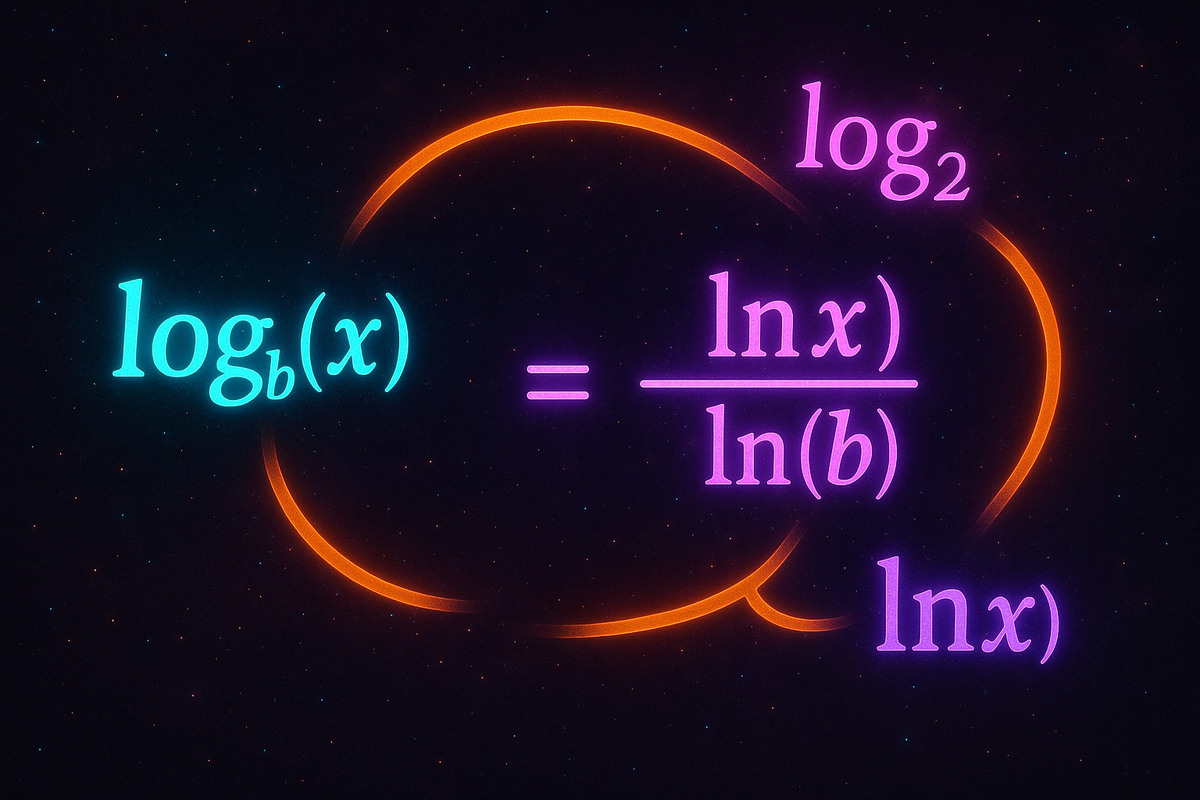
Any logarithm can be computed using any other logarithm.
Your calculator has buttons for log (base 10) and ln (base e). But what if you need log₂(7) or log₅(100)?
Use the change of base formula. It converts any logarithm into a ratio of logarithms you can compute.
log_b(x) = ln(x) / ln(b) = log(x) / log(b)
That's it. Divide two logarithms you can calculate, and you get the logarithm in any base you want.
The Formula
log_b(x) = log_c(x) / log_c(b)
where c can be any base (usually 10 or e).
In practical terms:
log_b(x) = log(x) / log(b) using base 10
log_b(x) = ln(x) / ln(b) using natural log
Both give the same answer. Use whichever your calculator has.
Why It Works
Let log_b(x) = y. This means bʸ = x.
Take log_c of both sides: log_c(bʸ) = log_c(x) y × log_c(b) = log_c(x) y = log_c(x) / log_c(b)
Therefore: log_b(x) = log_c(x) / log_c(b). ∎
The formula works because logarithms are exponents, and the power rule (log of a power is power times log) lets us extract the exponent.
Examples
Example 1: log₂(10)
log₂(10) = log(10) / log(2) = 1 / 0.301 ≈ 3.32
Check: 2^3.32 ≈ 10 ✓
This tells you 10 is about 3.32 doublings above 1.
Example 2: log₃(81)
log₃(81) = log(81) / log(3) = 1.908 / 0.477 = 4
Check: 3⁴ = 81 ✓
When the answer is exact, the division comes out clean.
Example 3: log₅(7)
log₅(7) = ln(7) / ln(5) = 1.946 / 1.609 ≈ 1.209
Check: 5^1.209 ≈ 7 ✓
Example 4: log₇(100)
log₇(100) = log(100) / log(7) = 2 / 0.845 ≈ 2.37
This tells you 100 is about 2.37 powers of 7 above 1.
Common Conversions
Between base 10 and base e:
ln(x) = 2.303 × log(x)
log(x) = 0.434 × ln(x)
The conversion factor is ln(10) ≈ 2.303 (or its reciprocal 0.434).
Between base 2 and base e:
log₂(x) = 1.443 × ln(x)
ln(x) = 0.693 × log₂(x)
The conversion factor is ln(2) ≈ 0.693 (or its reciprocal 1.443).
Between base 2 and base 10:
log₂(x) = 3.322 × log(x)
log(x) = 0.301 × log₂(x)
Solving Equations with Change of Base
Example: Solve 5ˣ = 17.
Take log of both sides: x × log(5) = log(17) x = log(17) / log(5) = 1.230 / 0.699 ≈ 1.76
This is the same as x = log₅(17) ≈ 1.76.
Example: Solve 3^(2x-1) = 7^x.
Take ln of both sides: (2x - 1)ln(3) = x × ln(7) 2x × ln(3) - ln(3) = x × ln(7) x(2 ln(3) - ln(7)) = ln(3) x = ln(3) / (2 ln(3) - ln(7)) x = 1.099 / (2.197 - 1.946) = 1.099 / 0.251 ≈ 4.38
The Ratio Interpretation
log_b(x) / log_b(y) = log_y(x)
The ratio of two logarithms (same base) gives a logarithm in a new base.
Example: log(1000) / log(10) = 3 / 1 = 3 = log₁₀(1000) ✓
Example: ln(8) / ln(2) = 2.079 / 0.693 = 3 = log₂(8) ✓
This is the change of base formula in another form.
Why Different Bases Exist
Base 10 — Human counting, orders of magnitude
- log₁₀(1000) = 3 means "three orders of magnitude"
Base e — Calculus, continuous processes
- ln(x) = ∫₁ˣ (1/t)dt, the natural antiderivative
Base 2 — Computing, information theory
- log₂(x) counts bits, doublings, binary digits
Arbitrary bases — Context-dependent
- log₁₂(x) might matter for time (hours)
- log₆₀(x) might matter for time (minutes)
The change of base formula means you never need a special calculator. Any logarithm is a ratio of logs you already have.
Special Cases
log_b(b) = 1 for any base
log_b(b) = log(b) / log(b) = 1 ✓
log_b(1) = 0 for any base
log_b(1) = log(1) / log(b) = 0 / log(b) = 0 ✓
log_b(bⁿ) = n for any base
log_b(bⁿ) = log(bⁿ) / log(b) = n × log(b) / log(b) = n ✓
The formulas check out.
The Reciprocal Relationship
log_a(b) × log_b(a) = 1
Proof: log_a(b) = log(b) / log(a) log_b(a) = log(a) / log(b)
Multiply: [log(b)/log(a)] × [log(a)/log(b)] = 1 ✓
In other words: log_a(b) = 1 / log_b(a)
If log₂(8) = 3, then log₈(2) = 1/3.
Check: 8^(1/3) = 2 ✓
Mental Estimation
For quick estimates, remember:
- log₂(10) ≈ 3.32 (10 is about 3.3 doublings)
- log₁₀(2) ≈ 0.301 (doubling adds about 0.3 to the log)
- ln(10) ≈ 2.30
- ln(2) ≈ 0.69
Example: Estimate log₃(50).
log₃(50) = log(50) / log(3) ≈ 1.7 / 0.48 ≈ 3.5
Check: 3^3.5 ≈ 47 ✓ (close to 50)
Why This Matters
The change of base formula is liberating. It says:
- You only need one logarithm. Any base converts to any other.
- Calculators are enough. You have log and ln; that covers everything.
- Logarithms are fundamentally the same. They differ by constant factors, not in kind.
- Solving exponential equations is always possible. Any base, any equation—take a log and divide.
The formula log_b(x) = ln(x)/ln(b) is the universal adapter. It connects all logarithms into one unified framework.
Part 5 of the Logarithms series.
Previous: Natural Logarithm: Why ln Uses Base e Next: Logarithmic Scales: When Numbers Span Many Orders of Magnitude
Comments ()