Chemical Equilibrium: Where ΔG Equals Zero
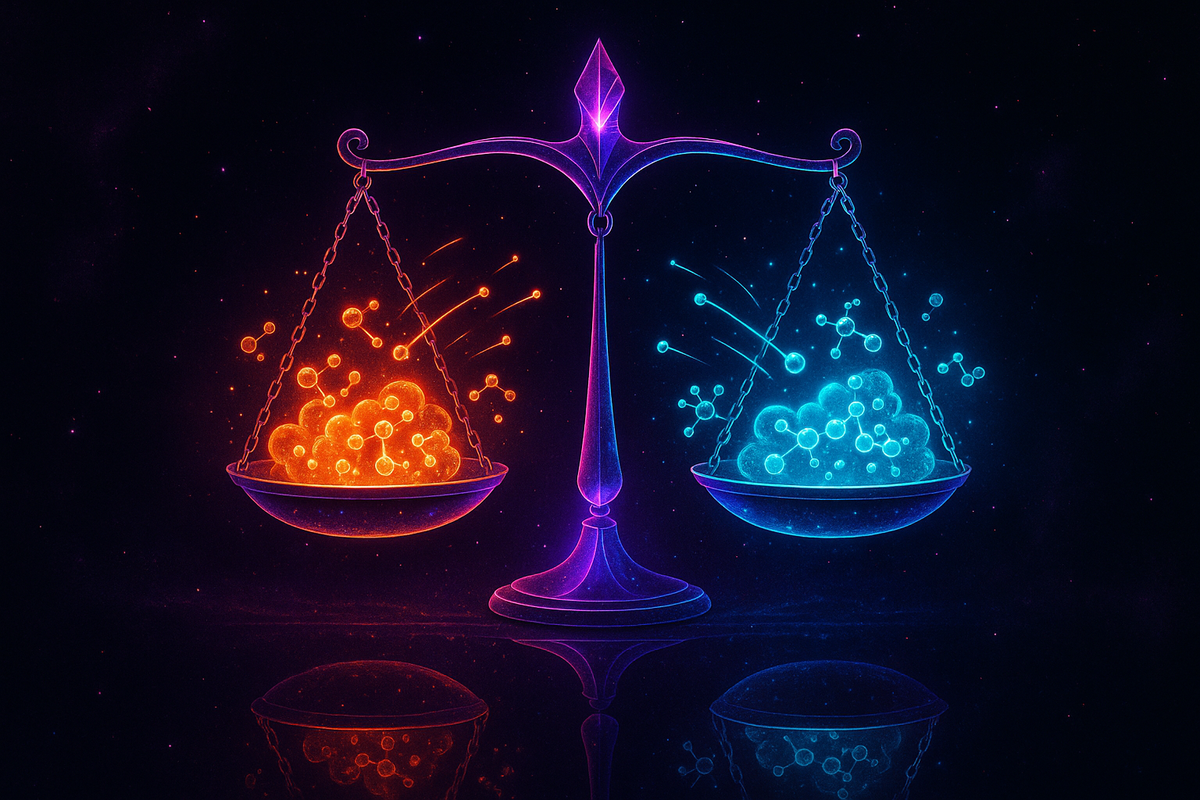
Chemical equilibrium is the state where free energy is minimized and ΔG equals zero. Forward and reverse rates equalize, locking in a stable ratio of products to reactants — a balance point written in thermodynamic law.
Chemical Equilibrium: Where ΔG Equals Zero
Every reaction has a destination. Not where all reactants become products, and not where nothing happens. The destination is equilibrium—the point where forward and reverse reactions balance perfectly.
At equilibrium, ΔG = 0. The system has found its free energy minimum. No driving force remains in either direction.
This isn't death. It's dynamic balance. Molecules still react in both directions, but the rates match. The concentrations stabilize. The system has found its rest.
Understanding equilibrium through Gibbs free energy reveals why reactions don't go to completion, how to shift them in your favor, and what "spontaneous" really means when concentrations matter.
Standard vs Actual Free Energy
There's a crucial distinction:
ΔG° (standard free energy change): The free energy change when all species are at standard conditions—1 M concentration, 1 bar pressure, specified temperature (usually 298 K).
ΔG (actual free energy change): The free energy change at actual concentrations, pressures, and conditions.
They're connected by:
ΔG = ΔG° + RT ln Q
Where Q is the reaction quotient—the ratio of product concentrations to reactant concentrations at any moment, raised to their stoichiometric powers.
This equation is thermodynamics' GPS. It tells you where you are relative to equilibrium and which direction you need to go.
The pebble: ΔG° tells you where equilibrium lies. ΔG tells you which way the reaction will go from where you are now.
The Reaction Quotient Q
For a reaction: aA + bB ⇌ cC + dD
Q = [C]^c[D]^d / [A]^a[B]^b
Q looks like the equilibrium constant K, but K is Q evaluated specifically at equilibrium. Q can be calculated at any point.
Q < K: Too many reactants. Reaction proceeds forward (ΔG < 0). Q > K: Too many products. Reaction proceeds backward (ΔG > 0). Q = K: Equilibrium. Reaction balanced (ΔG = 0).
The reaction quotient measures how far you are from equilibrium. The free energy change measures the force driving you there.
The Equilibrium Constant
At equilibrium, ΔG = 0. Substituting into ΔG = ΔG° + RT ln Q:
0 = ΔG° + RT ln K
Solving:
ΔG° = -RT ln K
Or equivalently:
K = e^(-ΔG°/RT)
This is profound. The equilibrium constant—an empirical ratio of concentrations—is directly determined by the standard free energy change. Thermodynamics predicts equilibrium from first principles.
If ΔG° < 0: K > 1 (products favored at equilibrium) If ΔG° > 0: K < 1 (reactants favored at equilibrium) If ΔG° = 0: K = 1 (neither favored)
The pebble: The equilibrium constant isn't arbitrary. It's the mathematical consequence of the reaction's intrinsic thermodynamics.
Why Reactions Don't Go to Completion
Even with ΔG° strongly negative, reactions rarely consume all reactants. Why?
Consider the entropy of mixing. As products accumulate and reactants deplete, the system gains free energy from unmixing—separating into pure components. This entropic contribution to ΔG increases as the reaction proceeds.
At some point, the entropic cost of further reaction (concentrating products, depleting reactants) balances the intrinsic favorability (ΔG°). That's equilibrium.
Think of it as a hill. ΔG° defines the slope—how much lower products are than reactants. But concentration creates a valley bottom. You roll downhill (forward reaction) but stop when you reach the lowest point, not when you've gone maximally far.
The more negative ΔG°, the farther you roll before stopping. But you always stop somewhere.
Temperature Dependence of Equilibrium
From ΔG° = -RT ln K, we can derive the van't Hoff equation:
d(ln K)/dT = ΔH°/RT²
For exothermic reactions (ΔH° < 0): K decreases with temperature. Heating shifts equilibrium toward reactants.
For endothermic reactions (ΔH° > 0): K increases with temperature. Heating shifts equilibrium toward products.
This is Le Chatelier's principle in mathematical form. The system responds to heating by shifting toward the direction that absorbs heat.
Example: Ammonia Synthesis N₂ + 3H₂ ⇌ 2NH₃ (ΔH° = -92 kJ/mol)
At 298 K: K ≈ 10^8 (strongly favors products) At 700 K: K ≈ 10^-3 (strongly favors reactants)
The equilibrium constant drops by 11 orders of magnitude. Industrial ammonia production must compromise: high enough temperature for reasonable reaction rates, low enough to maintain favorable equilibrium. Catalysts help by speeding the reaction without changing K.
Pressure and Equilibrium
For gas-phase reactions, pressure affects equilibrium if the number of moles changes.
From the ideal gas law, concentration ∝ pressure. The equilibrium expression in terms of partial pressures:
Kp = Kc(RT)^Δn
Where Δn = moles of gaseous products - moles of gaseous reactants.
If Δn < 0 (fewer moles of products): High pressure favors products. If Δn > 0 (more moles of products): High pressure favors reactants.
Example: Ammonia Synthesis N₂ + 3H₂ ⇌ 2NH₃ (Δn = 2 - 4 = -2)
High pressure shifts equilibrium toward ammonia. The Haber process operates at 150-300 atm for this reason.
Multiple Equilibria
Real systems often involve coupled equilibria. The total free energy minimization involves all equilibria simultaneously.
Example: Carbon dioxide in water
CO₂(g) ⇌ CO₂(aq) K₁ CO₂(aq) + H₂O ⇌ H₂CO₃ K₂ H₂CO₃ ⇌ H⁺ + HCO₃⁻ K₃ HCO₃⁻ ⇌ H⁺ + CO₃²⁻ K₄
The overall equilibrium depends on pH, temperature, and CO₂ partial pressure. Ocean acidification occurs because rising atmospheric CO₂ shifts all these equilibria, increasing [H⁺].
Each equilibrium has its own ΔG° and K. The system finds the configuration that minimizes total free energy across all species.
Biological Equilibria: The ATP Example
ATP hydrolysis: ATP + H₂O ⇌ ADP + Pi
ΔG°' = -30.5 kJ/mol (at pH 7, 1 mM Mg²⁺)
K = 4.9 × 10^5
Equilibrium strongly favors hydrolysis. But cells maintain ATP/ADP ratios far from equilibrium—typically [ATP]/[ADP] ≈ 10.
The actual ΔG under cellular conditions:
ΔG = ΔG°' + RT ln([ADP][Pi]/[ATP]) ΔG ≈ -50 to -65 kJ/mol
The cell keeps ΔG strongly negative by maintaining concentrations far from equilibrium. This requires constant energy input (metabolism) but provides large free energy release for each ATP hydrolysis.
The pebble: Life operates far from equilibrium. That's not an accident—it's the definition of being alive. Equilibrium is death.
Catalysts and Equilibrium
Catalysts speed reactions but don't change equilibrium. They lower the activation energy equally for forward and reverse reactions.
Why? A catalyst that favored one direction would violate detailed balance. At equilibrium, forward and reverse rates must equal. A selective catalyst would create perpetual motion.
Catalysts help you reach equilibrium faster. They don't change where equilibrium lies. ΔG° is unaffected; only the kinetics change.
This limits what catalysts can achieve. If thermodynamics says a reaction is unfavorable (ΔG > 0), no catalyst will make it happen spontaneously. You need to couple it to a favorable reaction or supply external energy.
Equilibrium vs Steady State
Equilibrium: No net reaction, ΔG = 0, Q = K. The system has minimum free energy.
Steady state: Constant concentrations, but maintained by continuous input/output. ΔG ≠ 0. Free energy continuously dissipated.
A candle flame is a steady state—constant temperature and shape, but far from equilibrium, constantly consuming wax and oxygen. Blow it out, and it reaches equilibrium (cold, dark).
Living systems are steady states. They maintain constant internal conditions while processing matter and energy. They're not at equilibrium; they're poised above it, using free energy to stay there.
Electrochemistry Connection
For electrochemical reactions:
ΔG = -nFE
Where n = electrons transferred, F = Faraday constant, E = cell potential.
At standard conditions: ΔG° = -nFE°
And from ΔG° = -RT ln K:
E° = (RT/nF) ln K
This is the Nernst equation's foundation. It connects electrochemistry to thermodynamics through free energy.
A battery works because its half-reactions have different ΔG°. The overall ΔG is negative; the battery discharges. A dead battery has reached equilibrium (ΔG = 0, E = 0).
Industrial Applications
Maximizing Yield: - Adjust temperature (van't Hoff) - Adjust pressure (for gas reactions) - Remove products (shift equilibrium right) - Add excess of cheaper reactant
The Haber Process (Ammonia): - Low temperature favors products (exothermic), but slows kinetics - High pressure favors products (Δn < 0) - Catalyst (iron-based) speeds approach to equilibrium - Compromise: ~450°C, 200+ atm, continuous product removal
Contact Process (Sulfuric Acid): - SO₂ + ½O₂ ⇌ SO₃ (exothermic, Δn = -0.5) - Similar optimization: moderate temperature, high pressure, catalyst (V₂O₅)
Summary
Equilibrium is where free energy bottoms out:
- ΔG° determines where equilibrium lies (the K value) - ΔG determines which direction the reaction goes (from current Q) - Q < K: forward reaction spontaneous - Q = K: equilibrium, no net reaction - Q > K: reverse reaction spontaneous
Temperature shifts equilibrium via enthalpy. Pressure shifts gas equilibria via mole change. Catalysts speed equilibration without changing where it lies.
Life stays far from equilibrium, using energy to maintain the distance. At equilibrium, chemistry stops mattering—everything is dead and mixed.
The pebble: Equilibrium isn't where reactions want to go. It's where reactions have to stop going, because there's nowhere lower to fall.
Further Reading
- Atkins, P. & de Paula, J. (2014). Physical Chemistry. Oxford University Press. - Denbigh, K. (1981). The Principles of Chemical Equilibrium. Cambridge University Press.
This is Part 6 of the Gibbs Free Energy series. Next: "[ATP and Free Energy: Biology's Energy Currency](/atp-gibbs-free-energy/)"


Comments ()