Circular RNA: The Newly Discovered Layer
RNA is supposed to be linear: a start, a message, an end. Circular RNA breaks that rule — looping back on itself to resist degradation and quietly regulate gene expression in ways scientists are still mapping.
Circular RNA: The Newly Discovered Layer
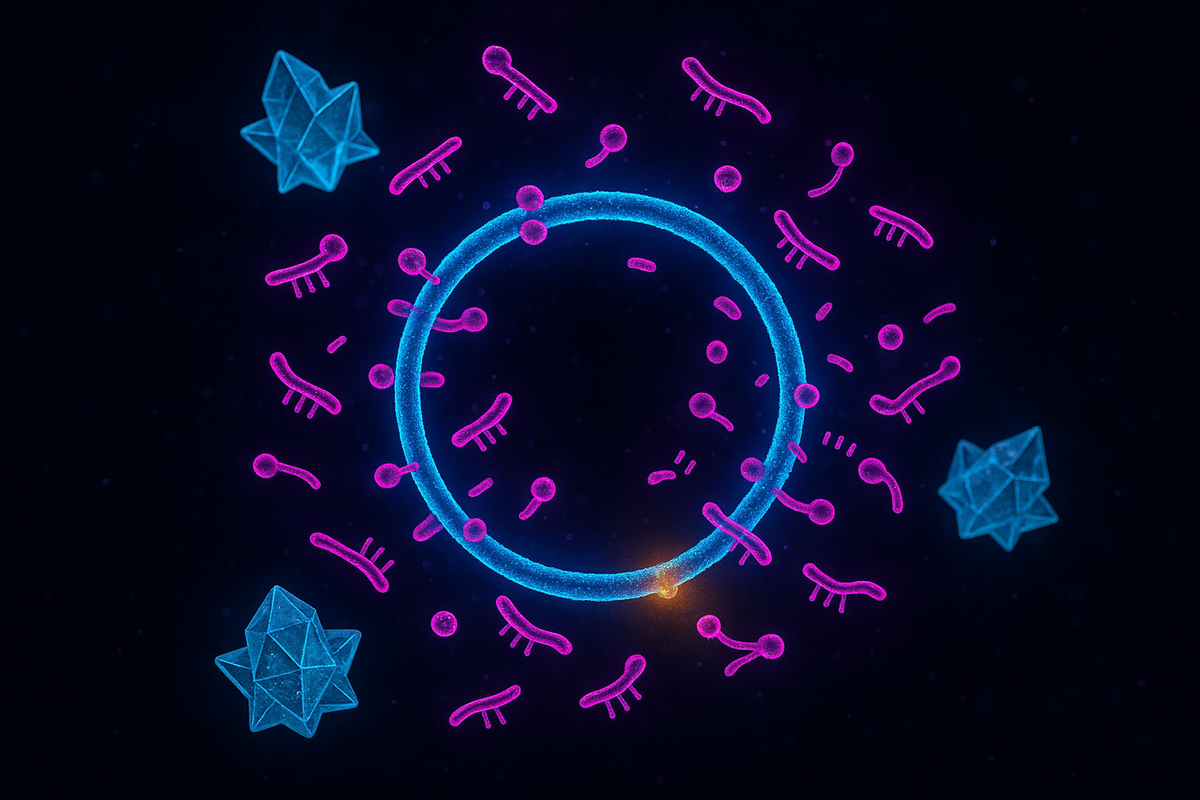
In 1976, researchers studying plant viruses found something strange. Some viral RNA molecules weren't linear chains with two ends—they were closed loops. Circles. The RNA's 3' end was covalently bonded to its 5' end, forming a continuous ring. This was interesting but seemed like a viral oddity. Viruses do weird things. It didn't seem relevant to normal cellular biology. Then, starting in 2012, deep sequencing of human transcriptomes revealed something nobody expected: circular RNAs are everywhere. Not just in viruses. In us. In all animals. Thousands of them, in every cell type examined. They'd been hiding in plain sight for decades—missed because standard sequencing methods assumed RNA was linear. We weren't looking for circles. So we didn't see them. There's an entire class of RNA that we didn't know existed until ten years ago. And it's not rare. It's abundant.
How They Form
Circular RNAs are produced by an unusual splicing event called backsplicing. Normal splicing takes a pre-mRNA transcript and removes introns (the non-coding regions), stitching together exons (the coding regions) in linear order. Exon 1 connects to exon 2 connects to exon 3, in sequence. Backsplicing does something different. Instead of connecting exon 2 to exon 3, it connects the downstream end of exon 2 back to the upstream end of exon 2—or to an upstream exon. The result is a circle containing one or more exons, spliced out of the normal linear transcript. What triggers backsplicing? Several factors: Flanking intronic sequences. Many circRNAs have repetitive sequences (like Alu elements in humans) in the introns surrounding the circularized exons. These sequences can base-pair with each other, bringing the splice sites together in an orientation that promotes backsplicing. RNA-binding proteins. Certain proteins, like QKI and MBL, bind to flanking introns and promote circularization. The protein brings the splice sites into proximity. Competition with linear splicing. Backsplicing competes with normal splicing. Factors that slow down linear splicing can tip the balance toward circle formation. The result: from a single gene, cells can produce both linear mRNA (which gets translated into protein) and circular RNA (which does... something else). The same gene gives rise to different molecular species with different fates.
What They Do
This is the hard question. We know circRNAs exist. We know they're abundant. But what are they for? Several functions have been proposed, with varying levels of evidence: MicroRNA sponges. The most famous example is CDR1as (also called ciRS-7), a circular RNA that contains over 70 binding sites for miR-7, a microRNA that regulates genes in the brain. CDR1as binds miR-7 and sequesters it—acting as a "sponge" that soaks up the microRNA and prevents it from silencing its normal targets. This is a compelling mechanism. MicroRNAs regulate gene expression by binding to mRNAs and promoting their degradation or blocking their translation. A circRNA that binds and traps microRNAs would de-repress those targets—an indirect way to activate genes. But here's the catch: most circRNAs don't have many microRNA binding sites. CDR1as is exceptional. Most circles have one or two sites at most, which isn't enough for effective sponging. The sponge hypothesis may apply to some circRNAs, but it's probably not the general answer. Protein scaffolds. Some circRNAs bind proteins and might serve as platforms for protein complexes—bringing together factors that need to interact. Transcription regulation. Some circRNAs interact with RNA polymerase II or other transcription machinery, potentially affecting how their parent genes are expressed. Translation templates. Here's a twist: some circRNAs may actually be translated into proteins. They don't have a normal start codon, but they can contain internal ribosome entry sites (IRES) that allow translation to begin. Small proteins encoded by circRNAs have been detected. Whether these proteins are functional remains unclear. Unknown functions. Honestly, for most circRNAs, we don't know what they do. They exist. They're regulated. They're sometimes tissue-specific. But their function remains obscure. This is frustrating but honest. Ten years isn't very long to characterize thousands of novel molecules.
Stability: The Superpower
One property of circular RNAs is unambiguous: they're stable. Much more stable than linear RNAs. The cell has enzymes—exonucleases—that degrade RNA by chewing from the ends. Linear RNA molecules are constantly being degraded and replaced. The half-life of a typical mRNA is hours; some are degraded in minutes. Circular RNAs have no ends. Exonucleases can't get a grip. The circles persist. This gives them unusual kinetics. A circRNA can accumulate over time in ways that linear RNAs can't. Cells can build up stores of these molecules, creating reservoirs of regulatory potential. This also makes circRNAs attractive as biomarkers. In blood, in other bodily fluids, RNAs are normally degraded quickly. But circRNAs survive. They can be detected in plasma, saliva, urine. This opens the door to diagnostic applications. Circles don't have ends. The cell can't destroy what it can't grab.
CircRNAs in Disease
As with other RNA species, the question is: what happens when things go wrong? Cancer. Many circRNAs are differentially expressed in tumors versus normal tissue. Some are upregulated; others are downregulated. Certain circRNAs have been shown to promote proliferation, migration, and invasion when overexpressed. Others may be tumor suppressors. The challenge is sorting correlation from causation. Cancer cells have massively dysregulated transcription—they express lots of things differently. Some differences will be causes; others will be consequences. Neurological disease. The brain is particularly rich in circRNAs—more diverse and more abundant than other tissues. Many brain circRNAs are conserved across species. Their function in neurons is unclear, but their abundance suggests importance. Some have been linked to Alzheimer's, Parkinson's, and other neurodegenerative conditions. Cardiovascular disease. CircRNAs are expressed in cardiac tissue and change with heart failure, myocardial infarction, and other conditions. Some may regulate cardiac gene expression or cell death pathways. Immune response. Certain circRNAs regulate immune cell function. Some are induced by viral infection and may have antiviral roles. The immune system itself uses circRNAs in ways we're only beginning to understand. Aging. CircRNA abundance changes with age in multiple tissues. Whether this is cause or consequence of aging is unknown. The disease connections justify the research. If circRNAs are dysregulated in cancer, they're potential therapeutic targets. If they're stable biomarkers in blood, they're potential diagnostics.
The Conservation Question
Are circRNAs conserved across species? The answer is complicated. Individual circRNA sequences are not always conserved—the same backsplice junction in human may not exist in mouse. But the capacity to produce circRNAs from certain genes is often conserved. A gene that produces circRNAs in humans often produces circRNAs (though perhaps different ones) in other mammals. Some specific circRNAs are conserved. CDR1as, the microRNA sponge, is found across mammals, and its miR-7 binding sites are conserved—suggesting selective pressure to maintain the sponge function. The conservation pattern suggests that circRNA production is functional in aggregate, even if individual circles are evolutionarily flexible. The regulatory layer exists across species; the specific molecules can vary.
Engineered Circular RNAs
If circRNAs are stable and functional, can we make artificial ones? Yes. Several groups have developed methods to produce synthetic circular RNAs. You can design the sequence, express it in cells, and the cell's splicing machinery will produce circles. This opens therapeutic possibilities. Circular RNAs as delivery vehicles for therapeutic sequences—more stable than linear mRNAs, potentially with longer-lasting effects. Circular RNAs encoding proteins, for gene therapy applications. Circular RNAs as sponges to sequester disease-promoting microRNAs. The first circRNA therapeutics are in preclinical development. It's early days, but the logic is straightforward: if nature uses these molecules for stability and function, why not engineer them for medicine? We didn't know circles existed until 2012. Now we're designing our own.
The Big Picture
Let's zoom out. The RNA world is expanding faster than we can catalog it. Linear mRNAs. MicroRNAs. Long non-coding RNAs. And now circular RNAs—thousands of them, produced by backsplicing, resistant to degradation, found in every tissue. Each discovery adds complexity to the picture. The simple gene-to-protein model becomes a network of interacting molecules, each with its own regulation, each potentially affecting the others. Circular RNAs are a particularly striking example because they were hiding in plain sight. We had the sequencing data for years. We just weren't looking for circles. Our assumptions about RNA structure caused us to filter out the very molecules we should have been studying. The lesson: the genome contains multitudes. When you change how you look, you find new things.
What We Don't Know
Let me be honest about the gaps. Function remains unclear for most circRNAs. We have hypotheses—sponges, scaffolds, translation templates—but solid functional evidence exists for only a handful of circles. The rest are functionally orphaned. The sponge hypothesis may be overblown. CDR1as is dramatic but possibly exceptional. Most circRNAs have too few microRNA binding sites to be effective sponges. Alternative functions may be more important. Expression changes don't prove causation. CircRNAs are dysregulated in many diseases, but that doesn't mean they're causing the disease. They might be bystanders. Careful gain- and loss-of-function experiments are needed to establish causality. Therapeutic applications are speculative. Engineered circRNAs work in cells. Whether they'll work in patients, with acceptable safety and efficacy, remains unproven. The field is young. These gaps are understandable. But they're real.
A New Layer of Regulation
Add circular RNAs to the list. DNA encodes the genome. RNA is transcribed—linear, circular, coding, non-coding, modified, unmodified. Proteins are translated from some of it. The rest does something else—regulates, structures, scaffolds, sponges. The layers accumulate. Each discovery reveals more complexity. Each new class of molecule fits into the network, affecting and being affected by everything else. Circular RNAs are not the last class we'll discover. They're the most recent. Somewhere in the genome, there are probably other molecules we're not seeing because we're not looking for them. Other assumptions filtering out other signals. Biology is more complex than our methods have revealed. The methods keep improving. The complexity keeps emerging. Circles were always there. We just learned to see them.
Further Reading
- Memczak, S., et al. (2013). "Circular RNAs are a large class of animal RNAs with regulatory potency." Nature.
- Hansen, T. B., et al. (2013). "Natural RNA circles function as efficient microRNA sponges." Nature.
- Kristensen, L. S., et al. (2019). "The biogenesis, biology and characterization of circular RNAs." Nature Reviews Genetics.
- Li, X., Yang, L., & Chen, L. L. (2018). "The Biogenesis, Functions, and Challenges of Circular RNAs." Molecular Cell.
This is Part 6 of the RNA Renaissance series. Next: "Phase Separation: The Liquid Physics of Cells."
Comments ()