Everything You Learned About Civilization's Origins Is Wrong
The textbook story of civilization had a clean arc: farming, then cities, then states, then complexity. New archaeological evidence is dismantling that arc entirely. Our ancestors were far more interesting.
Everything You Learned About Civilization's Origins Is Wrong
In 1651, Thomas Hobbes described the life of prehistoric humans: "solitary, poor, nasty, brutish, and short." They wandered in small bands, constantly on the edge of starvation, fighting over scraps. Then agriculture arrived like a miracle—surplus, specialization, cities, law, art. Civilization.
This story is still taught in schools. It appears in documentaries. It shapes how we think about human nature—we needed to be saved from our primitive condition by technology and institutions.
The story is wrong. Not just incomplete—fundamentally misleading. The archaeological and anthropological evidence tells a different tale entirely. One that's weirder, more interesting, and far more relevant to our current institutional crisis than the tidy narrative of linear progress.
The Standard Story
Here's the version you probably learned:
For 95% of human history, we lived as hunter-gatherers in small egalitarian bands. Maybe 25-50 people. Everyone did everything. No specialization, no hierarchy, no surplus. We were stuck—not stupid, but constrained by our mode of subsistence.
Then, around 10,000 BCE, someone planted seeds intentionally. Agriculture emerged. Surplus followed. Surplus enabled specialization—some people could become potters, priests, soldiers while others grew food. Specialization required coordination. Coordination required hierarchy. Hierarchy crystallized into states.
The sequence: bands → tribes → chiefdoms → states. A single ladder, climbed in one direction.
This narrative has enormous appeal. It explains why inequality exists (it's the price of civilization). It justifies current power arrangements (someone has to coordinate). It implies that pre-agricultural life was genuinely worse—we traded freedom for survival, and it was a good deal.
But the evidence doesn't support it.
What the Evidence Actually Shows
The archaeological record of the past two decades has upended the standard story in every particular.
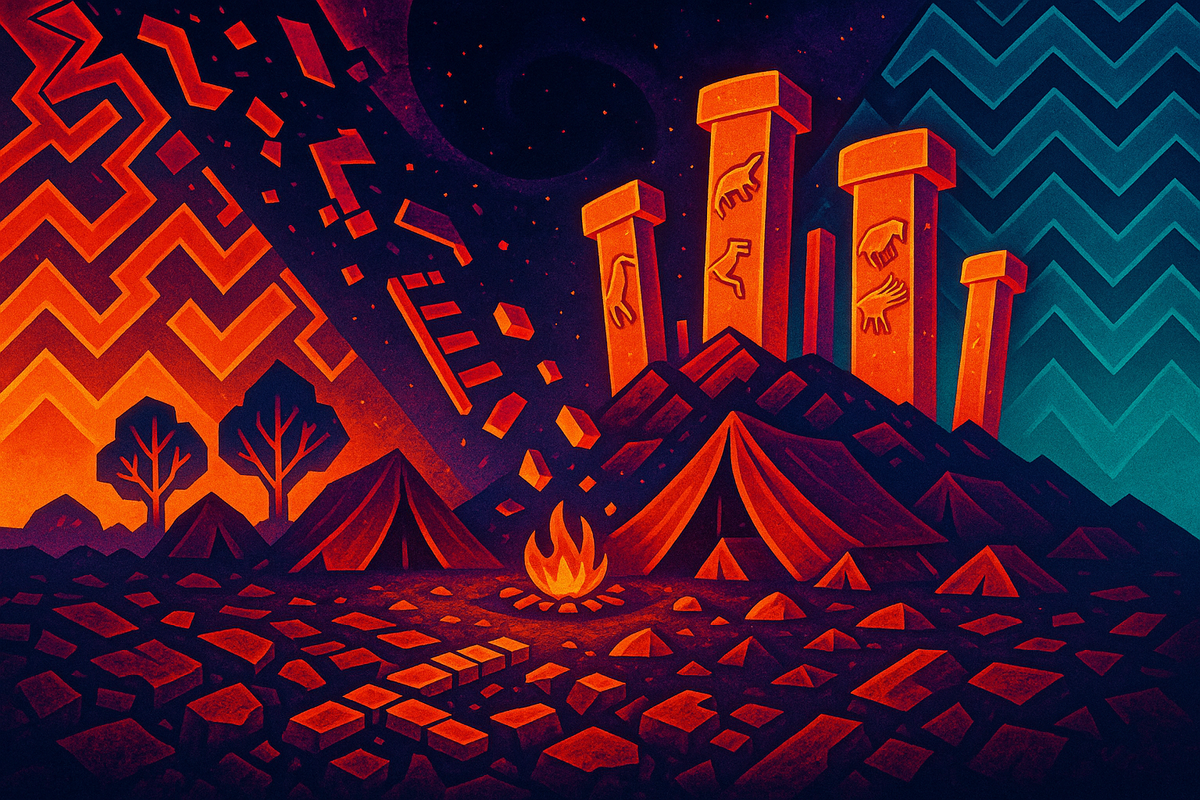
Hunter-gatherers weren't stuck in small bands. Göbekli Tepe in Turkey—monumental stone architecture, carved pillars, coordinated labor—was built around 9500 BCE. Before agriculture. Before permanent settlement. Hunter-gatherers built it, then walked away.
Think about what that means. Complex social organization. Long-term planning. Artistic sophistication. Religious or ceremonial purpose. All achieved by people who didn't farm, didn't have permanent villages, and didn't fit into any of the categories we've created for them.
The Poverty Point earthworks in Louisiana, dating to 1700 BCE, involved massive coordinated construction by non-agricultural peoples. No farms. No state. Just sophisticated social organization that assembled for a purpose and then dispersed.
"Egalitarian bands" weren't universal. The Pacific Northwest coast hosted hierarchical societies with slavery—based on fishing, not agriculture. The Kwakiutl held potlatch ceremonies involving the destruction of enormous wealth. The Great Plains before European contact saw complex political organization among purely mobile groups. The idea that you need farms to have politics is simply false.
Agriculture didn't lead automatically to states. In many places, people adopted agriculture and then abandoned it. Seasonally agricultural societies existed—people who farmed part of the year and hunted the rest. The Amazonian evidence shows sophisticated cultivation systems maintained for centuries by societies that never developed state structures. Ukraine had "mega-sites"—settlements of 10,000+ people around 4000 BCE—that show no evidence of central authority, palaces, temples, or ruling class. Egalitarian cities. They shouldn't exist, according to the standard story. They existed for centuries.
The progression wasn't one-directional. Societies scaled up and then deliberately scaled down. Cities were abandoned. Hierarchies were dismantled. The history of institutions isn't a ratchet—it's a series of experiments, many deliberately reversed.
Teotihuacan, one of the largest cities in the ancient world, appears to have undergone an egalitarian revolution around 300 CE. The elaborate pyramids stopped being built. Instead, the city constructed identical apartment compounds—standardized housing that suggests a conscious rejection of inequality. The ruling class didn't fall. They may have been overthrown, or they may have been absorbed into a different kind of society.
The Seasonal Hypothesis
David Graeber and David Wengrow, in The Dawn of Everything, propose a striking alternative: many early societies were seasonally variable.
The same group of people might have hierarchical chiefs during one season—say, the summer buffalo hunt, when coordination mattered—and egalitarian decision-making during another season. The structures weren't fixed. They were tools, used when appropriate and put away when not.
This isn't speculation. We have ethnographic evidence. The Inuit had authoritarian whale hunt captains whose authority evaporated the moment they returned to shore. The Cheyenne had "soldier societies" that enforced collective decisions during the summer hunt but had no power during winter dispersal.
The implications are profound. These societies understood that different situations require different structures. They created authority for specific purposes—and built in mechanisms to dissolve it when those purposes ended. Authority was situational, not permanent. And people knew this. They designed their institutions to prevent authority from accumulating across contexts.
We have a word for this in modern organizational theory: it's called "task force" or "project team." Temporary authority structures assembled for a purpose. But we treat them as exceptions—deviations from the normal permanent hierarchy. For many early societies, the temporary structure was the norm.
This reframes the question entirely. It's not "how did humans develop institutions?" It's "how did temporary, situational authority become permanent?" What changed wasn't the invention of hierarchy—hierarchy existed situationally for millennia. What changed was the inability to put it away.
The Three Freedoms
Graeber and Wengrow identify three fundamental freedoms that early societies often possessed and that modern societies have largely lost:
The freedom to move. If you don't like how things are run, you can leave. This was practical when land was abundant and social groups were flexible. It's an enormous check on authority—leaders who abuse power simply lose followers.
The freedom to disobey. Many societies had no enforcement mechanism for collective decisions beyond social pressure. You could ignore the chief. The cost was reputational, not physical. This limits what authority can actually accomplish.
The freedom to reorganize. Societies could and did consciously restructure themselves. Seasonal variation is one version. But there were also deliberate one-time reorganizations—constitutional moments when groups decided to change how they operated.
Modern states have systematically eliminated all three. You can't easily leave (borders, citizenship, property). Disobedience has consequences (police, courts, prisons). Reorganization happens only within narrow channels (elections, amendments).
The question isn't why early societies were different. It's why we gave up these freedoms. The standard story says we traded them for benefits—security, prosperity, coordination. The revised story asks: did we trade them, or were they taken?
Why the Wrong Story Persists
If the evidence contradicts the standard narrative, why does it persist?
Partly data limitations. The archaeological record is fragmentary. Stone survives; wood doesn't. Permanent architecture leaves traces; temporary camps don't. Our evidence is biased toward the kinds of societies that build things that last—which happens to be states.
Partly disciplinary bias. Anthropology and archaeology developed in the colonial era. They were shaped by assumptions about "primitive" peoples that served colonial interests. The ladder narrative—savages at the bottom, Europeans at the top—was politically convenient.
Partly narrative convenience. Linear progress is a satisfying story. It has beginning, middle, and end. It implies we're at the pinnacle. It's easy to remember. Messy experimentation, seasonal variation, and deliberate regression are harder to teach.
Partly investment. Entire careers were built on the standard story. Museums are organized around it. Curricula depend on it. Rewriting is expensive.
But the evidence keeps accumulating. And the old story keeps failing to accommodate it.
The Schismogenesis Principle
One of Graeber and Wengrow's most provocative ideas: societies often define themselves against their neighbors.
Schismogenesis is Gregory Bateson's term for differentiation through opposition. When two groups interact, they often become more different over time—each defining themselves by what the other is not.
Graeber and Wengrow argue this shaped early institutional development. Hunter-gatherer societies that bordered agricultural societies often became more egalitarian and mobile precisely to distinguish themselves. Agricultural societies that bordered hierarchical empires sometimes became more egalitarian as a statement of identity.
Institutions weren't just functional adaptations. They were identity markers. People chose how to organize partly based on what neighboring societies were doing—often as a deliberate rejection.
This means institutional diversity wasn't just experimentation. It was something closer to political argument. Early humans debated how to live—not just in words, but in how they structured their societies. The archaeological record is a frozen conversation.
What This Means
If the standard story is wrong, several implications follow.
Human nature is more flexible than we thought. We're not wired for any particular social arrangement. We can do hierarchy. We can do equality. We can alternate between them. The constraints aren't biological—they're political and technological.
Inequality isn't the price of civilization. Many complex, sophisticated societies existed without the kind of institutionalized inequality we take for granted. What we have isn't necessary—it's one option among many that happened to succeed in particular circumstances.
Deliberate design is possible. Early humans designed institutions—and redesigned them when they stopped working. This capacity hasn't disappeared. We could do it again, if we understood what we were doing.
The past contained futures that didn't happen. Every society that scaled down, every hierarchy that was dismantled, every experiment that was abandoned—these represent paths not taken. They're not failures. They're evidence of possibility.
The Contemporary Relevance
Why does this matter now?
We're living through institutional crisis. Trust in existing institutions—governments, media, churches, corporations—is declining precipitously. New forms are emerging—platforms, networks, DAOs—without clear templates or precedents.
The standard story offers no help. It says: institutions evolved from simple to complex. We're at the pinnacle. Change means regression.
The revised story offers something different. It says: humans have always experimented with institutions. We've tried many configurations. Some worked. Some didn't. Some were deliberately abandoned when they stopped serving people.
Consider what we're building now. Social media platforms create new forms of collective action—flash mobs, viral movements, decentralized organizing. Cryptocurrency experiments with governance—on-chain voting, token-weighted decisions, algorithmic execution. Remote work unbundles employment from location. The "passion economy" unbundles labor from firms.
These aren't unprecedented. They're experiments—the same kind of experiments humans have run for millennia. Some will work. Many will fail. A few might become new institutions.
The anthropological lens helps us see what we're doing. When DAOs try to create organizations without permanent hierarchy, they're attempting something our ancestors did routinely. When digital nomads exercise the freedom to move, they're recovering something older than states. When online communities develop their own governance, they're running the same experiments that Neolithic societies ran.
This isn't an argument for any particular political program. It's an argument for institutional imagination—the recognition that what we have is not inevitable, that alternatives are possible, that our ancestors were more creative than we've given them credit for.
The question isn't whether our institutions will change. They always have. The question is whether we'll design the next ones consciously, or stumble into them by accident.
The Takeaway
Everything you learned about the origins of civilization is probably wrong. The ladder from bands to states was never a ladder. The trade-off between equality and complexity was never necessary. The progression from primitive to civilized was never inevitable.
Humans have always been institutionally creative. We experimented with hierarchy and equality, permanence and seasonality, scale and intimacy. We chose—and we can choose again.
The archaeological record isn't a museum of extinct lifeways. It's a library of experiments. Most of them haven't been tried again. Some of them might be exactly what we need.
Further Reading
- Graeber, D., & Wengrow, D. (2021). The Dawn of Everything: A New History of Humanity. Farrar, Straus and Giroux. - Scott, J. C. (2017). Against the Grain: A Deep History of the Earliest States. Yale University Press. - Flannery, K., & Marcus, J. (2012). The Creation of Inequality: How Our Prehistoric Ancestors Set the Stage for Monarchy, Slavery, and Empire. Harvard University Press.
This is Part 1 of the Anthropology of Institutions series. Next: "[The Dawn of Everything](/graeber-dawn-of-everything/)"


Comments ()