Coal and Steam: Breaking the Biological Ceiling
For all of history, civilization ran on muscle power. Then coal and steam arrived, and suddenly machines could do work that no number of human laborers could match. That transition changed everything.
Coal and Steam: Breaking the Biological Ceiling
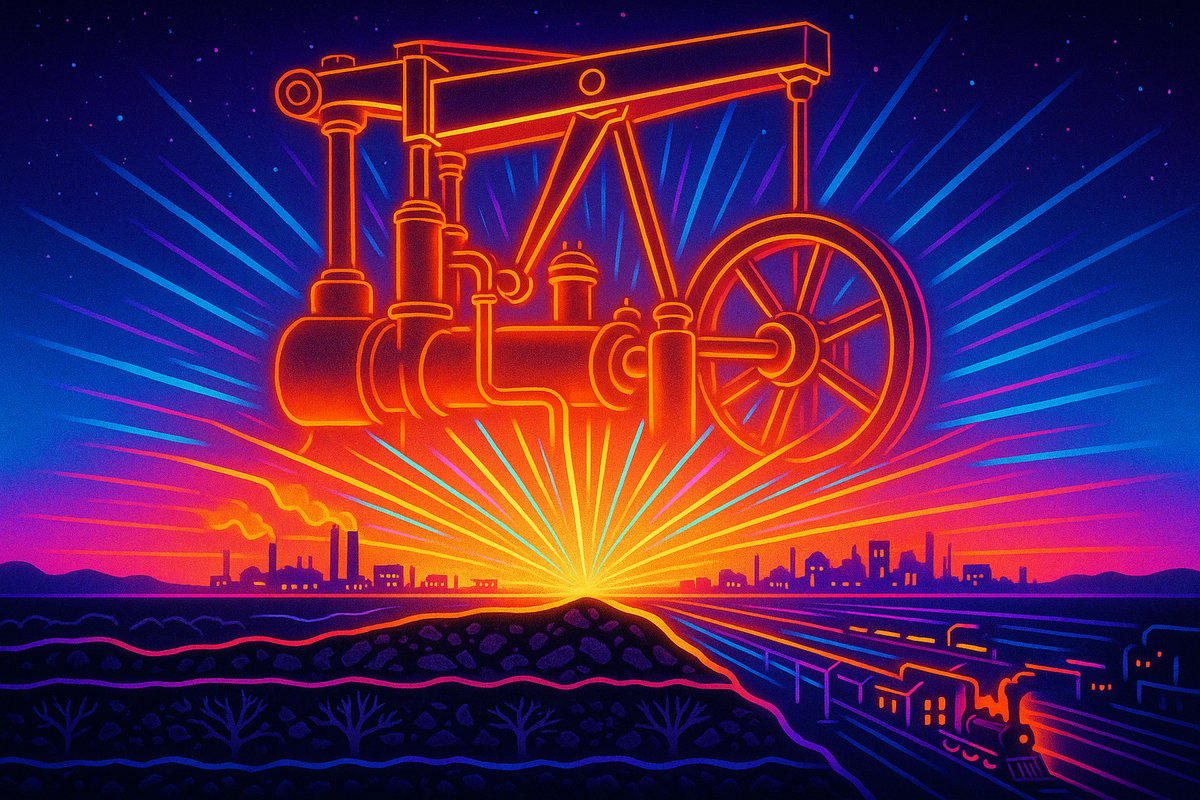
In 1712, Thomas Newcomen installed a steam engine at a coal mine in Dudley Castle, England. It was crude—a massive beam rocking slowly up and down, powered by steam condensing in a cylinder, driving pumps that removed water from the mine.
The engine was inefficient. It burned coal at a prodigious rate. But it worked. And it worked continuously, hour after hour, day after day, pumping water that would have overwhelmed any number of horses.
For the first time in history, humans had a mechanical prime mover that didn't run on food. The muscle ceiling was broken.
This wasn't immediately obvious. The early steam engines were specialized tools for a specific problem—mine drainage. It took decades for the implications to unfold. But in retrospect, Newcomen's engine marks the boundary between the ancient energy regime and the modern one.
What Coal Actually Is
To understand the revolution, you need to understand coal.
Coal is stored sunlight. Hundreds of millions of years ago, during the Carboniferous period, vast forests covered the Earth. Plants captured solar energy through photosynthesis, converting carbon dioxide and water into biomass. When they died, some of this biomass accumulated in swamps where oxygen-poor conditions prevented decay.
Over geological time, heat and pressure transformed this accumulated plant matter into coal. The chemical energy that plants stored from ancient sunlight remained locked in carbon bonds, waiting.
Coal is a battery charged by the sun over 300 million years. Burning it releases that stored energy.
This is fundamentally different from burning wood. Wood comes from contemporary sunlight—trees growing now, capturing photons now. The rate of wood production is limited by current solar flux on current forests. You can only burn wood as fast as forests grow.
Coal breaks this limit. Burning coal releases energy accumulated over millions of years, drawing on a stockpile far vaster than any contemporary forest. The geological past subsidizes the industrial present.
England had abundant coal. It also had depleted forests—centuries of shipbuilding and fuel use had stripped much of the original woodland. Coal filled the gap, initially for heating and industrial processes like iron smelting. But the strategic shift was using coal not just for heat, but for motion.
The Problem That Demanded Steam
Why did the steam engine emerge when and where it did?
The immediate driver was mine drainage. As surface deposits of coal and ore were exhausted, mines went deeper. Deeper mines hit groundwater. Water constantly seeped in, flooding the workings. Without pumping, the mines would fill and become unusable.
Horse-powered pumps had limited capacity. A whim (a horse-drawn hoist) could lift water only so far and so fast. Chains of horses working in shifts could do more, but the cost in fodder and maintenance was enormous. Deep mines needed more pumping power than horses could economically provide.
Thomas Savery patented a steam-powered pump in 1698. It had no moving parts—just steam pressure pushing water directly. It was dangerous and limited in lift. But it proved the concept: steam could do work.
Newcomen improved on Savery by adding a piston and cylinder. Steam filled the cylinder, then cold water sprayed in, condensing the steam, creating a vacuum. Atmospheric pressure pushed the piston down, doing work. It was called an "atmospheric engine" because it was atmospheric pressure, not steam pressure, that provided the power stroke.
The Newcomen engine was remarkably inefficient—converting only about 1% of the coal's energy into useful work. But coal was cheap at the mine head. What mattered was that the engine worked, running around the clock, pumping water that nothing else could handle.
Watt's Revolution
The Newcomen engine worked, but it wasted coal. Each cycle heated the cylinder with steam, then cooled it to create the vacuum. This heating and cooling consumed enormous energy.
James Watt, working as an instrument maker at the University of Glasgow, realized the problem in 1765. His insight: keep the cylinder hot at all times by condensing steam in a separate vessel. This "separate condenser" roughly tripled the efficiency of the engine.
Watt spent years perfecting his design and finding financial backing. In 1776, the first commercial Watt engines went into service. They used perhaps one-third the coal of Newcomen engines for the same work output.
But Watt didn't stop there. He developed the double-acting engine, which delivered power on both strokes of the piston rather than just one. He added a governor to regulate speed automatically. He created a way to convert the up-and-down piston motion into continuous rotation.
This last innovation was crucial. Rotational motion could drive machinery—not just pumps, but mills, looms, and eventually locomotives. The steam engine stopped being a specialized mining tool and became a universal prime mover.
By 1800, there were approximately 2,500 steam engines in Britain, mostly in mines and textile mills. Their combined power output was perhaps 30,000 horsepower. This sounds modest, but remember: this was power that didn't need to eat, didn't tire, and could run continuously. It was equivalent to 30,000 horses working simultaneously around the clock—an impossible number to actually maintain.
The Numbers That Changed Everything
Let's quantify what steam actually delivered.
A Watt engine of the 1780s might produce 20 horsepower (about 15 kilowatts) while consuming perhaps 10 kilograms of coal per hour. By the mid-19th century, more efficient engines could produce 100 horsepower from the same coal consumption.
A kilogram of coal contains about 30 megajoules of chemical energy. At 10% conversion efficiency, that's 3 megajoules of mechanical work—equivalent to a human laborer working flat out for about 10 hours. A steam engine could do in one hour what a human did in a full working day, and it could do it 24 hours a day.
Coal production in Britain rose from about 2.5 million tons in 1700 to 10 million tons in 1800 to 50 million tons in 1850. Each ton of coal, converted to work by increasingly efficient engines, multiplied human capability.
The economic historian E. A. Wrigley calculated that by 1870, British coal production was delivering mechanical energy equivalent to the labor of about 800 million human workers. Britain's actual population was about 26 million. The country had achieved an energy multiplier of roughly 30x through fossil fuels.
This wasn't just more of the same. It was a phase transition to a different kind of economy—one no longer bound by the biological constraints that had limited civilization for ten millennia.
What Steam Enabled
The steam engine didn't just pump water. It restructured society.
Manufacturing: Textile mills no longer needed to cluster around streams for water power. Factories could locate anywhere coal could be delivered—which increasingly meant cities with rail connections. Manufacturing scaled up massively. Production that once required thousands of cottage workers could be concentrated in a single factory.
Transportation: Steam locomotives appeared in the 1820s, steam ships in the 1830s. By mid-century, railroads crisscrossed Britain and were spreading across Europe and America. Travel that took days now took hours. Goods could move at scale, cheaply, regardless of weather or terrain.
Mining: Steam engines pumped deeper mines, lifted heavier loads, and ventilated longer tunnels. Coal extraction became a positive feedback loop: coal powered engines that extracted more coal that powered more engines.
Agriculture: Steam-powered threshers, tractors, and pumps began appearing by mid-century. The agricultural labor force as a fraction of the population started declining—a shift impossible under the muscle regime.
Cities: With food and goods transportable by rail, cities could grow beyond the limits that horse-drawn carts imposed. London's population went from about 1 million in 1800 to over 6 million by 1900. Urbanization at this scale would have been impossible without steam-powered logistics.
The Self-Reinforcing Revolution
The industrial revolution was self-reinforcing in a way no previous transition had been.
Steam engines enabled coal mining. Coal mining powered more steam engines. More engines built more railroads. Railroads moved more coal. Coal powered more factories. Factories made more engines.
This positive feedback loop meant that growth could accelerate rather than asymptotically approaching a limit. Each expansion enabled further expansion. The ceiling that had constrained civilization—the muscle ceiling—was not just raised but eliminated.
Of course, new constraints eventually appear. We're now discovering the environmental limits to fossil fuel combustion. But for a century and a half, from roughly 1800 to 1950, the coal-steam revolution seemed like limitless abundance. Each generation could reasonably expect to have more energy, more goods, more capability than the previous one.
This expectation of growth is so deeply embedded in modern consciousness that we forget how radical it is. For most of human history, the expectation was stability or slow cycles. The idea that children would reliably be richer than their parents was unimaginable before coal and steam made it normal.
The political implications were equally profound. When power came from muscle, controlling workers was controlling power. When power came from coal, controlling mines and factories mattered more. The shift from agrarian to industrial economies reshaped class structures, created new forms of labor organization, and ultimately transformed political systems.
Stored Sunlight, Released
The philosophical implications are worth pausing on.
Coal represents millions of years of accumulated solar energy. The industrial revolution was, in effect, a drawdown of that accumulated capital. Humanity stopped living within the "income" of current solar flux and started spending geological "savings."
This allowed a kind of time travel. The energy that powered 19th-century factories was energy collected by Carboniferous forests 300 million years ago. Present capabilities were built on past accumulation.
The pattern continues with oil and gas—different geological eras, same basic principle. Fossil fuel civilization is subsidized by the deep past.
Whether this subsidy is sustainable, and what happens when it runs out or becomes too dangerous to use, are questions the next articles will address. For now, the point is that steam and coal broke the muscle ceiling by accessing energy reserves outside the biological present.
Fire cooked our food. Steam cooked our coal. The same principle—controlled combustion releasing stored energy—scales from hearth to industrial furnace.
The Legacy
The steam engine's direct descendant is the internal combustion engine and the steam turbine that generates most of our electricity. The principle—heat from combustion driving mechanical motion—remains the same. We've refined the technology, improved the efficiency, scaled the output. But Newcomen would recognize what a modern power plant does.
Steam also taught us something about energy itself. The study of steam engines led to thermodynamics—the science of heat, work, and energy transformations. Carnot, Clausius, Kelvin: the founders of thermodynamics were all trying to understand and improve steam engines. The laws they discovered apply to everything from refrigerators to black holes.
The steam revolution was thus not just technological but intellectual. It gave us the conceptual framework to understand energy in general—the framework that now lets us analyze brains, computers, and AI in thermodynamic terms.
The journey from Newcomen's mine pump to today's AI data centers is continuous. Each step builds on the previous. And it all began with coal and steam, breaking a ceiling that had constrained humanity for ten thousand years.
Further Reading
- Wrigley, E. A. (2010). Energy and the English Industrial Revolution. Cambridge University Press. - Smil, V. (2017). Energy and Civilization: A History. MIT Press. - Allen, R. C. (2009). The British Industrial Revolution in Global Perspective. Cambridge University Press.
This is Part 4 of the Energy of Civilization series. Next: "[Tesla vs Edison: The Battle That Lit the World](/tesla-edison-ac-dc/)."


Comments ()