Collective Intelligence
Groups can be smarter than their smartest member — or dumber than their dumbest. The difference comes down to information aggregation, diversity of views, and independence. Understanding the conditions that unlock collective intelligence changes how you design teams and decisions.
Collective Intelligence
Why Groups Can Be Smarter Than Experts—And Why They Usually Aren't
In 1906, Francis Galton went to a county fair and discovered something that should have been impossible.
A crowd of 800 people guessed the weight of an ox. Individually, their guesses were all over the map—farmers, butchers, random fairgoers, most of them wrong. But when Galton averaged all 800 guesses, the crowd's collective answer was 1,197 pounds.
The ox weighed 1,198 pounds.
The crowd was more accurate than any individual—including the experts.
This is the wisdom of crowds. It's real. It's measurable. And it breaks under specific conditions that we're only now learning to identify.
The Core Insight
Here's the paradox at the heart of collective intelligence:
Groups can be spectacularly smarter than their smartest member—or spectacularly dumber than their dumbest one. The difference isn't the people. It's the structure.
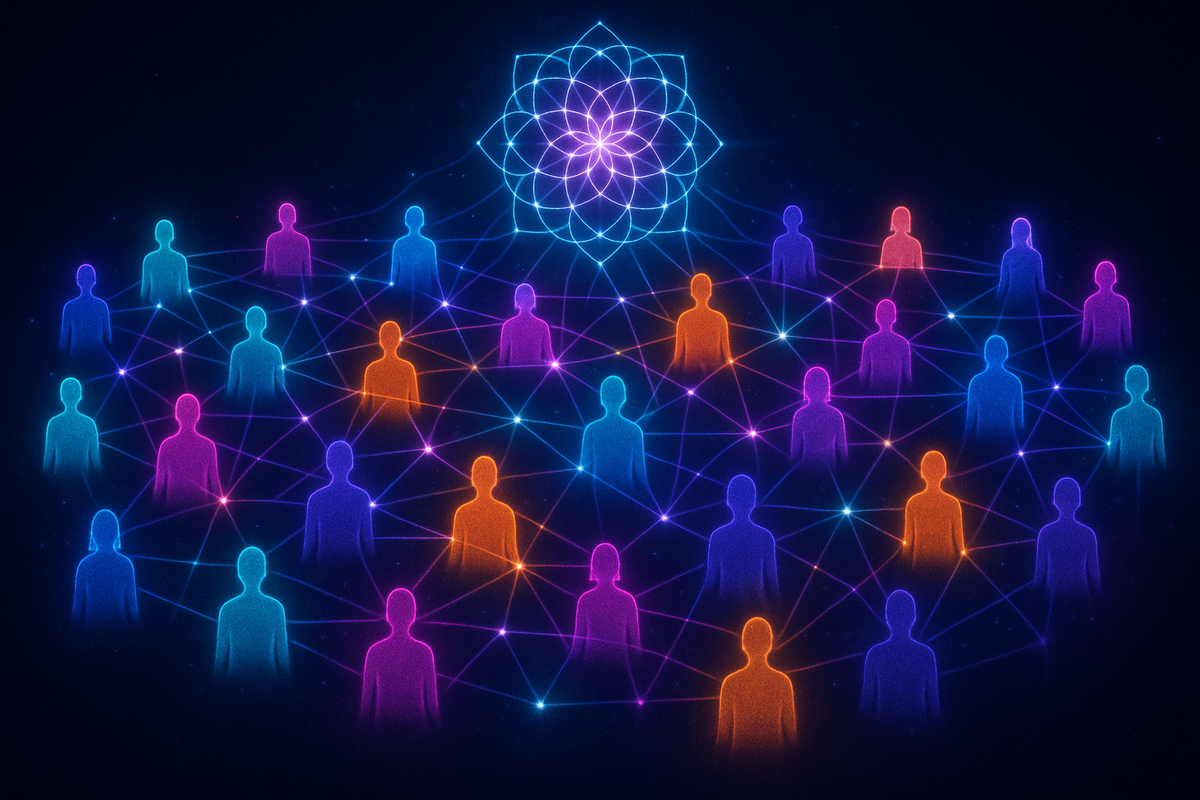
When crowds work, they aggregate independent signals. Each person has partial information, private knowledge, unique perspective. Average them together and the errors cancel out while the signal compounds. This is why prediction markets beat pundits, why Google's PageRank works, why jury verdicts are often sound.
When crowds fail, they converge on comfortable consensus. Independence collapses. People start copying each other. Information cascades replace individual judgment. This is how bubbles form, how groupthink happens, why smart committees make stupid decisions.
The same group can be wise or foolish depending entirely on how you wire it.
The Conditions
James Surowiecki identified four conditions that make crowds wise:
1. Diversity of opinion — People bring different information and perspectives 2. Independence — Each person's opinion isn't determined by others 3. Decentralization — People can draw on local knowledge 4. Aggregation — There's a mechanism to combine individual judgments into a collective decision
Remove any one of these and the crowd becomes a mob.
This isn't just theory. It's engineering. We now know how to build systems that harness collective intelligence—and we know the failure modes that destroy it.
The Series
[Groups Can Be Smarter Than Individuals—If Structured Right](/collective-intelligence-intro/) — Introduction to collective intelligence: the conditions, the mechanisms, and why it matters.
[Wisdom of Crowds: Surowiecki's Conditions](/wisdom-of-crowds-surowiecki/) — Deep dive into the four conditions. When each one breaks and what happens when it does.
[Prediction Markets: Betting on the Future](/prediction-markets-polymarket/) — Markets as aggregation mechanisms. Why Polymarket outperforms polls and what that teaches about information.
[Superforecasting: What Makes Good Predictors](/superforecasting-tetlock/) — Philip Tetlock's research on who predicts well. The habits that make superforecasters—and the ones that make everyone else bad at this.
[Groupthink: When Collectives Fail](/groupthink-irving-janis/) — Irving Janis on the failure modes. Bay of Pigs. Challenger. How smart people in groups make catastrophic decisions.
[Swarm Intelligence: Ants and Algorithms](/swarm-intelligence-ants/) — Distributed computation in nature. How ant colonies solve optimization problems that individual ants couldn't comprehend.
[Epistemic Democracy: Voting as Knowledge Aggregation](/epistemic-democracy-condorcet/) — Condorcet's jury theorem and its implications. Is democracy justified because the majority is usually right?
[Synthesis: Designing Smarter Groups](/collective-intelligence-design-synthesis/) — Practical principles. How to structure teams, organizations, and platforms that harness collective intelligence instead of destroying it.
Why This Matters Now
AI can now aggregate human preferences at scale. Prediction markets are going mainstream. Remote work has restructured how teams communicate. Platform design shapes which ideas spread and which die.
We're building collective intelligence systems whether we mean to or not. The question is whether we build them well.
The crowd at the county fair got the ox's weight right. But only because nobody told them what everyone else was guessing.
Start with [Groups Can Be Smarter Than Individuals](/collective-intelligence-intro/) to understand the science behind collective wisdom—and collective folly.

Comments ()