Common Logarithms: Base 10 and Scientific Notation
Common logarithms compress the universe's range of scales into manageable numbers. Each increment of 1 means multiplying by 10, not adding 10 — which is why they're essential for scientific notation, pH, and the Richter scale.
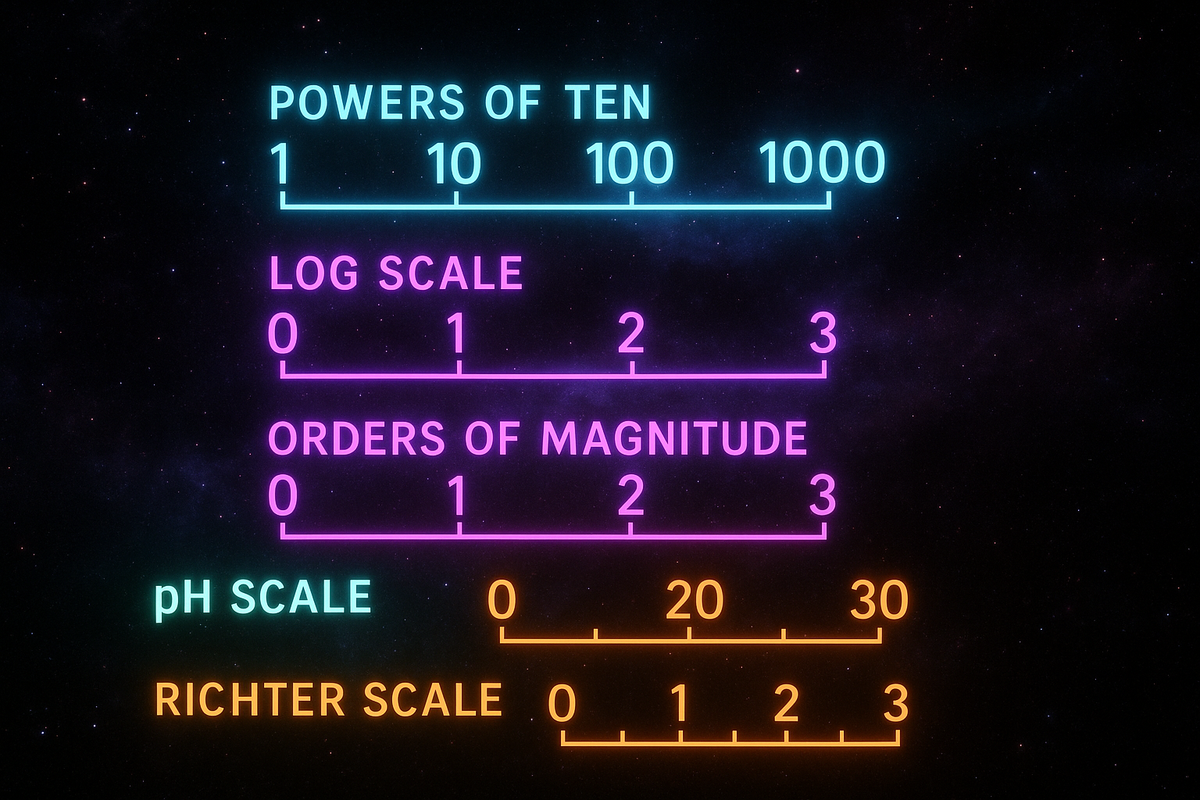
Common logarithms count powers of 10.
log₁₀(100) = 2 because 10² = 100. log₁₀(1,000,000) = 6 because 10⁶ = 1,000,000.
That's all a common logarithm is: how many powers of 10 is this number?
We call them "common" because base 10 matches our counting system. Humans have 10 fingers. Our number system has 10 digits. Base 10 logarithms are the natural choice for human-scale measurements.
The Notation
log₁₀(x) is usually written as log(x) when base 10 is assumed.
In most contexts—engineering, chemistry, everyday mathematics—log without a subscript means base 10.
Warning: Some advanced math contexts use log to mean natural log (ln). Programming languages vary. When in doubt, check or specify.
Powers of 10
The common log of powers of 10 is trivial:
| x | log(x) |
|---|---|
| 0.001 | -3 |
| 0.01 | -2 |
| 0.1 | -1 |
| 1 | 0 |
| 10 | 1 |
| 100 | 2 |
| 1,000 | 3 |
| 1,000,000 | 6 |
| 1,000,000,000 | 9 |
Each factor of 10 adds 1 to the logarithm. That's why log is useful: it compresses vast ranges into manageable numbers.
The difference between 1 and 1,000,000,000 is enormous. But log(1) = 0 and log(10⁹) = 9. On a log scale, the difference is just 9 units.
Scientific Notation and Logarithms
Scientific notation writes numbers as (something between 1 and 10) × (power of 10):
6,380,000 = 6.38 × 10⁶
The logarithm has the same structure:
log(6,380,000) = log(6.38 × 10⁶) = log(6.38) + log(10⁶) = 0.805 + 6 = 6.805
The integer part (6) is the characteristic—it's the power of 10. The decimal part (0.805) is the mantissa—it's the log of the coefficient.
Before calculators, log tables only listed mantissas. You determined the characteristic from the number's magnitude.
Orders of Magnitude
An order of magnitude is a factor of 10.
The moon is about 400,000 km away. The sun is about 150,000,000 km away.
The sun is about 400 times farther—roughly 2.5 orders of magnitude.
log(150,000,000) - log(400,000) = log(375) ≈ 2.57
Comparing orders of magnitude means comparing logarithms.
When scientists say "X is three orders of magnitude larger than Y," they mean X ≈ 1000Y. The log difference is about 3.
The Decibel Scale
Sound intensity is measured in decibels (dB), a logarithmic scale:
dB = 10 × log(I/I₀)
where I₀ is the threshold of hearing.
| Sound | dB | Intensity Ratio |
|---|---|---|
| Threshold of hearing | 0 | 1 |
| Whisper | 20 | 100 |
| Normal conversation | 60 | 1,000,000 |
| Rock concert | 110 | 100,000,000,000 |
| Jet engine | 140 | 100,000,000,000,000 |
The human ear can detect sounds from 0 dB to about 140 dB—a factor of 10¹⁴ in intensity. The log scale compresses this to a 0-140 range.
Every 10 dB increase means 10× more intensity. Every 20 dB means 100×.
The pH Scale
Acidity is measured by pH:
pH = -log[H⁺]
where [H⁺] is the hydrogen ion concentration in moles per liter.
| Substance | pH | [H⁺] |
|---|---|---|
| Battery acid | 0 | 1 |
| Lemon juice | 2 | 0.01 |
| Coffee | 5 | 0.00001 |
| Pure water | 7 | 0.0000001 |
| Baking soda | 9 | 0.000000001 |
| Bleach | 12 | 0.000000000001 |
Each pH unit is a factor of 10 in acidity. pH 3 is 10 times more acidic than pH 4, and 100 times more acidic than pH 5.
The negative sign ensures that more acidic solutions (higher H⁺) have lower pH.
The Richter Scale
Earthquake magnitude is logarithmic:
Each whole number increase means 10× more ground movement and about 31× more energy released.
| Magnitude | Description | Energy (relative) |
|---|---|---|
| 3 | Minor | 1 |
| 4 | Light | 31 |
| 5 | Moderate | 1,000 |
| 6 | Strong | 31,000 |
| 7 | Major | 1,000,000 |
| 8 | Great | 31,000,000 |
A magnitude 8 earthquake releases about a million times more energy than a magnitude 5. The log scale makes both expressible as simple numbers.
Calculating with Common Logs
Finding log(x) for any x:
Example: log(350)
350 = 3.5 × 10² log(350) = log(3.5) + 2 ≈ 0.544 + 2 = 2.544
Example: log(0.0072)
0.0072 = 7.2 × 10⁻³ log(0.0072) = log(7.2) + (-3) ≈ 0.857 - 3 = -2.143
Finding x from log(x):
Example: log(x) = 4.3
x = 10^4.3 = 10⁴ × 10^0.3 ≈ 10,000 × 2 = 20,000
More precisely: 10^4.3 ≈ 19,953
Why Base 10?
Base 10 is natural for humans because of our decimal counting system.
When you write 5,280 feet in a mile, you're using powers of 10: 5,280 = 5×10³ + 2×10² + 8×10¹ + 0×10⁰
Common logarithms tell you roughly how many digits a number has:
- log(5,280) ≈ 3.72 → 4 digits (between 10³ and 10⁴)
The integer part of log(x) is always one less than the number of digits (for x ≥ 1).
Common Log vs Natural Log
| Common Log (log) | Natural Log (ln) |
|---|---|
| Base 10 | Base e ≈ 2.718 |
| Used in science, engineering | Used in calculus, physics |
| Measures orders of magnitude | Measures continuous growth |
| log(10) = 1 | ln(e) = 1 |
Conversion: ln(x) = log(x) × ln(10) ≈ 2.303 × log(x)
For practical measurement and human-scale reasoning, use log (base 10). For calculus and theoretical work, use ln (base e).
Applications Summary
Common logarithms appear wherever:
- Ranges are vast. Sound intensities, earthquake energies, acid concentrations span many orders of magnitude.
- Human perception is involved. We perceive pitch, volume, and brightness logarithmically.
- Scientific notation is natural. The log gives you the power of 10 directly.
- Comparisons are multiplicative. "How many times larger?" is a log difference.
The common logarithm is the exponent translator for base 10. It tells you where a number sits on the scale of powers of 10—whether it's closer to 1 or to a billion.
Part 3 of the Logarithms series.
Previous: Log Rules: Why Multiplication Becomes Addition Next: Natural Logarithm: Why ln Uses Base e
Comments ()