Comparative Mysticism
Strip away the theology and mystics across traditions report the same phenomenology: ego dissolves, boundaries vanish, dimensionality expands. That convergence demands an explanation.
Comparative Mysticism
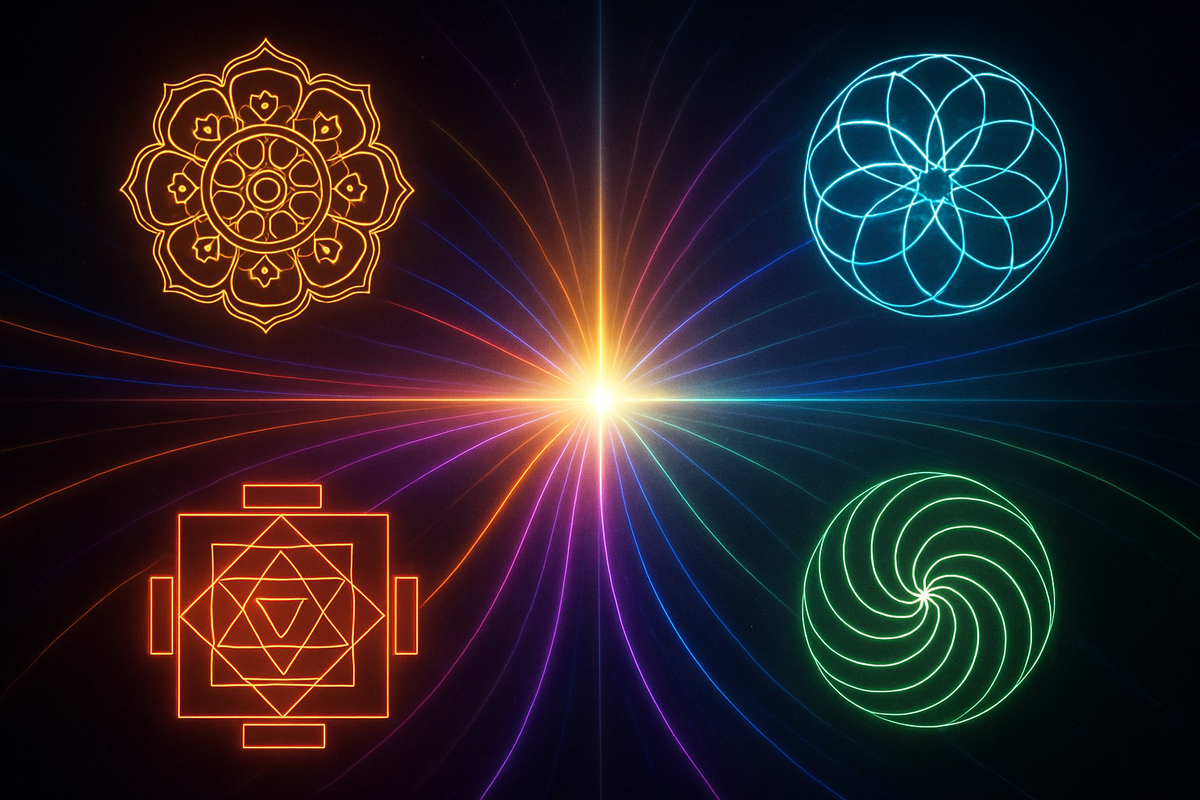
Christian mystics describe union with God. Buddhist practitioners report dissolving into no-self. Sufis speak of annihilation in the Beloved. Hindu yogis claim recognition of ultimate reality. Psychonauts on DMT encounter boundary dissolution and cosmic unity.
Different words. Different concepts. Different metaphysics. Same geometric destination.
The convergence problem in mysticism: why do diverse traditions, separated by geography and culture, describe strikingly similar phenomenology at their experiential peaks? Not identical—context shapes interpretation—but convergent enough to demand explanation.
The standard dismissal: they're all projecting cultural expectations onto vague feelings. But that doesn't explain the structural similarities: ego dissolution, subject-object collapse, time distortion, sense of profound understanding, ineffability, and lasting transformation. These aren't vague. They're specific, recurring, and consistent.
Comparative mysticism studies these convergences not as evidence of metaphysical truth but as clues about coherence geometry—the navigable state-space of human consciousness and the attractor configurations traditions reliably reach.
Why This Matters for Understanding Coherence
If different contemplative traditions navigate to similar geometric configurations, it suggests these states are structural features of consciousness, not cultural artifacts. Just as faces evolve convergently because vision has functional demands, mystical states might recur because certain configurations are deeply stable, low-curvature attractors in the space of possible experiences.
The phenomenology suggests specific geometric properties: reduced curvature (less prediction error, more integration), expanded dimensionality (access to broader state-space), and boundary reconfiguration (dissolved self/other distinction, altered Markov blanket structure).
Traditions differ in how they reach these states—Buddhism through analysis and attention, Christianity through surrender and love, Sufism through devotion and remembrance, Yoga through integration—but the target geometry remains consistent: a particular configuration of low curvature, high integration, and minimal self-model activation.
Understanding mystical convergence through coherence geometry clarifies what's universal (the state-space structure), what's variable (the path and interpretation), and what practices actually accomplish (systematic navigation toward stable low-curvature attractors).
Articles in This Series








Further Exploration



Part of the HUMAN MEANING collection exploring how coherence operates across historical, cultural, and social scales.
Comments ()