Computational Mythology: Network Analysis and Distant Reading of Mythic Corpora
Apply network analysis to the Iliad or the Mahabharata and something strange emerges: mythological social graphs match those of real human societies. Computational mythology is finding unexpected structure in ancient narratives.
Computational Mythology: Network Analysis and Distant Reading of Mythic Corpora
For most of human history, studying mythology meant close reading of individual texts: immersing yourself in the Iliad, analyzing the Popol Vuh, interpreting the Bhagavad Gita. Scholars spent careers mastering single traditions.
Then computational tools arrived. And suddenly you could ask: what patterns emerge when you analyze every Greek myth simultaneously? What does the network structure of all Irish folktales reveal? How do narrative attractors change across 1,000 years of Chinese stories?
This is computational mythology—using quantitative methods, network analysis, natural language processing, and machine learning to find patterns invisible to close reading. And what it's discovering is remarkable: myths aren't just culturally specific stories. They're structured information with measurable topology, and that topology reveals universal coherence dynamics.
Distant Reading vs. Close Reading
Literary critic Franco Moretti coined the term "distant reading"—analyzing thousands of texts computationally rather than dozens through careful interpretation. The method was controversial. Humanists objected: "You can't understand Hamlet by reducing it to word frequencies and character networks."
True. But you're not trying to understand Hamlet. You're trying to understand what makes tragic narratives structurally distinct from comedies across 500 years of European theater. For that question, close reading fails—you can't hold 10,000 plays in your head simultaneously. Computation can.
Applied to mythology, distant reading reveals:
Structural invariants across culturally disconnected traditions
Evolution of motifs through historical transmission
Network topologies of character relationships and narrative paths
Attractor structures in conceptual and narrative space
Information compression patterns that make myths memorable
This isn't replacing traditional scholarship. It's adding a lens that shows the forest alongside the trees.
Mapping Mythological Networks
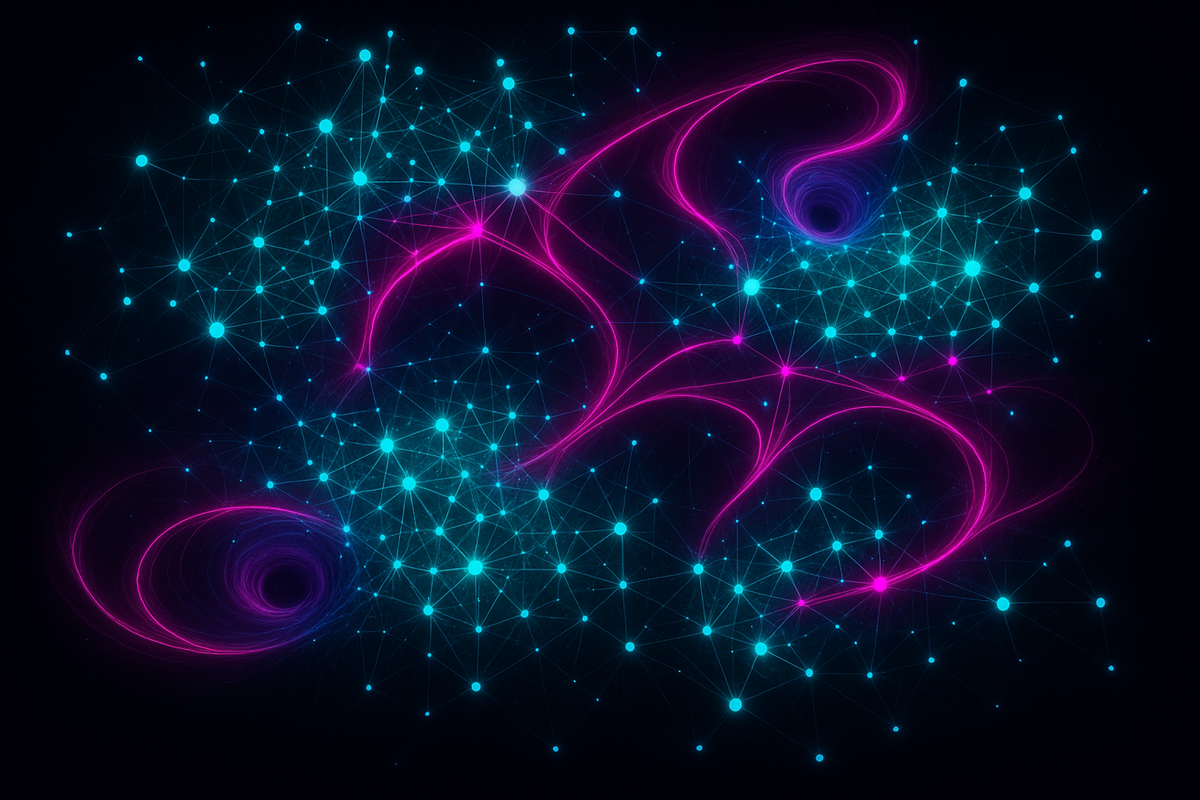
One of the most striking computational findings: mythological systems have network structure, and that structure is non-random.
When researchers build character-relationship networks from Greek mythology (Zeus connects to Hera, Athena, Apollo; Athena connects to Odysseus, Achilles, etc.), they find:
Scale-free topology: A few highly connected nodes (major gods) and many peripheral nodes (minor characters). This is the same structure as social networks, the web, protein interaction networks. It's optimized for resilience and efficient information propagation.
Small-world properties: Any character can reach any other character through a short path (average 3-4 steps). This enables rapid narrative traversal—you can get from any myth to any other myth through shared characters.
Clustered communities: Tight subgraphs around particular domains (Olympian gods, Trojan War heroes, Underworld figures, Titans). These clusters map to coherent thematic domains and enable modular storytelling.
Power-law degree distribution: The number of connections follows a power law—most characters have few connections, a few have enormous numbers. This creates narrative hubs that stories naturally flow through.
This isn't arbitrary. Network structure with these properties is optimized for cultural transmission. Scale-free networks are robust to node deletion (losing a minor character doesn't break the network). Small-world properties mean you can always find a path from one story to another. Clustering enables focus on domains while maintaining global connectivity.
Myths evolved this structure because networks with these properties transmit better and remain coherent longer.
Motif Evolution and Transmission
Computational tools let you track how narrative elements mutate as they propagate through cultures.
Example: The "flood myth" appears across disconnected traditions (Mesopotamian, Hebrew, Greek, Hindu, Indigenous American). Are these independent inventions or cultural transmission?
Phylogenetic analysis—the same statistical methods used to track genetic evolution—can be applied to mythic motifs. By measuring "distance" between versions (how many elements differ), you can construct evolutionary trees showing which versions descended from which.
Results reveal:
Some motifs are convergent invention (flood myths in traditions with no contact show different detailed structure, suggesting independent response to similar existential threats)
Some show clear transmission (Greek and Roman myths are obviously related through cultural contact)
Some are ancient and geographically dispersed (Indo-European myth motifs track with historical language dispersal)
This confirms something mythographers suspected but couldn't prove: some narrative patterns are human universals (convergent solutions to common problems) while others are historically transmitted (specific cultural innovations that spread through contact).
Narrative Attractor Structures
When you analyze thousands of stories computationally, you can map the attractor basins in narrative space—configurations that stories tend to fall into.
Researchers using topic modeling and clustering algorithms on large fairy tale corpora find:
Stable narrative clusters that recur across cultures:
- Quest narratives (departure→tests→achievement→return)
- Transformation narratives (ordinary→magical→return-to-ordinary)
- Trickster narratives (rule-violation→chaos→new-order)
- Sacrifice narratives (loss→benefit-for-others→recognition)
- Origin narratives (chaos→ordering→current-world)
Hybrid attractors that combine elements from multiple clusters in predictable ways
Rare configurations that occupy sparse regions of narrative space and don't transmit well
This is exactly what you'd predict if myths are evolved compression algorithms. Cultural evolution explores narrative space, and certain configurations are sticky because they map to real coherence dynamics. Stories that don't match these attractors mutate toward them through retelling, or disappear from canon.
Semantic Space Analysis
Modern NLP lets you embed myths in semantic space—representing stories as high-dimensional vectors based on their meaning rather than surface words.
When researchers embed thousands of myths and visualize the resulting space, fascinating structure emerges:
Cultural clusters: Greek myths cluster together, separate from Norse, separate from Yoruba. But there's overlap in the regions representing universal themes (creation, death, transformation).
Thematic axes: You can identify dimensions along which myths vary—individual vs. collective, order vs. chaos, human vs. divine, linear vs. cyclical.
Conceptual bridges: Certain myths sit at boundaries between clusters, serving as translation points between traditions. These are often the myths that spread most successfully across cultures.
Compression gradients: Myths that pack the most narrative information into the smallest conceptual space occupy central positions—they're prototypical instances that other myths reference.
This analysis reveals the geometry of mythic meaning-space. It's not flat and uniform. It has structure, curvature, dense regions and sparse regions. And that geometry constrains which stories can exist, how they relate, and how they transmit.
Predictive Modeling: Generating Myths Computationally
If myths have measurable structure, can you generate new ones that feel authentic?
Researchers have trained neural networks on mythological corpora and generated novel myths. Results are revealing:
Surface-level generation is easy: GPT models can produce grammatical sentences that sound mythic: "The hero descended to the underworld and was tested by three spirits."
Deep structure is harder: Generated myths often violate Proppian ordering or archetypal logic in subtle ways that make them feel off. The model learns word patterns but misses the deeper coherence algorithm.
Hybrid generation works better: Combining neural text generation with explicit structural constraints (Propp's functions, Campbell's stages, character archetypes) produces myths that feel more authentic because they respect the underlying state-machine logic.
This confirms: mythic structure isn't superficial. There's deep algorithmic coherence that pure statistical pattern-matching misses. You need both the surface linguistics and the deep logical structure.
Quantifying Memorability and Transmission
Computational methods let you test what makes myths memorable.
Researchers have measured:
MCI density: Stories with 2-3 minimally counterintuitive elements per 500 words transmit better than stories with 0 or 6+. Too few and they're forgettable. Too many and they're incoherent.
Emotional arousal profiles: Myths that oscillate between calm and high-arousal scenes transmit better than flat emotional narratives. The variation creates attentional punctuation.
Character network complexity: Stories with 4-7 central characters hit a sweet spot. Fewer is too simple. More is too complex to track.
Narrative arc steepness: Rate of change in the protagonist's state follows a predictable curve—slow early, steep mid-narrative, resolution at end. Violations of this temporal structure reduce transmission.
Coherence closure: Myths that tie up loose ends transmit better than open-ended narratives. Brains prefer complete patterns.
These are measurable design principles that cultural evolution optimized unconsciously. Myths that followed these principles survived. Myths that violated them got filtered out. Computational analysis lets us reverse-engineer the selection pressures.
Applications Beyond Mythology
The techniques developed for computational mythology are being applied to:
Contemporary storytelling: Hollywood uses network analysis to optimize character relationships in franchises. Writers use computational plot analysis to identify successful narrative structures.
Historical analysis: Tracking how political narratives evolve through news coverage. Identifying propaganda patterns through semantic drift analysis.
Religious studies: Mapping how theological concepts cluster and evolve across denominations and historical periods.
Cultural evolution: Understanding how ideas spread through populations using the same tools applied to genetic and memetic evolution.
AI training: Using mythological corpora to teach language models about narrative structure, causation, and human values.
The insight is the same across domains: cultural information has structure, that structure is measurable, and measurement reveals design principles.
What Computation Can't Capture
For all its power, computational mythology has limits:
Phenomenology: You can measure that a myth contains an "ordeal" function, but you can't capture what it feels like to identify with the hero in that moment. The lived experience of narrative is inaccessible to computation.
Cultural context: Statistical patterns don't tell you why a specific culture at a specific time needed a specific myth. Historical particularity gets flattened in large-scale analysis.
Meaning vs. structure: You can identify that myths cluster around certain themes, but you can't computationally determine what those themes mean to the people who tell them.
Individual genius: Homer, Vyasa, the anonymous creators of the Epic of Gilgamesh—computational analysis reveals patterns but misses the singular creative acts that transcended pattern.
Sacred vs. profane: For practitioners, myths aren't just information structures—they're sacred technology. Computation treats them as data, missing their religious function.
This is why computational mythology works best in dialogue with traditional scholarship. Computation finds patterns. Interpretation determines what they mean. Neither is sufficient alone.
The Meta-Pattern: Convergent Coherence Solutions
What's most striking about computational mythology findings is how much convergence there is.
Disconnected cultures independently discover:
- Similar narrative structures (quest, transformation, origin)
- Similar character archetypes (hero, trickster, mother, mentor)
- Similar sequence constraints (Proppian function ordering)
- Similar network topologies (scale-free, small-world)
- Similar compression techniques (MCI violations, emotional arcs)
This convergence isn't coincidence or cultural transmission. It's independent discovery of solutions to universal problems.
How do you encode coherence instructions in transmissible form? You discover MCI violations hook attention. You discover emotional arcs enhance memory. You discover archetypal compression enables pattern-matching. You discover network structure enables flexible recombination.
These discoveries aren't arbitrary. They're constrained by:
- Human cognitive architecture (what patterns our brains can learn and transmit)
- Coherence dynamics (what actually works for navigation)
- Cultural selection (what survives transmission across generations)
The computational evidence reveals: mythology is convergent engineering. Different cultures solving the same design problem with the same cognitive tools arrive at the same solutions, which is why we can analyze them quantitatively and find universal patterns.
Implications for Understanding Myth
Computational mythology confirms what this series has been arguing:
Myths are information technology, not primitive superstition. They have measurable structure optimized for specific functions.
That structure maps to real dynamics, not arbitrary cultural preference. The patterns recur because they encode true constraints on coherence navigation.
Cultural evolution is a discovery process, finding solutions that work through variation and selection over time.
The patterns are universal, not because humans share mystical collective unconscious, but because we share cognitive architecture and face common coherence challenges.
Modern tools let us reverse-engineer ancient wisdom, extracting the design principles our ancestors discovered unconsciously and making them explicit.
And perhaps most importantly: the fact that myths have computational structure doesn't reduce their power. It explains it. They work because they're optimally structured for their function. Understanding the mechanism doesn't destroy the magic—it reveals why the magic works.
Further Reading
- Moretti, Franco. Distant Reading. Verso, 2013.
- Murai, Hiata, et al. "Quantitative Analysis of Mythological Networks." Journal of Complex Networks, 2020.
- Tehrani, Jamshid. "The Phylogeny of Little Red Riding Hood." PLOS ONE, 2013.
- Reagan, Andrew J., et al. "The Emotional Arcs of Stories Are Dominated by Six Basic Shapes." EPJ Data Science, 2016.
- Tangherlini, Timothy R. "Toward a Generative Model of Legend." Journal of American Folklore, 2018.
This is Part 7 of the Cognitive Mythology series, exploring how myths function as compression algorithms for coherence instructions.
Previous: Propp's Morphology: Narrative as State Machine
Next: Myth and Meaning Crisis: Why the Compression Algorithms Stopped Working
Comments ()