The Compute Ceiling: Why AI Hit a Wall
Training costs double every six months while Moore's Law fades. The compute ceiling is real, and the next AI breakthroughs may require rethinking the entire architectural stack.
The Compute Ceiling: Why AI Hit a Wall
In 2020, OpenAI trained GPT-3. It took approximately 1,287 megawatt-hours of electricity—enough to power 120 American homes for a year. The cost: somewhere between $4 million and $12 million, depending on how you count.
In 2023, GPT-4 training consumed an estimated 50 gigawatt-hours. That's not a typo. Fifty times the energy, roughly $100 million in electricity alone.
In 2024, the industry whispers about models that cost half a billion dollars to train. Not to deploy. Not to run. Just to train once.
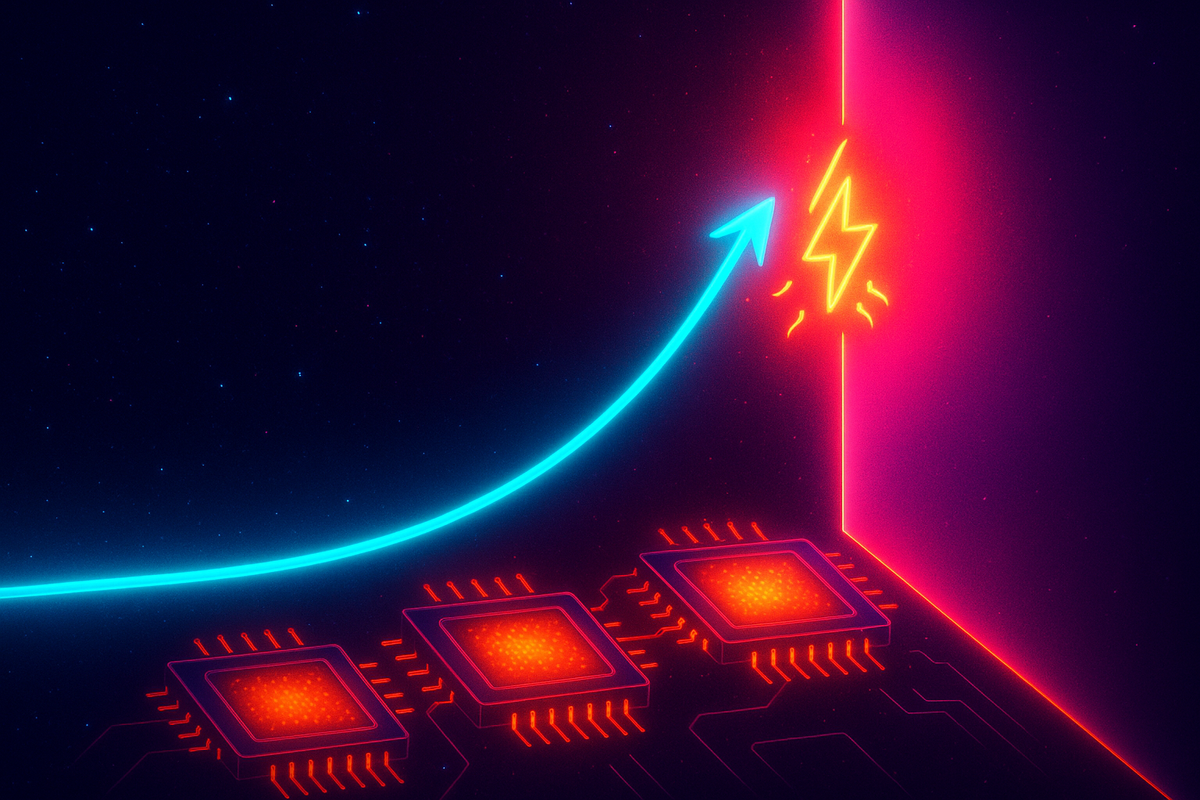
The compute requirement for cutting-edge AI is doubling every six months. That's faster than Moore's Law ever was. And unlike Moore's Law, there's no physical shrinking trick that can keep up.
Welcome to the compute ceiling. AI didn't hit a wall of intelligence. It hit a wall of joules.
The Scaling Hypothesis and Its Appetite
The past decade of AI has been dominated by a single, surprisingly simple idea: make it bigger. More parameters. More training data. More compute. And, almost magically, capabilities emerge.
This is the scaling hypothesis—the bet that intelligence is primarily a function of scale. GPT-2 to GPT-3 wasn't a breakthrough in architecture; it was a breakthrough in size. GPT-3 to GPT-4 wasn't a new algorithm; it was more of everything.
The scaling laws, first formally described by Jared Kaplan and colleagues at OpenAI in 2020, show clean power-law relationships: double the compute, get predictable improvements in capability. The curves are remarkably smooth. They suggest that intelligence, or at least the statistical modeling of intelligence, might scale indefinitely.
But here's what the scaling laws don't tell you: the exponent is greater than one. To get linear improvements in capability, you need superlinear increases in compute. To make a model twice as capable, you need more than twice the energy.
The math is unforgiving. If current trends continue, a model trained in 2030 would require more electricity than many small countries produce. Not per year—for a single training run.
Something has to give.
Dennard Is Dead
To understand why we can't just build our way out of this, you need to understand a piece of computing history that shaped the modern world—and then ended.
In 1974, Robert Dennard described how transistor miniaturization could proceed: as transistors got smaller, their power consumption would decrease proportionally. Shrink a transistor by half, use half the power. This meant you could pack more transistors into the same space without melting your chip.
Dennard scaling was the engine beneath Moore's Law. Gordon Moore observed that transistor counts doubled every two years. Dennard explained why that was sustainable: smaller transistors meant you could keep the power density constant.
For thirty years, this held. Computers got faster and more powerful without requiring proportionally more energy. The free lunch seemed infinite.
Then, around 2006, Dennard scaling died.
The problem is quantum mechanics. When transistors get small enough—around 65 nanometers and below—electrons start tunneling through barriers they shouldn't be able to cross. Current leaks. Gates that should be off stay partially on. The power floor stops dropping.
Since 2006, we've been able to make transistors smaller, but not cooler. Each generation of chips packs more transistors into the same space, but the power density stays constant or even rises. This is why modern chips need increasingly elaborate cooling solutions. It's why data centers are being built next to rivers and in cold climates.
Moore's Law limped forward for another decade through architectural cleverness—multiple cores, specialized accelerators, better packaging. But the efficiency gains that made computing cheap were over. The energy bill started to matter.
The Three Constraints
Today's AI faces three interlocking constraints, and none of them have obvious solutions.
Constraint one: training energy. Large language models require astronomical amounts of computation to train. The training process—adjusting billions or trillions of parameters through repeated passes over data—is inherently energy-intensive. Every gradient update involves floating-point operations that burn watts. There's no shortcut around this; it's what training is.
Current estimates suggest that training a frontier model produces more carbon emissions than the lifetime footprint of several cars. And training is a one-time cost that must be paid again for every new model. The largest labs run dozens of experimental training runs for every model they deploy.
Constraint two: inference energy. Once a model is trained, running it—inference—also costs energy. Every query to ChatGPT, every image generated by Midjourney, every AI assistant response burns watts. Inference is cheaper per operation than training, but it happens billions of times per day across millions of users.
As AI deployment scales, inference costs are becoming the dominant factor. A model that costs $100 million to train might cost $1 billion per year to run at scale. The economics only work if the value generated exceeds the energy consumed.
Constraint three: chip fabrication energy. Making the chips that run AI is itself enormously energy-intensive. A modern semiconductor fab requires as much power as a small city. The process of creating nanometer-scale structures demands extreme ultraviolet lithography, precision etching, and clean rooms maintained to extraordinary standards. All of this costs energy before a single calculation is performed.
The supply chain is strained. TSMC, which manufactures most of the world's advanced chips, faces both energy constraints and water scarcity in Taiwan. New fabs take years to build and billions of dollars to equip. The physical infrastructure for AI is a bottleneck that money alone cannot solve.
What the Companies Are Actually Doing
The AI industry isn't ignorant of these constraints. The response has been a scramble for energy—any energy, anywhere.
Microsoft reactivated Three Mile Island. Yes, that Three Mile Island. The nuclear plant that experienced America's worst commercial nuclear accident in 1979 has been purchased to power data centers. The company signed a twenty-year power purchase agreement.
Amazon bought a nuclear-powered data center campus from Talen Energy for $650 million. Google is investing in small modular reactors. Meta has announced plans for nuclear energy procurement.
This isn't greenwashing. The tech giants are becoming energy companies because they have no choice. The compute requirements exceed what the existing grid can provide. Building your own power plants is faster than waiting for utilities to expand.
But nuclear takes years to deploy. The current scramble is for natural gas plants, for renewable contracts, for any megawatts available. Data centers are being sited not where customers are, but where power is cheap and abundant.
Meanwhile, the efficiency push continues. Each generation of AI chips—Nvidia's H100 to H200 to Blackwell—offers better performance per watt. Training techniques like mixed-precision arithmetic reduce energy per operation. Distillation creates smaller models that approximate larger ones.
None of it is enough. Efficiency gains of 2-3x per year cannot keep pace with compute demands that double every six months.
The Fundamental Problem
Here's what makes this different from other technological challenges: the energy requirement isn't a bug in how we do AI. It might be a feature of what AI is.
Computation requires energy. This isn't an engineering limitation; it's physics. Every bit flipped, every multiplication performed, every parameter updated releases heat. There is a thermodynamic floor below which computation cannot occur.
We'll explore this floor—Landauer's limit—in the next article. But the key insight is that intelligence, whether biological or artificial, involves maintaining complex, organized states against the tendency toward disorder. This is the definition of anti-entropy, and anti-entropy always costs energy.
The brain does this remarkably efficiently: 20 watts for capabilities that current AI requires megawatts to approximate. But even the brain is not free. Evolution spent hundreds of millions of years optimizing neural efficiency because calories were scarce on the savanna.
Perhaps the AI energy crisis is revealing something fundamental: intelligence is expensive because complexity is expensive. Coherence costs.
What Happens Next
The optimists point to potential breakthroughs: neuromorphic computing that mimics biological efficiency, quantum computing that solves certain problems with less energy, new training algorithms that achieve more with less compute.
The pessimists note that none of these solutions are ready. Neuromorphic chips exist but can't run current AI architectures. Quantum computers are decades from practical AI applications. Algorithmic breakthroughs are unpredictable by definition.
The realists—and most people building AI fall into this camp—are simply racing to secure energy supplies while hoping for efficiency gains. Build the nuclear plants. Sign the renewable contracts. Optimize what we have. Buy time.
There are three possible futures:
Future one: breakthrough. Someone discovers a fundamentally more efficient way to achieve intelligence—perhaps by learning from biology, perhaps through entirely new computational paradigms. Energy ceases to be the binding constraint.
Future two: plateau. AI capabilities level off not because we've reached the limits of intelligence, but because we've reached the limits of energy we're willing to spend. Models stop getting dramatically larger. Progress shifts from scale to optimization.
Future three: reallocation. Society decides that AI is valuable enough to dedicate significant fractions of global energy production to it. Other uses contract; AI expands. This raises questions about priorities that are as much political as technical.
None of these futures is certain. All of them are possible.
The Uncomfortable Question
The compute ceiling forces a question that the AI industry has largely avoided: What is intelligence worth?
When compute was cheap, you could train models without thinking too hard about the cost. When electricity is the limiting factor, every training run is a decision about resource allocation. Should this energy go to AI, or to something else?
This isn't just an economics question. It's an ethics question. Training a large model might consume as much energy as a small town uses in a year. What does that model need to deliver to justify the expenditure?
The current answer, implicitly, is "market value." Models get trained because companies believe they can monetize the results. But market value and social value aren't the same thing. The energy spent on AI cat pictures could heat homes or power hospitals.
I'm not arguing that AI is a waste—far from it. I'm arguing that the energy constraint forces clarity about value that the industry has avoided. When intelligence costs joules, you have to decide how much it's worth.
The Deeper Pattern
Step back from the specifics and a pattern emerges: every leap in information processing has required a leap in energy capture.
Fire and cooking enabled the caloric surplus that grew big brains. Agriculture enabled the caloric surplus that grew civilizations. Fossil fuels enabled the energy surplus that grew industrial society. Nuclear and renewables may enable the energy surplus that grows artificial intelligence.
The compute ceiling isn't a detour from this pattern; it's the pattern reasserting itself. Intelligence—the organization of information into useful forms—is a thermodynamic achievement. It runs on energy gradients. Always has. Always will.
Biology understood this from the beginning. Neurons evolved to be efficient because organisms that wasted energy died. Brains that could think more per calorie outcompeted brains that couldn't.
Silicon is learning the same lesson, just faster. The selective pressure isn't death; it's the electricity bill. But the lesson is identical: intelligence that doesn't solve the energy problem doesn't survive.
What This Series Will Explore
The compute ceiling is the problem statement. The rest of this series explores the physics beneath it and the solutions being attempted.
Next, we go to the absolute floor: Landauer's limit, the thermodynamic principle that says every bit erased releases heat. Understanding this limit tells us how far from optimal current computing is—and how far it could theoretically go.
Then we examine nature's solution: the human brain, running on 20 watts, achieving computational feats that embarrass our best silicon. What is biology doing that we're not?
From there, the solutions: organoid computing, neuromorphic chips, nuclear power, fusion dreams. Each represents a bet on how to escape the ceiling—or at least raise it.
The synthesis will tie it together: why coherence costs energy, and what that means for minds both biological and artificial.
The ceiling is real. The question is whether it's a wall or just the next engineering problem to solve.
Further Reading
- Kaplan, J., et al. (2020). "Scaling Laws for Neural Language Models." arXiv preprint. - Patterson, D., et al. (2022). "The Carbon Footprint of Machine Learning Training Will Plateau, Then Shrink." IEEE Computer. - Strubell, E., Ganesh, A., & McCallum, A. (2019). "Energy and Policy Considerations for Deep Learning in NLP." ACL.
This is Part 1 of the Intelligence of Energy series, exploring the physical constraints on computation. Next: "[Landauer's Limit: The Physics of Erasing Information](/landauers-limit-information/)."


Comments ()