Conscious Agents All the Way Down: Hoffman's Mathematical Framework
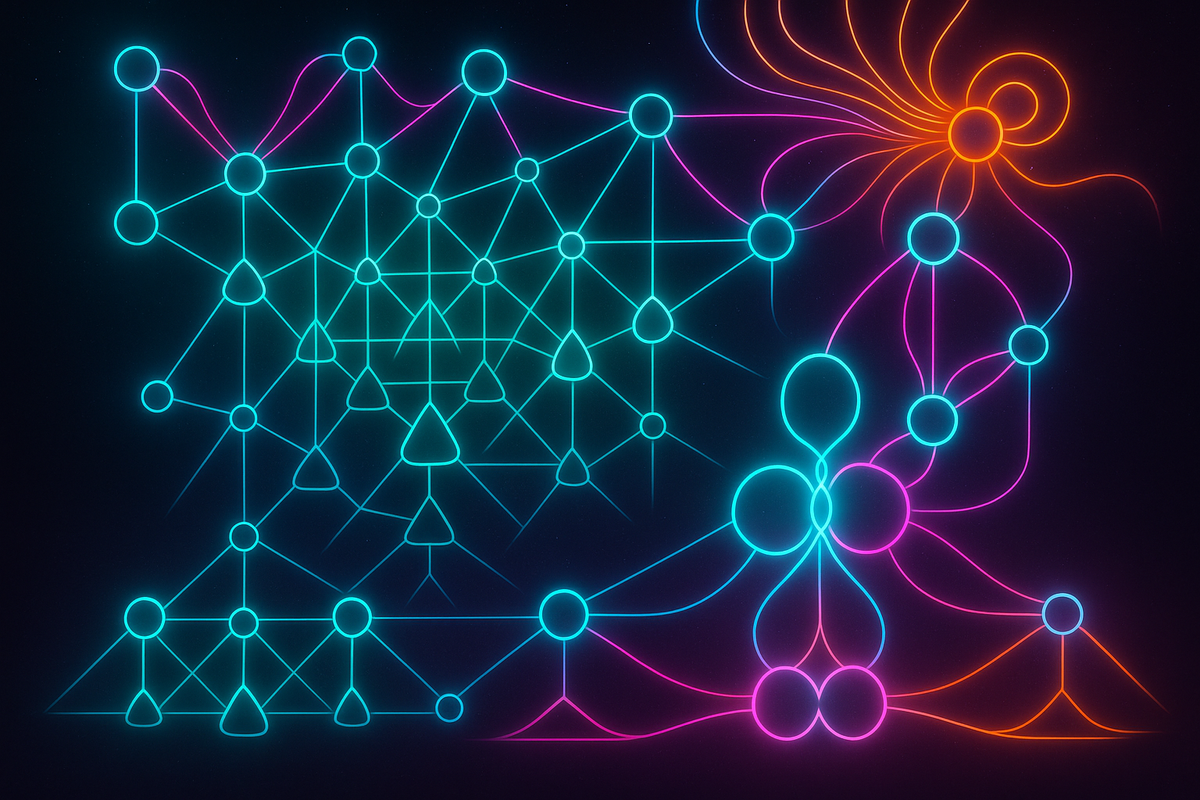
Conscious Agents All the Way Down: Hoffman's Mathematical Framework
Series: Interface Theory | Part: 4 of 10
If reality is a perceptual interface hiding deeper truths, what lies beneath? For Donald Hoffman, the answer isn't particles or fields or spacetime geometry. It's conscious agents all the way down.
This isn't mysticism dressed in equations. Hoffman has built a formal mathematical framework where consciousness is fundamental and physical reality emerges as a derived property. The conscious agent formalism treats perception and action as primary, with mathematical structure that predates—and generates—the physical world we experience.
This is where Interface Theory gets precise. Where the desktop metaphor becomes a rigorous theory. Where evolutionary game theory meets category theory to build reality from networks of perceiving, acting entities.
The Conscious Agent: Six Components
Hoffman defines a conscious agent as a six-tuple mathematical object. Not a brain, not a biological organism, but an abstract entity characterized entirely by what it does: perceive and act.
The formalism:
A conscious agent C consists of:
- X: A set of possible experiences (perceptual states)
- G: A set of possible actions
- P(x|w): A probability function mapping world states to experiences
- D(g|x): A decision function mapping experiences to actions
- W: A set of world states
- A(w'|g,w): An action kernel mapping actions and world states to new world states
This looks technical, but the intuition is straightforward. An agent experiences something (drawn from X), decides on an action (from G), which changes the world state (in W), leading to new experiences. A perception-action loop, formalized.
The radical move is treating this as fundamental. Not emergent from neural networks, not supervening on physics, but the basic building block from which everything else derives.
Consciousness isn't what brains do. Brains are what consciousness looks like when viewed through a particular perceptual interface.
Markovian Kernels and the Dynamics of Perception
The conscious agent formalism uses Markovian kernels—probability distributions that define how one state transitions to another. This mathematical machinery comes from dynamical systems theory and quantum mechanics, now repurposed for conscious agents.
The perception kernel P(x|w) describes how world states map to experiences. Crucially, this is not deterministic. The same world state can generate different experiences probabilistically. This isn't measurement noise—it's fundamental to how perception works.
The decision kernel D(g|x) maps experiences to actions. Again, probabilistic. The same experience can lead to different action choices. This captures the apparent freedom of conscious decision-making within the formalism.
The action kernel A(w'|g,w) defines how actions change world states. This completes the loop: perception → decision → action → new world state → new perception.
The mathematics here is doing serious work. Markovian kernels compose. You can combine conscious agents into larger networks, and the resulting system is itself a conscious agent with well-defined kernels. The formalism is compositional.
This means you can build up complex systems from simple agents. Two conscious agents can fuse into a new agent. Networks of agents can form hierarchies. The mathematics guarantees that perception-action structure is preserved at every scale.
Fusion: When Two Agents Become One
One of the most striking features of the conscious agent formalism is fusion—the process by which multiple agents combine into a single agent.
Given two agents C₁ and C₂, you can define a fusion operation that produces a new agent C₃. This isn't just metaphor. The kernels of C₃ are mathematically specified as combinations of the kernels from C₁ and C₂.
The fused agent has access to both perception channels, both action repertoires. It's a genuine enlargement of capacity, not just parallel processing.
Hoffman argues this explains how complex conscious systems emerge. Cells fuse perceptual channels. Organisms fuse sensory modalities. Societies fuse communication networks. At every level, fusion creates agents with richer perceptual and action spaces.
This connects to Markov blankets—the statistical boundaries that define where one system ends and another begins. When agents fuse, their Markov blankets reconfigure. What were external states become internal. What were separate agents become subsystems of a unified whole.
The mathematics here resembles category theory—a branch of mathematics concerned with composition and structure-preserving transformations. Conscious agents form a category where fusion is the compositional operation. This suggests deep mathematical properties: associativity, identity elements, perhaps even symmetries.
Hoffman hasn't fully developed the category-theoretic treatment yet, but the structure is there waiting to be formalized. If conscious agents really do form a category, then all the powerful machinery of category theory applies—functors, natural transformations, adjunctions. The space of possible conscious dynamics would have rich geometric structure.
Networks of Agents and Emergent Reality
Conscious agents don't exist in isolation. They form networks—interacting through their perception-action loops. Agent A's actions affect Agent B's world state, which influences B's perceptions, which determine B's actions, which affect A's world state, closing the loop.
This creates coupled dynamics. The agents entrain, synchronize, compete, cooperate. Their kernels interact, producing emergent patterns that no single agent encodes.
Hoffman claims this is where physical reality emerges. The stable, lawful patterns we call physics aren't fundamental—they're statistical regularities in networks of conscious agent dynamics.
Spacetime is a perceptual interface that certain networks of agents generate when interacting. Particles are compressed descriptions of agent network states. Fields are collective effects of agent interactions. Mass and energy are invariants of agent dynamics.
This is a constructive account. You start with conscious agents. You specify their kernels. You let them interact. Out of the coupled dynamics, you get structures that look like physics from the inside.
It's not that physics is wrong. It's that physics describes the interface, not the underlying reality. The equations of quantum field theory are real—they accurately characterize the perceptual regularities agents encounter. But they're descriptive, not fundamental.
The parallel to Friston's Free Energy Principle is striking. Friston starts with Markov blankets and derives active inference—systems that minimize surprise by updating both beliefs and actions. Hoffman starts with conscious agents and derives perceptual interfaces shaped by evolutionary fitness.
Both frameworks treat perception as active and constructive. Both see the world-as-experienced as dependent on the observer's structure. Both use Markovian dynamics and probability kernels as core mathematical tools.
The key difference: Friston treats consciousness as emerging from free energy minimization. Hoffman treats consciousness as fundamental, with free energy minimization as a derived property of certain agent networks.
The Measurement Problem and Observer-Dependent Collapse
Hoffman's framework offers a novel take on quantum mechanics' infamous measurement problem—why quantum superpositions collapse to definite outcomes when observed.
In the conscious agent picture, measurement isn't a special physical process. It's what happens when one agent's perceptual kernel interacts with another agent's action kernel. The "collapse" is the coupling of two agent dynamics, not a mysterious physical event.
An agent perceives a superposition as a world state W. The perception kernel P(x|w) maps this to an experience X. The experience triggers a decision D(g|x), which produces an action. That action affects the world state via A(w'|g,w), creating a new definite state.
The definiteness isn't in the world state itself—it's in the relational structure between agents. What looks like collapse from inside the perceptual interface is actually the synchronization of coupled agent kernels.
This resonates with QBism (quantum Bayesianism)—the interpretation of quantum mechanics that treats wavefunctions as expressions of an agent's beliefs rather than objective physical states. Hoffman pushes further: not just beliefs, but the entire perceptual-action structure is agent-relative.
The observer isn't separate from the observed. They're components of the same agent network, coupled through kernels. The measurement problem dissolves because there was never a separation between measurer and measured in the first place.
Fitness-Payoff Functions and Evolutionary Selection
How do conscious agent networks come to generate stable interfaces like spacetime and particles? Through evolutionary selection on fitness-payoff functions.
Recall from Fitness Beats Truth: evolution doesn't select for accurate perception of objective reality. It selects for perceptual strategies that maximize reproductive success.
In the conscious agent formalism, fitness is a function over the space of possible kernels. Different perception functions P(x|w) yield different fitness payoffs. Evolution selects kernels that navigate world states effectively, not kernels that represent them truthfully.
Hoffman proves that generic fitness functions drive perception away from veridicality. Agents with non-veridical but fitness-tuned interfaces outcompete agents that perceive accurately. The mathematical result is robust—it holds across wide classes of fitness landscapes and world state structures.
This means the perceptual interfaces we experience—spacetime, particles, causation—are adaptive fictions. They're compressed, simplified representations that guide adaptive action, not faithful maps of objective territory.
The desktop metaphor again: your computer's GUI shows files and folders because that interface is useful, not because the disk contains literal manila folders. Similarly, spacetime is the interface evolution gave us because it's useful for navigating the fitness landscape, not because reality is actually spatiotemporal.
Agent networks with shared fitness constraints converge on shared interface structures. This explains objectivity—why we all perceive similar physical laws. Not because we're accessing objective reality, but because we're running similar perceptual algorithms tuned to similar fitness functions.
The Space of Conscious Experiences
If conscious agents are fundamental, what determines the space of possible experiences X?
Hoffman argues this is constrained by the mathematical structure of perception kernels. Not all spaces X support well-defined Markovian dynamics. Some geometries permit composition and fusion, others don't.
This suggests experiences have geometric structure. The space X might be a manifold, a topological space, or something more abstract. Different agent types occupy different regions of this space. Fusion operations map products of experience spaces to joint experience spaces.
This connects to integrated information theory (IIT)—Giulio Tononi's framework that defines consciousness as integrated information Φ. IIT treats conscious states as points in a high-dimensional information space, with phenomenology determined by the geometry of cause-effect structures.
Hoffman's approach is compatible but more general. IIT focuses on information integration within a system. Hoffman's conscious agents emphasize perception-action coupling between systems. IIT derives phenomenology from causal structure. Hoffman derives causal structure from agent dynamics.
The mathematics here is still being worked out. What's the natural metric on the space of experiences? Do agent networks induce curvature in experience space? Can we define geodesics—optimal paths through phenomenology?
These aren't idle questions. If the formalism is correct, the geometry of conscious experience determines what kinds of perceptual interfaces can exist. The laws of physics emerge from this geometry, constrained by the mathematical structure of agent dynamics.
From Agents to Spacetime: The Derivation Challenge
The hardest open problem in Hoffman's framework: deriving spacetime from conscious agent networks.
He claims it's possible. That networks of agents with appropriate kernels will generate interaction patterns that, viewed from inside, look like particles moving through spacetime obeying quantum field theory.
But the derivation hasn't been completed. The mathematical machinery exists—Markovian kernels, fusion operations, fitness landscapes. What's missing is showing that these ingredients, assembled correctly, produce specifically the four-dimensional Lorentzian manifold with the symmetries and dynamics we observe.
This is non-trivial. Spacetime has precise structure: local Lorentz invariance, causality constraints, metric signature, dimensional consistency. Deriving all this from agent dynamics requires showing that networks with the right fitness-tuned kernels naturally generate these properties.
Some progress has been made. Hoffman and collaborators have shown that certain agent networks produce emergent symmetries resembling gauge theories. Others have demonstrated how agent fusion can generate dimensional hierarchies.
But a full derivation—starting with bare conscious agents and ending with Einstein's field equations or the Standard Model Lagrangian—remains elusive.
Critics point to this gap. Without a constructive derivation, the conscious agent framework is suggestive but incomplete. It's not enough to claim spacetime is emergent; you have to show the emergence.
Hoffman's response: the mathematics is hard, but tractable. The framework is young. Give it time, and the derivations will come.
The parallel to string theory is instructive. String theory claims all particles are vibrating strings in 10-dimensional spacetime. Elegant, beautiful, mathematically rich. But after decades, no clear predictions, no experimental confirmation, no completed derivation of the Standard Model.
Hoffman's conscious agent theory might face similar challenges: mathematically coherent, philosophically radical, but empirically elusive. Or it might succeed where physicalism hasn't, providing a unified account of consciousness and physics from first principles.
Coherence Across Scales
In AToM terms—the framework where meaning equals coherence over time—Hoffman's conscious agents are coherence-generators at every scale.
An agent maintains coherence by coupling perception to action through decision kernels. The perceptual state X influences the action G, which modifies the world state W, which feeds back into perception. This closed loop is a coherence-preserving structure.
Agent networks maintain coherence through synchronized dynamics. When agents fuse, they create larger coherence structures. When networks stabilize, they generate persistent interfaces—spacetime, particles, laws—that support even larger-scale coherence.
The M = C/T equation applies: meaning (the stable, predictable interface) equals coherence (synchronized agent dynamics) maintained over time. When agent networks lose synchronization, coherence collapses, and the interface destabilizes.
This connects conscious agent theory to 4E cognition—the view that cognition is embodied, embedded, enacted, and extended. Agents are inherently embedded in networks. Their perception-action loops are enacted processes, not static representations. Fusion extends cognitive capacity beyond individual boundaries.
The difference: 4E cognition typically assumes a physical world that grounds embodiment. Hoffman's agents generate the appearance of physicality through their dynamics. Embodiment is interface-level structure, not fundamental reality.
The Hard Problem and the Easy Problem
David Chalmers famously distinguished the hard problem of consciousness (why physical processes feel like anything) from the easy problems (how brains process information, control behavior, etc.).
For Hoffman, this distinction is backwards. The easy problem is hard because we're trying to derive consciousness from physics, when actually physics derives from consciousness.
The hard problem dissolves. There's no mystery about why conscious agents have experiences—that's what they are by definition. The mathematical structure of perception kernels and experience spaces directly determines phenomenology.
What's genuinely hard is deriving the interface—showing how agent dynamics generate the stable, lawful structures we call physical reality. This is the inverse of the standard approach: not "how does matter produce mind?" but "how does mind produce the appearance of matter?"
Critics charge that this just moves the mystery. Instead of explaining consciousness, Hoffman assumes it as a brute fact. Instead of deriving experience from physics, he derives physics from experience—but experience itself remains unexplained.
Hoffman's reply: explanations have to start somewhere. Physicalism starts with matter and energy as brute facts, then struggles to derive consciousness. His framework starts with consciousness as the brute fact, and derives everything else.
Which starting point is more productive? That's an open question. But Hoffman's formalism demonstrates that starting with consciousness is at least mathematically coherent. You can build a rigorous theory, make predictions, explore consequences.
Whether nature actually works this way—whether the universe really is conscious agents all the way down—remains to be seen. But the possibility is now on the table, formalized and ready for testing.
Further Reading
- Hoffman, D., Singh, M., & Prakash, C. (2015). "The Interface Theory of Perception." Psychonomic Bulletin & Review, 22(6), 1480-1506.
- Hoffman, D. & Prakash, C. (2014). "Objects of Consciousness." Frontiers in Psychology, 5, 577.
- Fields, C., Hoffman, D., Prakash, C., & Singh, M. (2018). "Conscious Agent Networks: Formal Analysis and Application to Cognition." Cognitive Systems Research, 47, 186-213.
- Hoffman, D. (2019). The Case Against Reality: Why Evolution Hid the Truth from Our Eyes. W.W. Norton.
- Prakash, C., Fields, C., Hoffman, D., Prentner, R., & Singh, M. (2020). "Fact, Fiction, and Fitness." Entropy, 22(5), 514.
This is Part 4 of the Interface Theory series, exploring Donald Hoffman's radical reconception of perception, reality, and consciousness.
Previous: The Desktop Metaphor: Why Your Perception Is Like a Computer Interface
Next: Where Hoffman Meets Friston: Interfaces and Markov Blankets
Comments ()