The Hard Problem: Consciousness and the Paranormal
The hard problem of consciousness — why there's something it's like to be you — remains unsolved. Paranormal reports are philosophically interesting not as evidence of the supernatural, but as data points that stress-test every theory of mind.
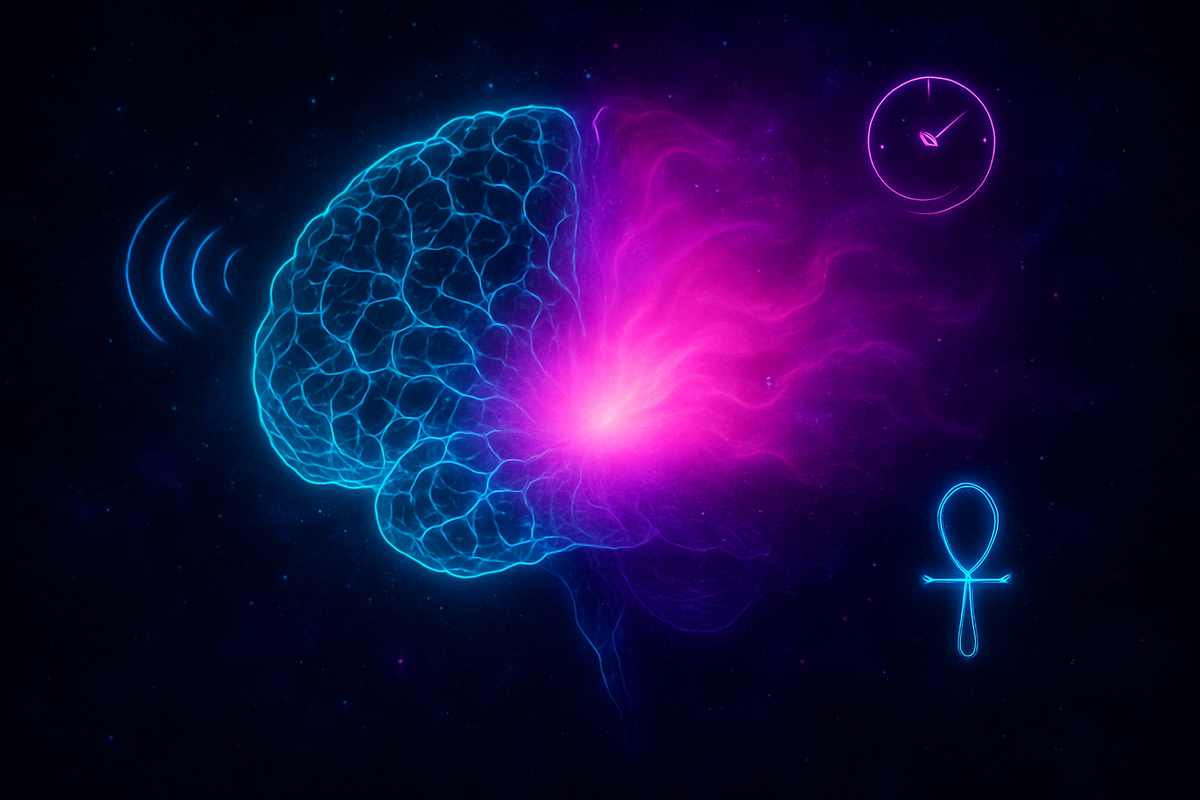
Consciousness and the Paranormal: The Hard Problem Connection
Series: Anomalous Cognition | Part: 8 of 9 Primary Tag: FRONTIER SCIENCE Keywords: consciousness, hard problem, paranormal, materialism, dualism, philosophy of mind
Here's something strange about the anomalous cognition debates: they keep pointing to consciousness.
Telepathy implies mind-to-mind connection. Precognition implies consciousness relating to time in unexpected ways. Near-death experiences raise questions about consciousness surviving brain death. Mystical experiences suggest consciousness can transcend ordinary boundaries.
Whether or not these phenomena are real, they all hinge on the same question: what is consciousness, and what is its relationship to the physical world?
This is the hard problem of consciousness—the deepest unsolved puzzle in science and philosophy. And it's connected to the paranormal question more than most realize.
The Hard Problem
The hard problem of consciousness (named by philosopher David Chalmers) asks: why is there subjective experience at all?
We can explain how the brain processes information, generates behavior, and controls the body. That's the "easy problems"—not actually easy, but in principle tractable through neuroscience.
The hard problem is different: why does information processing feel like something? Why isn't the brain a philosophical zombie—doing all the same things but with no inner experience?
The redness of red, the painfulness of pain, the something-it's-like-to-be-you—this subjective quality is consciousness. And we have no scientific explanation for why it exists or how it arises from physical processes.
Why This Matters for the Paranormal
The hard problem creates conceptual space for the paranormal.
If consciousness is fully physical (just what brains do), then anomalous cognition seems impossible. Telepathy would require information transfer without physical mechanism. Precognition would require backwards causation. Survival of death would require consciousness without a brain.
If consciousness is not fully physical—if it has aspects that aren't captured by brain states—then maybe it can do things brains can't. Maybe mind-to-mind connection doesn't require physical signals. Maybe consciousness relates to time differently than matter does.
This doesn't prove the paranormal is real. But it shows why the paranormal question is entangled with the consciousness question. Resolving one might require resolving the other.
Materialism and Its Challenges
Materialism (or physicalism) holds that consciousness is entirely physical—a product of brain activity, nothing more.
Strong arguments support materialism: - Brain damage alters consciousness - Drugs alter consciousness - Brain states correlate with conscious states - There's no evidence for consciousness without a brain
But materialism faces the hard problem. If consciousness is just brain activity, why does brain activity feel like anything? The correlation between brain and mind is undeniable. The explanation for why there's "something it's like" to be a brain is missing.
Materialists respond in various ways: - Eliminativism: Consciousness doesn't exist the way we think it does. The hard problem is confused. - Illusionism: Subjective experience is an illusion—there's nothing there to explain. - Emergentism: Consciousness emerges from physical processes in ways we don't yet understand but will. - Identity theory: Consciousness just IS brain activity. The "why" question is misguided.
None of these fully satisfies. Eliminativism and illusionism seem to deny the obvious. Emergentism promises future explanation without providing one. Identity theory answers "what" but not "why."
Dualism and Its Challenges
Dualism holds that mind and matter are fundamentally different kinds of things.
This makes room for the paranormal: if mind isn't reducible to brain, maybe it can connect to other minds directly, perceive future events, or survive death.
But dualism faces severe challenges: - Interaction problem: If mind and brain are different substances, how do they interact? When you decide to raise your arm, how does non-physical mind cause physical movement? - Violation of physics: The brain operates by physical laws. If non-physical mind influences neurons, it violates energy conservation and causal closure. - Evolution: How did non-physical minds evolve through physical processes? Why would natural selection produce something non-physical?
Dualism's answers (the pineal gland, quantum effects, fundamental laws connecting mind and matter) are unsatisfying or scientifically dubious.
Panpsychism and Neutral Monism
Some philosophers try to split the difference:
Panpsychism: Consciousness is fundamental and ubiquitous. All matter has some experiential quality. Human consciousness is complex because our brains are complex, but even electrons have micro-experience.
This solves emergence (consciousness doesn't emerge—it's already there) but faces the combination problem: how do micro-experiences combine into unified human consciousness?
Neutral monism: Neither mind nor matter is fundamental. Both emerge from something more basic—a neutral "stuff" that has both mental and physical aspects.
This is elegant but vague. What is the neutral stuff? How does it give rise to both physics and experience?
Integrated Information Theory (IIT): Consciousness is identical to integrated information (phi). Anything that integrates information is conscious to that degree. This makes consciousness measurable in principle.
IIT is scientifically specific but makes strange predictions (thermostats might be slightly conscious) and doesn't fully explain why integrated information feels like something.
The Paranormal Connection Revisited
Here's the honest situation:
1. We don't understand consciousness. 2. Our best materialist theories can't explain the hard problem. 3. Our best non-materialist theories face their own problems. 4. Anomalous cognition claims depend on consciousness having properties beyond what materialism allows. 5. We can't rule out those properties because we don't understand consciousness.
This creates irreducible uncertainty:
Maybe materialism is true, consciousness is just brain activity, and all paranormal claims are false or mistaken. The hard problem will eventually dissolve or be solved.
Maybe consciousness has non-physical aspects, and some anomalous cognition is real. The hard problem is hard because consciousness genuinely transcends physical description.
Maybe our entire framework (physical vs. non-physical, mind vs. matter) is confused, and we need a revolution in understanding to address both consciousness and the paranormal.
We don't know which. The mystery of consciousness is genuine, and it leaves the paranormal question more open than committed skeptics usually acknowledge.
What Would Settle It?
What would resolve the consciousness-paranormal connection?
A complete theory of consciousness: If we truly understood how and why brains generate experience, we could assess whether anomalous cognition is possible within that framework.
Definitive paranormal evidence: Replicated, large-effect evidence for telepathy or precognition would force rethinking of consciousness models. This hasn't happened despite decades of research.
Physical detection of consciousness: If we could directly measure consciousness (not just its neural correlates), we might understand its nature better.
Integration with physics: A theory that unifies consciousness with fundamental physics might clarify what's possible.
None of these exists. The questions remain entangled.
The Humble Position
I'm a provisional materialist. I think consciousness probably emerges from brain activity through processes we don't yet understand. I don't think the paranormal is real in the strong sense—no telepathy, no precognition, no survival of death.
But I hold this provisionally because: - The hard problem is real and unsolved - Materialism is a bet, not a proven conclusion - Consciousness is the one thing I know exists with certainty, and I don't understand it - Intellectual humility requires acknowledging what I don't know
The paranormal claims examined in this series are probably false. The small statistical effects in psi research are probably artifacts. The subjective experiences (NDEs, synchronicities, insights) are probably brain phenomena with naturalistic explanations.
Probably. Not certainly.
The connection to the hard problem keeps a door open—not to credulity, but to honest uncertainty.
Further Reading
- Chalmers, D. (1996). The Conscious Mind. Oxford University Press. - Koch, C. (2019). The Feeling of Life Itself. MIT Press. - Nagel, T. (1974). "What Is It Like to Be a Bat?" Philosophical Review. - Tononi, G. (2012). Phi: A Voyage from the Brain to the Soul. Pantheon.
This is Part 8 of the Anomalous Cognition series. Next: "What Anomalies Teach Us: A Synthesis."
Comments ()