The CRISPR Babies: When He Jiankui Edited the Human Germline
In 2018, He Jiankui announced the world's first gene-edited babies. The scientific community was horrified—not because it was impossible, but because he did it anyway, before the ethics had been worked out.
The CRISPR Babies: When He Jiankui Edited the Human Germline
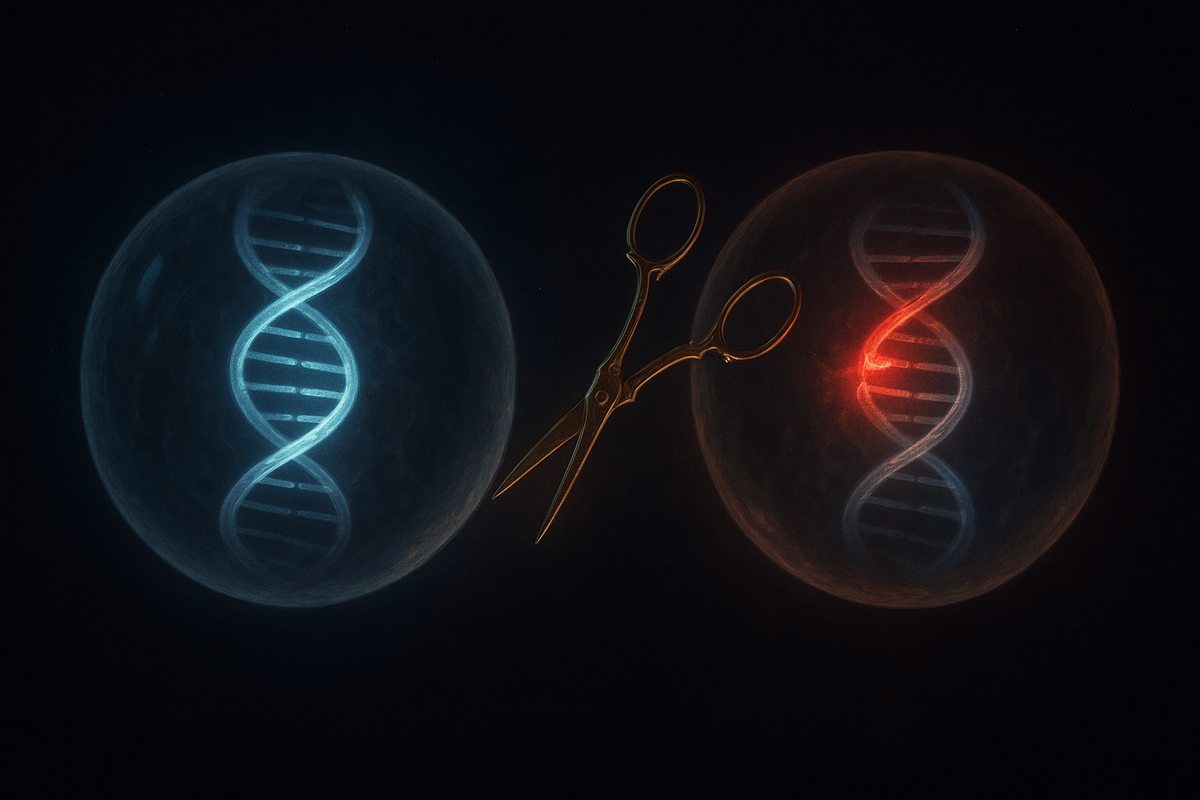
On November 25, 2018, a scientist named He Jiankui uploaded a series of videos to YouTube. He stood in what looked like a hotel conference room, speaking to the camera in careful English. He wore a blue button-down shirt. He smiled a lot. He seemed to expect that the world would thank him. The announcement: he had created the first gene-edited human babies. Twin girls, born from embryos he had modified with CRISPR. Their names, he said, were Lulu and Nana. He had altered their CCR5 gene—the doorway HIV uses to enter cells—hoping to make them immune to AIDS. "I feel a strong responsibility that it's not just to make a first," he said, "but also make it an example." Within hours, the scientific community was in meltdown. Not because germline editing is inherently monstrous. Many researchers believe it will eventually be appropriate for preventing devastating genetic diseases. The horror was how he had done it—secretly, recklessly, for a goal that didn't remotely justify the risks, on healthy embryos that didn't need intervention. He Jiankui had crossed the brightest line in bioethics. And he'd done it on YouTube, grinning like he'd won a Nobel Prize. He got three years in a Chinese prison instead.
Why CCR5 Was the Wrong Target (And He Knew It)
Let's talk about the science, because it matters. CCR5 is a protein on the surface of certain immune cells. It's one of the doorways HIV uses to enter and infect those cells. There's a natural mutation called CCR5-delta32 that disables the protein—and people who carry two copies of this mutation are essentially immune to the most common strain of HIV. This sounds like a perfect target for gene editing, right? Just give everyone the delta32 mutation and eliminate AIDS! Here's the problem: the babies weren't at meaningful risk of HIV in the first place. The fathers were HIV-positive, but the mothers were not. With modern medicine, there are simple, reliable ways to prevent HIV transmission during conception—sperm washing, antiretroviral therapy, careful IVF protocols. The risk of infection was already near zero. He wasn't solving a problem. He was creating a demonstration. And there are serious reasons not to knock out CCR5 even if you could do it safely. That protein exists for a reason. People with natural CCR5 deletions have higher mortality from influenza. They may be more susceptible to West Nile virus and certain other infections. Evolution kept CCR5 around because it does useful things. Deleting it isn't a free upgrade. He Jiankui knew all of this. He had access to the same literature everyone else did. He made a calculated decision that the risk was worth the glory. The most charitable interpretation is that he was naive. The least charitable is that he used vulnerable families as guinea pigs for his ambition.
The Hong Kong Summit (Where It All Fell Apart)
By wild coincidence—or maybe not coincidence at all—He's announcement landed the day before he was scheduled to speak at the Second International Summit on Human Genome Editing in Hong Kong. The summit was supposed to be a sober discussion of where germline editing might be headed, what safeguards were needed, how the international community should proceed. Instead, it became a tribunal. He showed up anyway. He walked onto the stage in front of hundreds of researchers, ethicists, and journalists. The room was electric with disbelief and anger. For over an hour, he answered questions. Or tried to. "Where is the independent ethical review?" someone asked. He couldn't clearly identify one. "Was there informed consent?" Murky. The consent forms were later found to emphasize the free IVF treatment, not the experimental gene editing. "Did you get regulatory approval?" He claimed he had, but the timeline didn't add up, and Chinese officials would later deny any authorization. "Why did you do this in secret?" He had no good answer. David Baltimore, the Nobel laureate chairing the session, delivered the verdict that would become the official consensus: "I think there has been a failure of self-regulation by the scientific community because of a lack of transparency." He Jiankui had broken the social contract. Science operates on trust—trust that results are reported honestly, that experiments are conducted ethically, that the community reviews dangerous work before it proceeds. He had bypassed all of it. He had treated human children as test subjects and presented the world with a fait accompli. The question was no longer whether to do germline editing. He had already done it.
What We Know About Lulu and Nana
Here's the terrifying part: we don't actually know if the edit worked. He claimed he had successfully introduced the CCR5-delta32 mutation in both embryos. But the data he presented—and later published in a manuscript that no journal would touch—told a different story. One twin appears to be mosaic—meaning some of her cells carry the edit and some don't. This happens when CRISPR acts after the first cell division, so only some lineages of cells get modified. Mosaicism makes the supposed protection incomplete at best. The other twin appears to have a novel mutation that doesn't match the natural delta32 variant. Nobody knows what this mutation does. It might confer some HIV protection. It might do nothing. It might cause problems nobody has anticipated. And that's assuming the sequencing data He presented is accurate. Given how thoroughly he deceived everyone else, who knows? What we know for certain:
- Two girls exist with edited genomes
- The edits may or may not confer HIV resistance
- The edits may or may not have other effects
- Both girls carry alterations that will pass to their children
- Nobody outside He's team has been able to verify anything
Lulu and Nana are now about seven years old. Their identities are protected. Their location is unknown to the public. By all reports, they're healthy—so far. But germline effects can take decades to manifest. Cancer susceptibility. Immune dysfunction. Neurological effects. Nobody knows what to look for because nobody has ever done this before. They're not just gene-edited children. They're an uncontrolled experiment walking around in the world.
The Aftermath: Prison, Condemnation, and Unanswered Questions
In December 2019, a Chinese court convicted He Jiankui of "illegal medical practice" and sentenced him to three years in prison, plus a fine of three million yuan. Two collaborators received shorter sentences. He served his time. He was released in April 2022. According to reports, he's trying to return to science—setting up a new lab, pursuing gene therapies for Duchenne muscular dystrophy. The scientific establishment remains divided on whether he should be allowed back. Some argue that his punishment was sufficient and his skills shouldn't be wasted. Others argue that someone who violated research ethics so fundamentally should never be trusted with human subjects again. The International Commission on the Clinical Use of Human Germline Genome Editing, convened after the scandal, concluded that the technology isn't ready for clinical use and may not be for years—but didn't call for an outright ban. The deeper questions remain unanswered: Could this happen again? Absolutely. CRISPR is cheap and available. IVF clinics exist worldwide with varying levels of oversight. A competent molecular biologist with access to embryos could attempt germline editing tomorrow. The barriers are ethical and legal, not technical—and ethics and laws vary by jurisdiction. Are there circumstances where germline editing would be justified? This is harder. Huntington's disease is caused by a single dominant mutation. If you inherit it, you will develop a devastating neurodegenerative condition. There is no cure, no treatment, no hope. If germline editing could eliminate Huntington's from a family line forever, isn't that worth considering? What about Tay-Sachs? Sickle cell? Cystic fibrosis? The scientific consensus is "not yet"—the technology is too imprecise, the risks too uncertain, the alternatives too available (genetic screening, IVF with preimplantation diagnosis). But "not yet" isn't "never." Where's the line between therapy and enhancement? If we can edit out disease genes, can we edit in advantageous ones? Height? Intelligence? Athletic ability? Most ethicists draw a hard line here, but lines are famously easy to move once you've crossed them.
What He Jiankui Actually Proved
Strip away the ethical horror and the sloppy science, and He's experiment demonstrated something important: germline editing in humans is possible. Not advisable. Not safe. Not ethical. But possible. The genie isn't going back in the bottle. Somewhere in the world, someone is probably already planning the next attempt—maybe with better science, maybe with worse ethics, maybe in a jurisdiction that doesn't care what the international community thinks. The He Jiankui scandal forced a conversation that was coming anyway, just faster and uglier than anyone wanted. How do we govern a technology that can alter human heredity? Who decides which edits are acceptable? How do we balance the potential to eliminate genetic disease against the risk of mistakes that propagate forever? Jennifer Doudna, the CRISPR co-inventor, said the announcement made her feel "physically sick." But she also acknowledged that germline editing might eventually have a place in medicine—once the science is mature, the safety is established, and the ethical frameworks are in place. That's the optimistic version: He Jiankui was a cautionary tale, not a template. The responsible researchers will proceed carefully. International consensus will emerge. Germline editing will eventually be done right. The pessimistic version: He was just first. Others will follow. The technology is too powerful, too accessible, too tempting. National competition will trump international caution. The edited future is coming whether we're ready or not. Lulu and Nana are living proof that we're not ready. But they're also living proof that we're past the point of choosing.
Further Reading
- Regalado, A. (2018). "Exclusive: Chinese scientists are creating CRISPR babies." MIT Technology Review.
- Cohen, J. (2019). "The untold story of the 'circle of trust' behind the world's first gene-edited babies." Science.
- Davies, K. (2020). Editing Humanity: The CRISPR Revolution and the New Era of Genome Editing. Pegasus Books.
- National Academies of Sciences, Engineering, and Medicine (2020). Heritable Human Genome Editing. The National Academies Press.
This is Part 3 of the CRISPR Revolution series. Previous: "Base Editing and Prime Editing." Next: "Gene Drives"—technology that can edit entire wild populations. We could eliminate malaria. We could also cause ecological collapse.


Comments ()